• This forum is the machine-generated translation of www.cad3d.it/forum1 - the Italian design community. Several terms are not translated correctly.

project lifter

  • Thread starter Thread starter Raind
  • Start date Start date

Raind

Guest
Good morning, guys, we're three students planning a warehouse lifter.
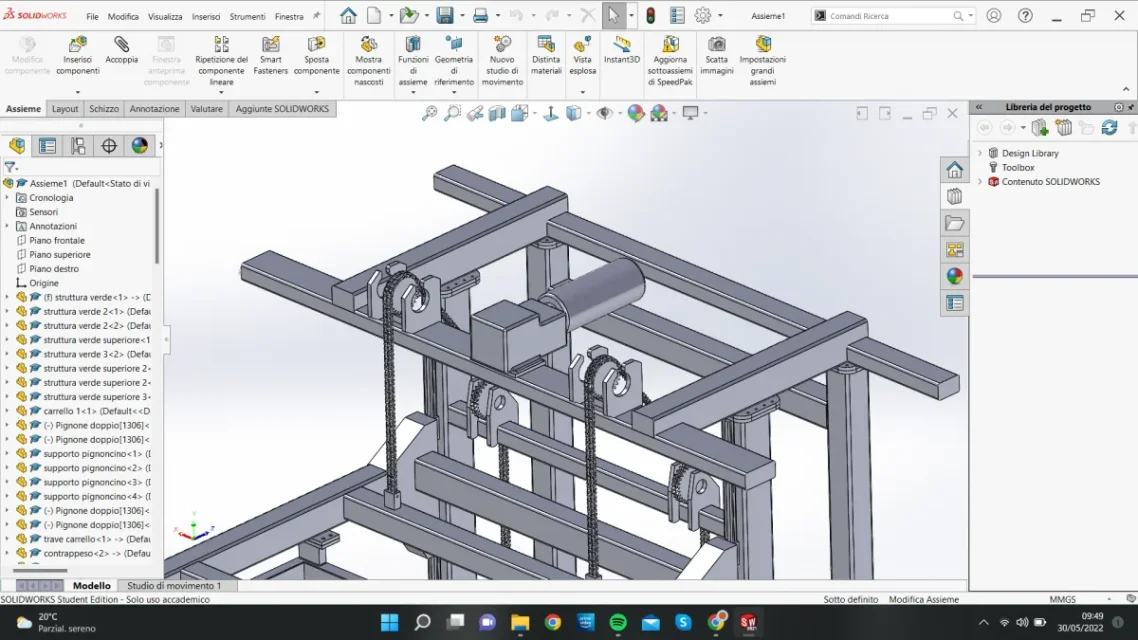
we chose chain and began to consider the forces on the cart (as you can see from technical relationships). the cart is lifted by an electric motor, which is connected to the two motor semi-axis by means of a motor.
we stuck on the sizing of the 2 trees, because, being a static analysis, we did not consider the torque of the engine. someone could give us a tip on how to proceed to the sizing of the tree and how to proceed in the work. Thank you very much to all.
 

Attachments

Why not make a unique tree that crosses the reducer?
on that tree there will be a torque moment, cutting stresses, a stinging moment. . .
In the calculation there will also be to take into account the different factors of carving due to the possible tabs. . change of sez etc. etc.
you will be considered the service factor and fatigue verification.
 
you should calculate it well because if I have to change it I send on you to do it , maybe and better place it in an easily accessible area , I am also curious to know what end the chain does since it does not close the ring on the lifter (if I have seen well). other argument could be the choice of chains and not of ropes, the position of the reference pinnacle, the guide system, the hanging plate of the load frame that I would avoid very gladly, to you already asked the calculation of the engine shaft...
 
Good morning, guys, we're three students planning a warehouse lifter.
we chose chain and began to consider the forces on the cart (as you can see from technical relationships). the cart is lifted by an electric motor, which is connected to the two motor semi-axis by means of a motor.
we stuck on the sizing of the 2 trees, because, being a static analysis, we did not consider the torque of the engine. someone could give us a tip on how to proceed to the sizing of the tree and how to proceed in the work. Thank you very much to all.
to consider also the forces of inertia due to the acceleration / deceleration of the load according to the time used to reach the maximum velocity.
 
you should calculate it well because if I have to change it I send on you to do it , maybe and better place it in an easily accessible area , I am also curious to know what end the chain does since it does not close the ring on the lifter (if I have seen well). Another argument could be the choice of chains and not of ropes, the position of the reference pin, the system of guides, the weight plate of the load frame that I would avoid very gladly, to you already asked the calculation of the motor shaft fails a higher size of the output of the gearbox you go well.
I think the chains behind go to connect to counterweights! Right?
 
you should calculate it well because if I have to change it I send on you to do it , maybe and better place it in an easily accessible area , I am also curious to know what end the chain does since it does not close the ring on the lifter (if I have seen well). other argument could be the choice of chains and not of ropes, the position of the reference pinnacle, the guide system, the hanging plate of the load frame that I would avoid very gladly, to you already asked the calculation of the engine shaft...
I like it, maybe if you put a possible solution, you can discuss it better.
 
first of all thanks to all for the prompt answers !!!
First we had hypothesized a unique tree, but the professor advised us to use one for the reducer and 2 pinion trees because in the case of a single tree there would be alignment problems.
Second, we used a double chain with counterweights.
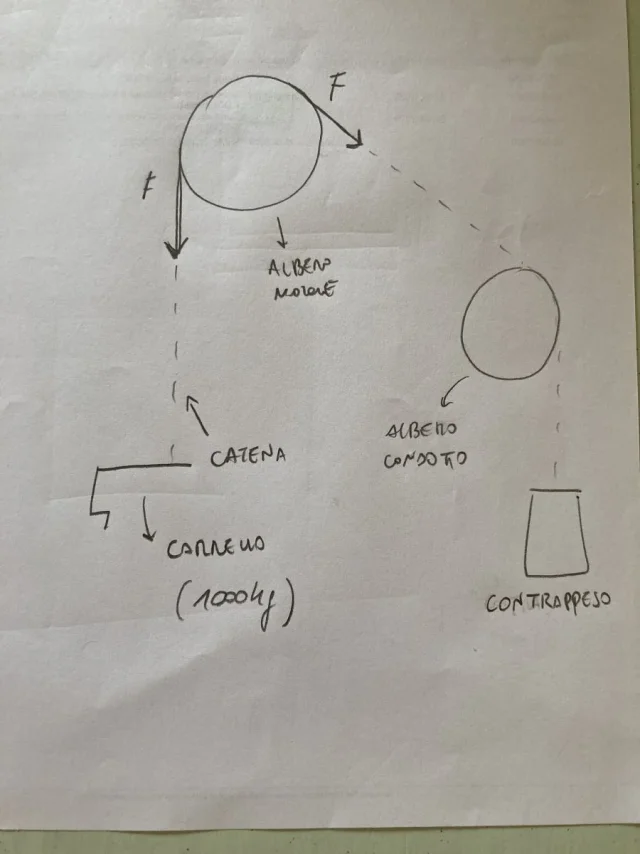
third thing, we are doing a static study and so is it right to consider the couple of the tree? (see photo)
fourth and last thing, what considerations should we do for inertia forces due to the acceleration/deceleration of the load according to the time used to reach the maximum speed (holding that we hypothesized an uphill time of the 7,5 s trolley with 900 mm driving race and with max speed of the cart of 0.12 m/s)?

thank you very much to all, any intervention/ council is well received...
 

Attachments

  • C95B87C9-995A-4839-9421-8772650F6D18.webp
    C95B87C9-995A-4839-9421-8772650F6D18.webp
    31.6 KB · Views: 73
for the problem of setting up the two pinions you can use two jackers!

for inertia you have to impose as long as you want to achieve maximum speed, if this time is short the acceleration will be higher and consequently the force of inertia.

for the control of the motor you can use an inverter and set the acceleration / deceleration ramps.
 
first of all thanks to all for the prompt answers !!!
First we had hypothesized a unique tree, but the professor advised us to use one for the reducer and 2 pinion trees because in the case of a single tree there would be alignment problems.
Second, we used a double chain with counterweights.
third thing, we are doing a static study and so is it right to consider the couple of the tree? (see photo)
fourth and last thing, what considerations should we do for inertia forces due to the acceleration/deceleration of the load according to the time used to reach the maximum speed (holding that we hypothesized an uphill time of the 7,5 s trolley with 900 mm driving race and with max speed of the cart of 0.12 m/s)?

thank you very much to all, any intervention/ council is well received...
There are no alignment problems as long as machine tools work the part where the gear motor and the seats of the two engine pins will be affixed.
If this is not possible, it will have to be done as the prof says, two trees for the two pinions connected through the appropriate shaft that crosses the gearbox.
 
Why not make a unique tree that crosses the reducer?
on that tree there will be a torque moment, cutting stresses, a stinging moment. . .
In the calculation there will also be to take into account the different factors of carving due to the possible tabs. . change of sez etc. etc.
you will be considered the service factor and fatigue verification.
see example attached.
Another alternative can be that of the unique tree with the two pinions connected to the gear shaft through sprocket transmission and chain; In this case it is easier to maintain and providing a reduction (pignone/corona) output to the reducer can be mounted a lower reducer.
to limit the footprint, in this case you could use a coaxial reducer parallel to the axis to be commanded.
fourth and last thing, what considerations should we do for inertia forces due to the acceleration/deceleration of the load according to the time used to reach the maximum speed (holding that we hypothesized an uphill time of the 7,5 s trolley with 900 mm driving race and with max speed of the cart of 0.12 m/s)?
can be taken from this thesis.
as regards the chosen motor, the fs service factor of 0.9 is low; once the exact absorbed power is established during loading lifting, for that type of application it is preferable to adopt a service factor greater than 1.5.

a question: what braking system did you expect? I ask why the engine you have chosen is not autofrenating (motor normally used in these applications).
 

Attachments

  • Scelta di una motorizzazione.webp
    Scelta di una motorizzazione.webp
    75.7 KB · Views: 78
Last edited:
for the sizing of the trees must be added the stress due at the torque moment to the components already considered. attention to fatigue testing, as the shaft is subject to an alternating bending effort due to the lifting load and to correctly consider the various carving coefficients, concentration of efforts, dimensional, etc.
the torque due to acceleration should be considered only in the transient, also as verification for the torque of point required to the motor. with speed 0.12 m/sec calculated, the lifting distance is covered in 7.5 sec, i.e. the required travel time. if the entire route must be done in the indicated time, the acceleration and decelation time must be assumed, during which the speed is averagely lower, starting and reaching 0, then the maximum speed reached increases: little bad because the ac engine can turn to rotations greater than the nominal one, although, over certain speeds, you lose something in terms of couple delivered.
returning to the application itself, you could opt for a unique tree, as said by others: the misalignment of the chain between the two pinions would be resolved by using a caller or a log link between chain and trolley.
the advantage of the central motor is that the torque deformation in the two semiaxis is theoretically the same, so the two pinions would move in perfect phase.
 
for the sizing of the trees must be added the stress due at the torque moment to the components already considered. attention to fatigue testing, as the shaft is subject to an alternating bending effort due to the lifting load and to correctly consider the various carving coefficients, concentration of efforts, dimensional, etc.
the torque due to acceleration should be considered only in the transient, also as verification for the torque of point required to the motor. with speed 0.12 m/sec calculated, the lifting distance is covered in 7.5 sec, i.e. the required travel time. if the entire route must be done in the indicated time, the acceleration and decelation time must be assumed, during which the speed is averagely lower, starting and reaching 0, then the maximum speed reached increases: little bad because the ac engine can turn to rotations greater than the nominal one, although, over certain speeds, you lose something in terms of couple delivered.
returning to the application itself, you could opt for a unique tree, as said by others: the misalignment of the chain between the two pinions would be resolved by using a caller or a log link between chain and trolley.
the advantage of the central motor is that the torque deformation in the two semiaxis is theoretically the same, so the two pinions would move in perfect phase
thanks to all for the interventions... the doubt that we had in the sizing of the tree is that, having to do a static study, there was nothing that we had to astonish the section subject to a twisting moment due to the torque of the engine; we had schematized the tree section in this way:
 

Attachments

  • image0 (1).webp
    image0 (1).webp
    86.4 KB · Views: 53
another question... to block the pinion on the tree you recommend a tab or a stick? Is it necessary to block even the pinion axially?
 
for the locking I would use a jacker, so you can put the two pinions in an easy way.
If you don't want to use the calettators, you use the tabs (which work on the hips), the stickers work tangentially, if you go to see a drawing book or an internet search you realize the difference.
Either way, it's better to block the pinion axially.
 
Keys practically never use because working conicals move the hub into the radial direction.
a calettatore will surely allow for friction to block axially and radially everything, with the braggy of the bundle. clearly that the hub must offer enough meat not to explode.
 
Good morning to all,
we didn't use the forum because we put on standby the project... We got him back in hand now and we have to deliver him in January.
we have assumed that the cart should accelerate in 2s until it reaches a speed of 0.14 m/s consequently the acceleration will be 0.07 m/s^2.
therefore the force of inertia will be 70 n, because to us from specific we have load max of 10000 n.
can be plausible to neglect the forces of inertia.
 
Good morning to all,
we didn't use the forum because we put on standby the project... We got him back in hand now and we have to deliver him in January.
we have assumed that the cart should accelerate in 2s until it reaches a speed of 0.14 m/s consequently the acceleration will be 0.07 m/s^2.
therefore the force of inertia will be 70 n, because to us from specific we have load max of 10000 n.
can be plausible to neglect the forces of inertia.
say that are negligible forces of inertia force results excessive, surely regarding the cart (mass 1000kg, weight about 10kn, inertia force 70n@0.07m/s^2), however, we can definitely say it since we talk about at least 3 different orders of magnitude.

for the other details in movement you must assess of case in case.
 

Forum statistics

Threads
44,997
Messages
339,767
Members
4
Latest member
ibt

Members online

No members online now.
Back
Top