• This forum is the machine-generated translation of www.cad3d.it/forum1 - the Italian design community. Several terms are not translated correctly.

project lightning

  • Thread starter Thread starter TechnoStudio
  • Start date Start date
only for precision: the st of siemens is parametric, in the sense that I can impose mathematical relationships between the variables of the model. It is not "feature based" as we are used to think of the parametric cads, the parameterization is obtained by other routes (the pmi quotas and the "live rules", that is the geometric bonds between edges and shapes of the model). (I hope I didn't say a solemn stupid thing, right now I can't verify. . . )

We will see in the future what approach will have been better.
only a note, nx st and also feature based.
 
only for precision: the st of siemens is parametric, in the sense that I can impose mathematical relationships between the variables of the model. It is not "feature based" as we are used to think of the parametric cads, the parameterization is obtained by other routes (the pmi quotas and the "live rules", that is the geometric bonds between edges and shapes of the model). (I hope I didn't say a solemn stupid thing, right now I can't verify. . . )

We will see in the future what approach will have been better.
it is right that you say, it makes confusion between feature based and parametric better to be precise, so cmq that once you go from a mode to the atra there is no way to go back, with project lighting no, I want to emphasize it.
 
it is right that you say, it makes confusion between feature based and parametric better to be precise, so cmq that once you go from a mode to the atra there is no way to go back, with project lighting no, I want to emphasize it.
You're right about that. Among other things, it is not possible to have "hybrid" models, while in nx si, it will be a marketing differentiation between high-end and medium-end products. in this sense better pro/e than with its modular license takes both sectors of market... .
 
As already said, the "parameter" is safe.
changes only the way to handle it.

as I have written somewhere the "contextualization" is becoming a "must" not for pure commercial exoteria but for real market needs.

the problems you want to solve are:
- to be able to work on third-party models with alien cads, so no history and no "features" to be dismantled.
- to be able to work with unaligned releases of the same sw, see above.
- exit the mobile sands anyway when the tree of history becomes a nightmare. when you have a med of a few thousand features (invited by a client) that you have worked from a "contractor" and to which you have to make a change in seconds and with all the firm nose waiting for you to give birth to the change, I want to see who does not come a panic crisis.

All this is not the result of sick business minds.
The problem is how to implement the new conceptual philosophy in the system.

There are those who simply thought:
- if you import a steppon from 150mb, I don't think you'll put them back on all the missing story and put the features that aren't there, then a separate environment will never integrate with the standard "feaure based". The infamous st is not a philosophic alternative to that standard of if, it's just an alternative in case the "contingent" suggests you use "the other way" from which you don't go back.

the ptc, as always, took the bull for horns and decided to make the two worlds compatible, if it succeeds (and from some footage of iutub I think they are on the good road) they will have put their cad a step forward.

p.s.: checche surrentiziamente is suggested by some "friend", in cocreate it does not "stira" to the eyemeter and nosemeter (who does it is a jerk) but simply imposes itself to a face of "move" relative to its starting position according to a series of "contextual" commands type: tot wheel, radiant tot wheel, aligned to that face, combine with other.
all in a very precise way (at least six).
:smile:
 
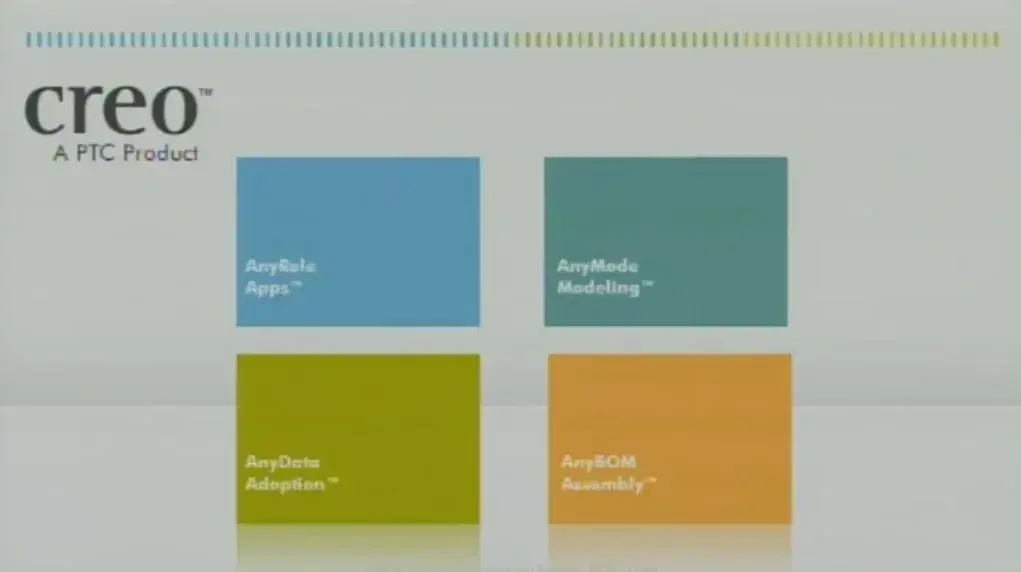
ptc has unveiled the name of the new product, it will be called
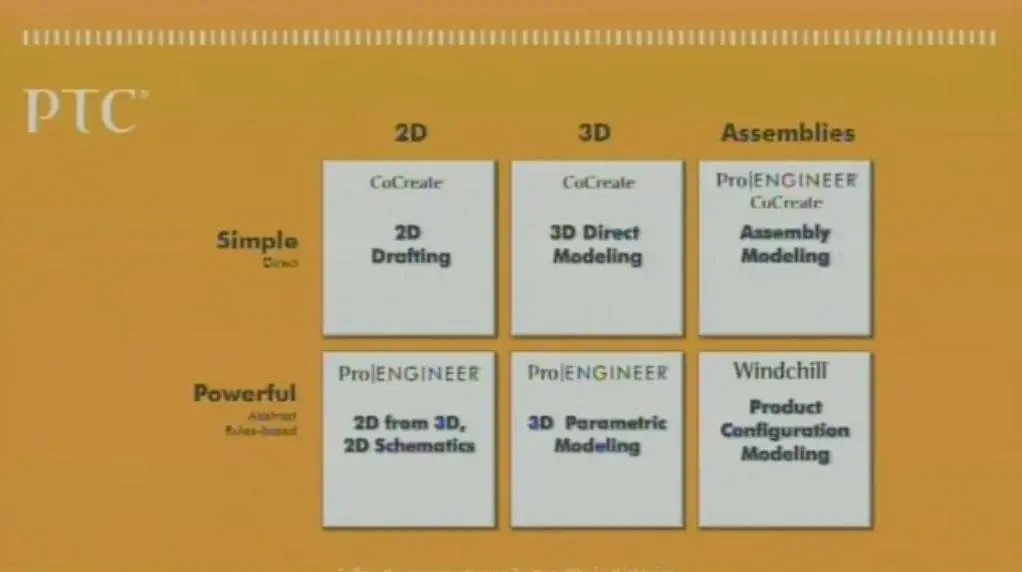
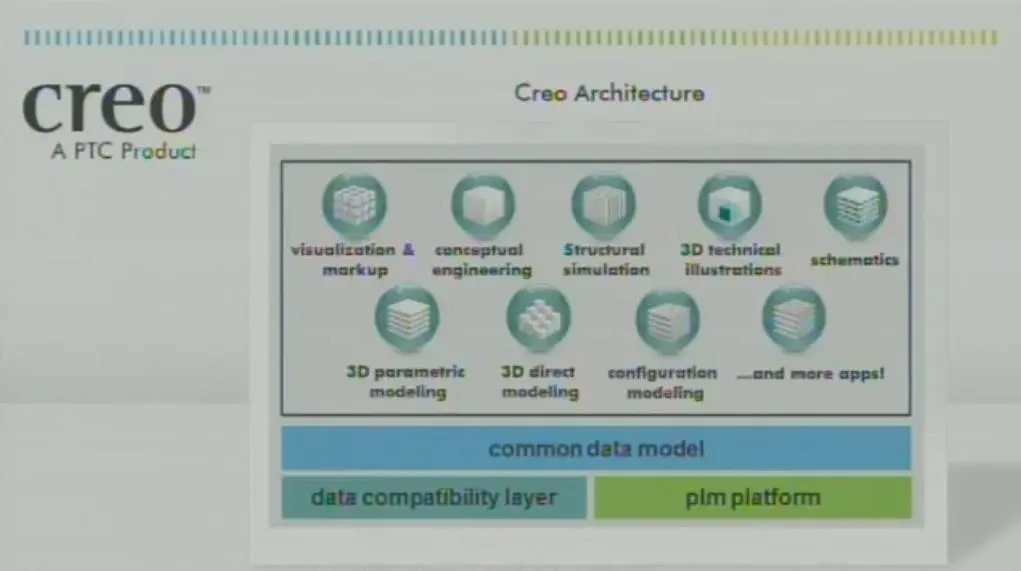
I thinkI attach some webcast screens (which is still in progress).
creo1.webp
creo2.webp
creo3.webp
 
I don't think there'll ever be a wildfire6. .

I think ptc will produce something like siemens if(or No.
 
the ptc, as always, took the bull for horns and decided to make the two worlds compatible, if it succeeds (and from some footage of iutub I think they are on the good road) they will have put their cad a step forward.
Sorry if I cut the odds (the post was all interesting, but I focus on one thing).

The two "direct" and "feature based" worlds are in my opinion unconcilable (I'm drawing up a mathematical-philosophical demonstration on this:smile: )... unless you parameterize geometric entities instead of "transformation functions"/"features" (somewhat spaceclaims). but also in this case it is not always feasible.

:)
 
in practice, and in poor words, what changes? What are the benefits of creo?
It seems to me that the most obvious novelty is the integration of explicit modeling (the approach to cocreate, so much to understand) in the environment pro/e.
I think it's not just this, but the thing that jumps more to the eye is this.

something I like little for so many reasons.

the great advantage of this approach is the great power in modifying imported pieces (step and iges), as you are able to select geometric entities and change them with great speed.
for modeling and tableing in native native continue to prefer the parametric mode.
 
something I like little for so many reasons.
I was of your opinion when the st came out, but then I changed my mind when I realized that it is possible to bind the surfaces even by explicitly shaping.

with the parameter based on the history of operations, the final solid is, as we all know, the result of successive additions or subtracts of volume, which are related to each other by constraints and "parameters" precisely.

in the st of siemens instead, the constraints are between the geometrical entities (faces) of the model (parallelism, concentricity, offset, etc.), and not between the sequences of operations chronolgicamente odinate. precisely because of this absence of the sorting aspect we talk about "sincronous". Surely this new ptc methodology will also allow this possibility, which if you think about it is a much more natural and intuitive way of imposing geometric constraints on the model. I think it'll be hard to get used to, but then they'll appreciate the benefits.
 
I have doubts about the table and the complex assemblies.
to me it is very convenient (in traditional mechanics) to use the modeling quotas for table putting.
in practice if you models well ... the putting into the table becomes very fast.

I don't know if it's just as effective in a synchronous system.

Then I would be very happy to believe if I found a system more effective than the current one.
 
creo elements/pro is the new...
the launch is previewed for summer 2011.. .
already from November, the m65 of the wildfire5 will become creo elements/pro 5.0, but it is only a name change, we will wait for the beta of the new software in spring and the official version in the next summer.
 

Forum statistics

Threads
44,997
Messages
339,767
Members
4
Latest member
ibt

Members online

No members online now.
Back
Top