• This forum is the machine-generated translation of www.cad3d.it/forum1 - the Italian design community. Several terms are not translated correctly.

proof di trazione

  • Thread starter Thread starter Nastran994
  • Start date Start date

Nastran994

Guest
Hello everyone!! I ask for help as I should reproduce a traction test on patran/nastran, to verify that the sigma/epsilon curve I inserted as field is actually the one played by the simulator, I would like to check it through a graph of the final results between stress tensor/deformation. to do this I did:
-realized test in the form of parallelepipedo
-created field
-given the characteristics to the elastic and elastoplastic linear material with the field
-vinculated one side of the parallelepipedo
-applied pressure to the opposite side in such a way as to keep the test in traction
- Mesh.
-results and graphics, but I always get a linear chart, despite having inserted to the full curve until breaking.
I did everything with a non-linear sol400 analysis.
would you have suggestions to get the full curve? ?
 
I do not know the software but the eye that in English deformation is our “cold”, therefore a dimensional size. what you need is the “strain” or adimensional deformation. verify, then it may be that the software you are using has this word.
then, apart from this, the traction test is carried out at increasing load. . if you impose a constant pressure individuals a point in the sigma-epsilon chart. the line you see, will be because the software is programmed to always consider and anyway the case “scaric” (the origin of the axes) and connect the other points you get from the analysis (in your case only one point) with it.
 
good observation that of the deformation, probably so I try to see if I can bring back the adimensional deformation.
I have tried to plot a series of increasing loads with its deformation but it does not give me anything sensible, is it possible that I should graphics only the going of a knot and not of all the solid?
 
what does “the performance of all the solid” mean? the values of effort and deformation are always referred to the single knot. if you do not select one yourself explicitly, software tends to take that with the maximum value of the magnitude you want to display. . apart from that if you draw a solid of homogeneous form, each knot sees the same effort and the same deformation, except for those in proximity to the constraints that will surely present anomalies, due to the difficulty of numerical solutors to converge in proximity to the boundary conditions. this to say that you can view the outputs almost on each node, is not that the problem. but don't tell me that you're graphics about the “solid” efforts because it's conceptually wrong?
 
no software requires me to run something, I selected all the knots of the solid but I realized how I wrote the previous message that could be wrong :roflmao: So trying to plot the results of a single knot, maybe one of the opposite face to the bond should I be able to get the real sigma/epsilon?
 
on patran you can request both deformation, expressed in mm or other unit of measurement used or strain.
then it is true that if you apply a pressure you get a final deformation, but if you use the sol400, you can divide the load into many substeps, and ask for the results for all substeps. then you can go check, for a single node, strain through the various substeps and make a stress/ strain chart
 
I tried to follow your precious tips, but I found problems:
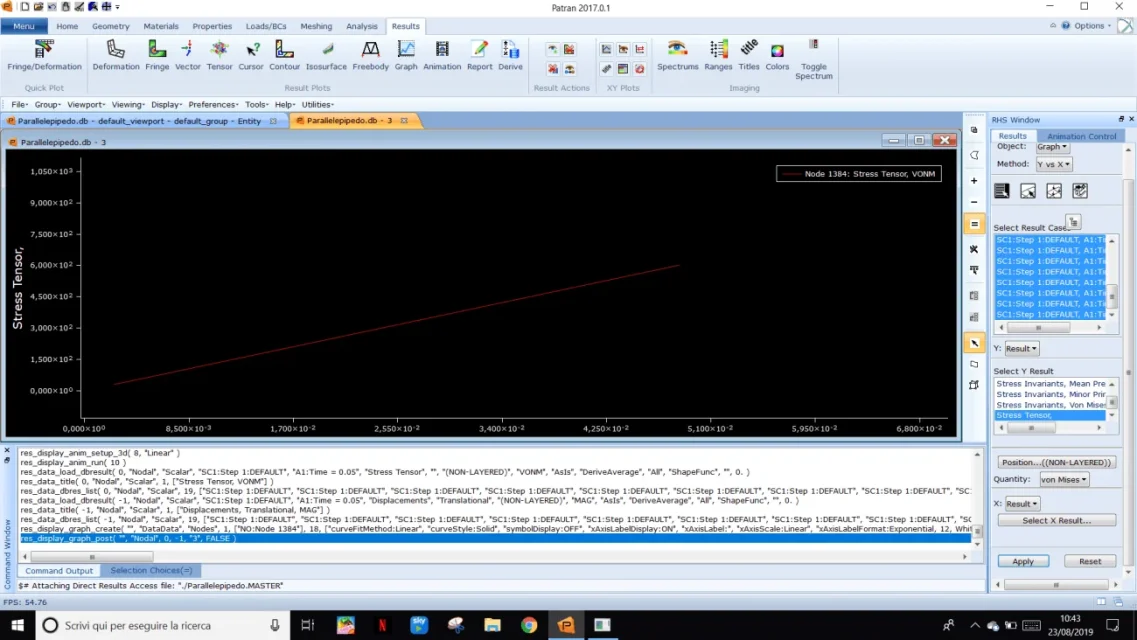
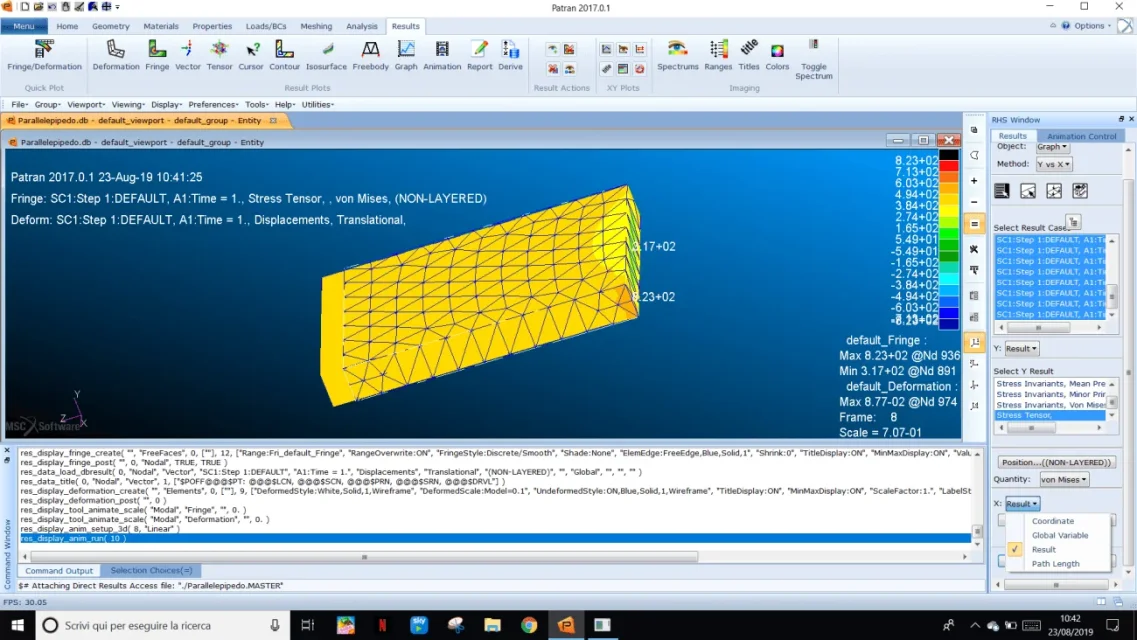
I did 20 load step to get a graph with different load situations, in y want stress but in x select a type of result:Screenshot (94).webpBut when I select the result I find only displacement that is closer to what I want, I have no chance to insert the strainScreenshot (95).webpScreenshot (96).webpand doing so I get the chart for the linear part (I have inserted for now only the elastic part:Screenshot (97).webp
 
in the penultimate photo there are various strains between the selectable outputs or wrong?
 
Good evening to all, I am a new member of the forum. I'm also at first-arms with a simulation of a traction test. my question is how do I divide the load applied in step and substep? Do I need to define a load story using the load case command? if you have any easy example of how to do it? thanks to all
 
Hello everyone!! I ask for help as I should reproduce a traction test on patran/nastran, to verify that the sigma/epsilon curve I inserted as field is actually the one played by the simulator, I would like to check it through a graph of the final results between stress tensor/deformation. to do this I did:
-realized test in the form of parallelepipedo
-created field
-given the characteristics to the elastic and elastoplastic linear material with the field
-vinculated one side of the parallelepipedo
-applied pressure to the opposite side in such a way as to keep the test in traction
- Mesh.
-results and graphics, but I always get a linear chart, despite having inserted to the full curve until breaking.
I did everything with a non-linear sol400 analysis.
would you have suggestions to get the full curve? ?
try searching on the forum because it was talked about in other discussions and the initial problems were like yours.
 
Good evening to all, I am a new member of the forum. I'm also at first-arms with a simulation of a traction test. my question is how do I divide the load applied in step and substep? Do I need to define a load story using the load case command? if you have any easy example of how to do it? thanks to all
you have to try to search for the tutorials.
 

Forum statistics

Threads
44,997
Messages
339,767
Members
4
Latest member
ibt

Members online

No members online now.
Back
Top