
• This forum is the machine-generated translation of www.cad3d.it/forum1 - the Italian design community. Several terms are not translated correctly.

quotation advice

  • Thread starter Thread starter 3DJack
  • Start date Start date
I don't understand how this forum works, since every thread is about anything indifferently, to the face of the oct!!!

However I agree with the reading given by @exxon and indeed, having been myself entrepreneur right in those parts of the pious, and therefore knowing very thoroughly the reality from within.. I would be even more critical and skeptical in judgment. at the bottom remains the result of thirty years of hard work and completely deregulated.. from every point of view, even tax!
the good organization gives fruits and also serves in only two people. regarding the teutonics (which are Austrian, German or, even worse, Swiss) there the speech is different, it concerns their way of thinking.

sent by my nexus 5 using tapatalk
 
Do you have the title of that "old text" you're talking about?
I don't remember:unsure:,but it seems to me that the crack-tessarotto (they used it) or better kept it to take dust in the company where I did the internship at the university)
p.s. I apologize if I went
 
Haha! I got it!

old text purchased at padova in the night of the times (it would have been around 90, '91...). I recognized it from the blue-minio cover. I got a lot of dust from the shelf.
Now I clean it up and then hover for that information. If I find you, I can post an extract.

note: I do not think we are then very ot: we talk about drawing of rules and related procedures. if you then insert some anecdotes it makes it more pleasant also to run.

Thank you. _ .
 
Last edited by a moderator:
He did. in the text "design of machines" of mario speluzzi & mario tessarotto, ed. hoepli 1987, reprint 1992 (I had gone near...), we talk about this:
In general, the quotation rules are to be considered if it is possible to give a single and definitive criterion in order to quote any piece: but it must be said that even if the rules given are observed, a good quotation depends on an acute analysis that is based on the knowledge of the function of the piece, the process used to produce it and the way it will finally be controlled in its actual dimensions. It is therefore possible to define, as we have already mentioned, different categories of quotas: quotas related to assembly, functional, construction and control and cinematic quotas.. It follows that if a given piece can be produced in several ways, each procedure will correspond to a more concurrent type of quotation. . .
In many drawing texts we mention the different quotations for the different types of manufacture, but I do not remember having seen elsewhere the indication of the specific quotations for functionality and control.

Note1: That text is really well done (almost 1000 pages fixed-fixed of useful information), I think you can find it free from copyright on the net, otherwise... Who's got it? :cool:

note2: what to say, good memory _ ...
 
I confess that I have lost sight of the discussion and thought that no one had commented any more, not having received notifications.
I thank you for the valuable advice, I think these discussions are always useful.
 
well, in the light of the new "discoveries" that in more than one user you are reporting, then I can quote myself:

"to quote a design it would be necessary to know the tools and the procedure to realize it or to define it in order to give preponderance to the really useful measures"

that can be equal to say that it is the functional quotation.


sent by my nexus 5 using tapatalk
 
.....when a piece also requires only two placements, I am accustomed to making two designs, or at least a drawing with the two views. on the design I want indicated the zero-piece, the material with our p/n, the table with the critical odds to check with the piece still in the machine, the tool list, the file name nc, our design review number (!!!), etc. etc.

...... .
.... technical office in which the drawings of the clients are together with contracts and offers, while at each piece to produce correspond one or more drawings, all with the same format, with the information tabled in an identical and immediately recognizable way, etc. etc. How long does it save? and above all, how many mistakes do you avoid? all this in a era in which the import of a design is made in electronic format in a few minutes.

By addressing this in these terms, perhaps you can understand why with such an approach it is much more important to have the originals with the quotas aimed at control and not to production.
The organization you have just stated, though, works:
1) in case the customer is one of the many you have, so having multiple orders you should standardize everything within you and if he or another arrives, inside you nothing changes.
Because if you have only one big client, it is for him and for you that your organization is a continuation of his. his design arrives and continues until the production of the piece of production. if you need additions or modifications makes you the customer and everything happens "seamless". otherwise if you have to recode everything at every new update, spend more time recording than working. and the same on the customer side . Think if a company has 10 suppliers of the same type of object and each is equipped with different systems .
2) "force relationships" are "balanced" towards you, perhaps because of the type of product you make or of particular technologies or patents, so you can allow you to impose on the customer the fact that within you the management of "your" piece is made to "your" way. It is probably bosch, brembo, comau or Mr. brugola if they can afford it.
That's the customer coming, he gives you the design and features that should have the piece, pays and leaves with the pieces that you explain to him how they work.
Otherwise, if the customer pays, for example, even the production and testing equipment, it is possible that he asks you to codify and manage everything with his system, since once you pay, he may also decide to keep them or give them to another supplier.
3) the type of contract you have has to be large enough to be able to amortize costs of "duplication" designs for internal management and avoid from continuous updates in progress. Because if you have a €10,000 and €2000 commission, they go to "management" , go ahead a little bit, I think.
 
Last edited:
The organization you just stated, though, works. .
I have the impression that you didn't understand what I wrote.

the procedures I have described serve to improve the relationship with the customer, not to stiffen it, much less from a position of strength. it is on the contrary not to implement them that requires force that become indispensable. with an example, maybe you understand better.

The customer wants a piece of drawing. gives me a 2d design, badly quoted, difficult to achieve. We talk for a few hours, we mess up the design and come to what might be a deal. at this point we ask the customer to review the design with the changes, but he says it doesn't matter, that the annotations are sufficient.

No problem: We exploit the design with the various signatures on the variants and send it to the technical office that draws a design following our standard. production has no problem because it always sees the same procedure and everyone is happy.

when the customer comes to the company for verification of the sample, you take the unused design and discuss it on that. we are happy, the customer is happy.

meanwhile, the y customer who buys from us regularly the product p/n123, sends us a change for the next batch. a hole changes diameter, but the design keeps the same number and date. we do not oblige him to follow our protocol: we assign to the new design received a new number of protocol (other than that assigned at its time to the original design), while internally we change everything, because for us it is a different product. we do not risk making mistakes, while the customer is free to do what he wants.

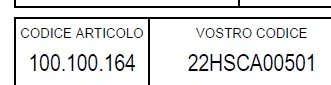
who followed me up here will ask: "and how do you know what to produce when the customer orders you the same code, but now it's a different piece for you"? simple. each part always has two codes: the internal p/n, managed by us and the "customer code", managed by them. if a customer performs a change, when accepted, it will change the association between its code (which could remain unchanged) and the internal code, certainly different.

just to make it clear, I attach the image taken from a transport document where you see the two codes.
F1.webp
 
Your repeated explanations, of which I thank you, continue to have, some basic assumptions that are not said always happen and anyway.


and I'm surprised (in addition to not understanding why you've reactivated a 2008 profile, kept "dormient" until November 2018..... ) that escapes you, in the image of the numbers you posted, a macro obvious.


you have two numbers instead of one,
two ways to proceed instead of one.
and with that you doubled the job.
simple.
and doubling the job, as long as you can afford it (because not all customers are happy to pay your technical office when they already have their own), as you first increased the possibility of errors.
Because it's not just a matter of adding a number, it's a matter of overlapping, at least partly, procedures.


It will also be "not stiff" but you have added, in addition to the tens of "layers" that already exist on a product (check list, files, permissions, testing, etc.) a layer that could be transparent to the customer, as no.
in your customer example x , if your interior design and customer's design have different control odds , when you have to make a dimensional report , what do you send around for the company ? two reports (one for you and one for the customer)? a single one with the two verifications and the two coexisting names and the customer send a unique report with two coexisting names?


and if, instead of "stop at the door", your client involves you in drawing? If the design, instead of being a 2d printed on cheese paper, is a 3d noted made with cad xyz (review 52 ), that the customer does not send you, but simply shares with you on his plm? how you open it if, I imagine, you have your system cad wkh because you decided that for you the optimal restitution is that? if the 3d requires a modification for the production What size?
You understand that the risk that, in each of these further steps, something goes wrong, increases.
you run the risk, for example, that the customer arrives pieces other than those he has deliberated, because a change has been made within you without going through the customer's process.
or, in the best case, the process that facilitates you in managing, for example, your files, becomes a problem for the customer that you have to "smaze" your renamed files to insert them in his plm or in the communications where the customer's emails are "pipe project" instead for you become "pippo -topolino project" and when you write a new communication becomes only more " mouse"
or, even, in the choice of a material.
you have your beautiful plastic suppliers, who work well, with which you make nice dinners (which then, many times, the choices between the many possible systems, pass through this...) .
then comes a customer who, for performance reasons, must use the superplastic "tiziocaio" .
The dealer of the dealer is certified for your client, but not for you.
means that before you produce the pieces for your customer, first you have to go through all the process for "your approval".
at least takes time. Long time.


So, in summary. organized, yes.
especially if you don't have the same on the other side.
But if the client is already well organized, it's better to follow his organization, especially if you're medium-small.


and not "the drawings of the clients are together with contracts and offers" but above all a phrase like "3) the design of the client is a "contract", is not a support to the production....", if taken so, is against every good principle of sound management of the relationship between engineering companies.
 
and I'm surprised (in addition to not understanding why you've reactivated a 2008 profile, kept "dormient" until November 2018..... )
And what does that have to do with the subject?

for the rest, it is obvious you did not understand the procedures I explained, because all the answers to the questions you posted are already there.

I avoid a useless re-explaination, even to avoid controversy.
 
And what does that have to do with the subject?

for the rest, it is obvious you did not understand the procedures I explained, because all the answers to the questions you posted are already there.

I avoid a useless re-explaination, even to avoid controversy.
I don't see any controversy, at least for me. I exposed a fact and I would have liked an answer about it.

Anyway.
those I wrote, adapting them to the examples, are not problems created to four hands on a forum, just to put a message on the homepage or because someone puts a "like" on the bottom of my message.

They are real problems that I have encountered in the relationships between companies and suppliers that use the system we are talking about.
because they took the designs of the clients and put them "with contracts and offers" and , considering them nothing but "contract", not a production support. . "

For example, someone asked what happens if you decide to use:
- its own code and/or
- its own system
- its own system of encoding changes and/or
- its own dimensional reporting system and/or
- its own design standard

If you, European whk company, supplier of the American xyz company, give a subcontracting job to another Chinese qtj company, which in turn gives a sub-sub-supply to the abc company in India?

According to the concept set out before and if each of the companies involved has equal contractual power, that piece should have at least 4 drawing numbers printed above, with relative modification indices .

This limiting us only to a very, very simple example.

It is clear that, as I said, unless you call yourself, for example, a workshop of 100 people, with 10 people as a technical, mono or bi-client office, has little to adopt, for example, your own cad system, if one of the 2 customers imposes your cad service system (version , work release and

the adoption of quality systems also in small and medium-sized enterprises, but we should also know how to distinguish what is "quality system" and what is, instead, useless and dangerous duplication/triplication/quadrupling of documentation and instrumentation .

and therefore, returning to the beginning, why create 2/3/4 different designs (depending on the level of sub-supply) if there is already a "master" design that shows all the indications ? and if it does not report them, why not change that "master" instead of creating 1/2/3 new designs that, besides being source of new costs, are possible new sources of errors ?
 
I ended up in this very interesting discussion and decided to do a little bit of archaeology ...
4) the client's design says what he wants, not how it should be done. Perhaps it already indicates that it is a resumption of machine fusion, but it should not (or should not) indicate how much overmetal to use, as will certainly not indicate shapes and sizes of the slaughterhouses or casting channels.
here exxon I allow myself to disagree.
in the sense that sometimes the design indicates also the method of manufacture.
I know that they are rarely found but the indications of roughness with the indications of the direction of processing, but they inequivocally bind the method of processing.
If a customer asks me a dive-rected piece (without propeller) it is not that I can decide to do differently.
equally if it indicates mj threads, special thermal or superficial treatments, etc...
about the issue of internal encoding of drawings ...
I personally work in a company that only works on behalf of third parties, with less than 100 employees, of which 4 in the technology office.
we codify all customer designs, and we create processing tables for almost all mechanical processing. Sometimes we do not make processing tables for grinding, but this applies only to prototypal products
series products (annual productions from 1'000 to 70'000 parts) have all their phase drawings, one for each internal, external or heat treatment phase. each table is then balled and accompanied by its control plan.
the design of the finished component is used only for final batch validation controls, or for (initial) feedback to validate the processing tables.
to the revision of the customer design, it is evaluated whether it is necessary to change the working boards, or if it is necessary to remake them completely (it has happened to have to overwhelm productive cycles due to changes sensitive to the design of the finished).
the design of the customer is associated with a speaking code that with an incremental exponent binds to the change index of the customer. index that sometimes the customer himself does not indicate in the order ... furiously, deliberately or foully is to you judge it

Is it an expensive job? Yes, I don't deny it, but if rightly maintained, it allows you to have so many things under control and to go back to so many problems that otherwise would end "in the pile".
 

Forum statistics

Threads
44,997
Messages
339,767
Members
4
Latest member
ibt

Members online

No members online now.
ciao
Back
Top