
• This forum is the machine-generated translation of www.cad3d.it/forum1 - the Italian design community. Several terms are not translated correctly.

radial force of the roll wrapped on soul

  • Thread starter Thread starter meccanicamg
  • Start date Start date

meccanicamg

Guest
Here we are with a question to which I have not yet found a mathematical treatment.

I have a roll wrapped with a known shot. I have known thickness and width. material with known elastic module. inner and outer diameter roll.
I need to determine the radial force that develops the roll on the inner soul because of the winding voltage.

I tried to use pressure tube theory but I get results with orders of magnitude too higher than what I expect in practice.

Do you have any smart ideas to calculate the phenomenon?
Thank you.
 
I imagine that the transmission of force to the soul takes place for friction between the cylindrical surface of the soul and the first spiral of the roll.
I believe that in this case you can use the theory that is used for the sizing of belt transmissions or the formula of eytelwein/capstan.
 
spannometrically I would think that the tension does not propagate "too much" inside the layers, in the sense that if I wrap for good part of the roll holding the free part not very tense, and I string at the end, for the friction between the layers I will not be able to "stringe" as if I had pulled strong from the beginning.

if you consider the tension on the free tape as distributed on the half of the winding circumference, a bit like the recroaching verification of the seat of a pin, but on the contrary, are results verosimili or absurd values?
which is a bit the same as the distribution of the pressures of a rope wrapped on a carbide. .


If I'm not mistaken in the past there was such a discussion. .
 
the beginning of the tape is welded to the pole that turns. then clearly the friction between a spy and the other exists that reduces the traction in the tape.
Unfortunately doing the calculation with the system of a cylinder shirt I get numbers 100/1000 and beyond the reality, so I have to make different considerations.
I know the subject is critical.
 
no, however, it is a pity that it is not, because I would have been useful to follow it carefully and learn something.
on the plates.... pass :oops: (but I still follow because the problem seems to me to be tough )
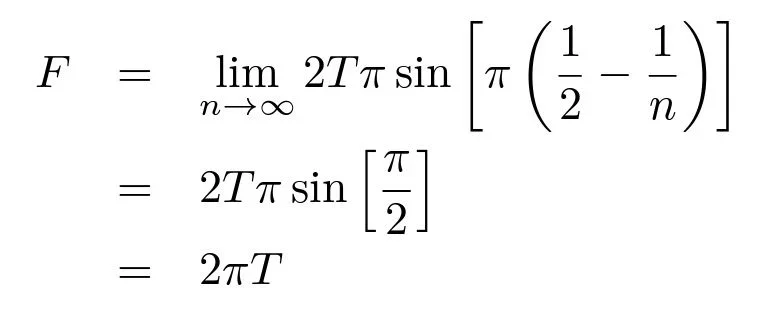
 
We try with the approach of the band of the annex and we will try to see if repeated for each turn of material we get something sensible.
the initial scheme is so and knowing t that impose me as a winding shot I prefiggo to get f.IMG_20190504_155947.webpthat for the single clamp is worth:IMG_20190504_160041.webptherefore assuming to draw a sheet thickness 0,5mm wide 1500mm with specific shot 20mpa I get a t=t•b•tsp=15kn and then a radial force f=2•3,15•t=94,2kn.
Well... but now the next round what does it do? adds 94,2kn?...10 rpm is 940kn? I don't think so.
 

Attachments

In my opinion, every round you have to take off the tangential shooting friction
 
then friction force at the lap fa=fa•t=0,18•15kn=2,7kn that subtracts to the t=15kn shoot makes a useful shot tu=t-fa=12,3kn.

and reapplying the formula of first obtain f=2•3,14•tu=77,2kn for each round wrapped.
being that the coil radially is equal to 500mm and the tape thickness 0.5mm I have 1000 windings.

we make the total radial force 77,2•1000=77200kn=7700ton.
It really seems to me a very high thing yet on the diameter 508mm core for 1500mm width means an area of about 2400000mm2 and therefore I have a specific compression pressure of about 32mpa.

but is reasoning correct?
 
I reasoning on the pressures for a small angle on a single winding (without friction) I have obtained that: σr = 2 σt sen(1/2r) where σr is the specific radial pressure (surface unit) while σt is linear tangential pressure (traction force of the tape / tape side).

edit: I think that the next winding, beyond friction, would be to remove the resistance of the underlying winding, and so on...
 
Last edited by a moderator:
I reasoning on the pressures for a small angle on a single winding (without friction) I have obtained that: σr = 2 σt sen(1/2r) where σr is the specific radial pressure (surface unit) while σt is linear tangential pressure (traction force of the tape / tape side).

edit: I think that the next winding, beyond friction, would be to remove the resistance of the underlying winding, and so on...
I meant this but writing from cell I have sinned synthesis
 
I meant this but writing from cell I have sinned synthesis
But I do not see the end of friction in this formula as it is written that there is no friction in the formula.

I think you're suggesting that I use the formulas that are used on piston shirts.IMG_20190504_204010.webpIf I know the shooting and the area I have the specific shot that could be sigmat of my formulas and get p. and I get the same result.
Do I get it right?
 
Last edited:
I think you're suggesting that I use the formulas that are used on piston shirts.
If you want to remove the literature, there would be that inherent to the circled cylinders (lamé equations). the setting of the problem is similar it is only about rewriting for the specific case.
and I get the same result.
Do I get it right?
what same result? show show
 
I would say that friction can leave him alone, at least initially: This is not what generates radial action on the drum, at least not directly. the friction force (which is obviously tangential) is due to the possible striping of the tape on the drum (if there is no sliding there is friction), and it is calculated obviously by multiplying the radial reaction of the tape on the drum (which is what you are looking for) by the friction coefficient. this crawling (local) in the straps it is necessary to transmit the motion, and is due to the deformation of the same (of course we do not talk about massive streaks, otherwise the belt would slip): by finding us here in the presence of a material with an elastic module much higher than that of a belt and fixed to the drum, I would feel to exclude relative stripes between tape and drum, at least in the first approximation.

I believe that everything can be resolved by writing a balance to the translation along a radius of a tape element of infinitesimal length, trying to calculate the action of the tape on the drum (rt): following the classic exercise of mechanics applied on the straps (now I can't write the demonstration, after I can try) would be an expression of the type (transcuring the centrifugal force - conservative hypothesis - and the weight of the tape):

rt = 2t/d = 2*15/0,5 = 60 kn/m

It is an expression similar to that of the straps, under the same assumptions.

Whereas a lap (c = pi*d = 3,14*0,5 = 1.6 m) we have that the total force is rt, tot = rt*c = 60*1.6 = 96 kn. Whereas the surface area of the drum is equal to = pi*d*c = 3,14*0,5*1.5 = 2.4 m2, I have a contact pressure of p = 96000/2,4e6 = 0.04 mpa
with 1000 windings I would have 40 mpa.
the weight of the tape can be put into this balance, but the calculation is complicated: after I can try to consider it, but in the meantime do your considerations. . .
 
for now with all your considerations I get the same results from paulpaul.
without considering friction I get the exact same pressure.

The only thing I have seen to have wrong is the consideration of friction that I calculated as a shot by friction coefficient but instead it is the calculated radial component that must be multiplied by friction coefficient, so the calculation must first be done without friction and with the found value of radial force multiplied by the friction coefficient itself and get the shot from friction.
It is also true that if at each turn there is no relative crawling it can be said that the friction component does not exist.
 
can't be seen as a material that adds to the soul to endure the radial effort of the next round?
 
can't be seen as a material that adds to the soul to endure the radial effort of the next round?
a sort of balance there is but cannot be total, otherwise it would not explain the collapse of the coil center when it is leaned on the ground and the shooting parameters on the clothing are wrong.
In addition, physically you create an elastic effect that tightens and happens in some particular cases that you can't parade the roll from the spindle.
 
Therefore ultimately, the system with multiple windings is not a force multiplier and therefore the internal spindle is only affected by the band effect of the first stable turns of material.
 
I would say that friction can leave him alone, at least initially: This is not what generates radial action on the drum, at least not directly. the friction force (which is obviously tangential) is due to the possible striping of the tape on the drum (if there is no sliding there is friction), and it is calculated obviously by multiplying the radial reaction of the tape on the drum (which is what you are looking for) by the friction coefficient. this crawling (local) in the straps it is necessary to transmit the motion, and is due to the deformation of the same (of course we do not talk about massive streaks, otherwise the belt would slip): by finding us here in the presence of a material with an elastic module much higher than that of a belt and fixed to the drum, I would feel to exclude relative stripes between tape and drum, at least in the first approximation.

I believe that everything can be resolved by writing a balance to the translation along a radius of a tape element of infinitesimal length, trying to calculate the action of the tape on the drum (rt): following the classic exercise of mechanics applied on the straps (now I can't write the demonstration, after I can try) would be an expression of the type (transcuring the centrifugal force - conservative hypothesis - and the weight of the tape):

rt = 2t/d = 2*15/0,5 = 60 kn/m

It is an expression similar to that of the straps, under the same assumptions.

Whereas a lap (c = pi*d = 3,14*0,5 = 1.6 m) we have that the total force is rt, tot = rt*c = 60*1.6 = 96 kn. Whereas the surface area of the drum is equal to = pi*d*c = 3,14*0,5*1.5 = 2.4 m2, I have a contact pressure of p = 96000/2,4e6 = 0.04 mpa
with 1000 windings I would have 40 mpa.
the weight of the tape can be put into this balance, but the calculation is complicated: after I can try to consider it, but in the meantime do your considerations. . .
hello paulpaul, I fully share your speech of neglecting friction and that among other things had been mistakenly calculated.

I also like to think that rt grows when shooting t increases and behaves to the opposite of the diameter (in fact, I think that if you want to wrap a thread on an infinite ray spindle, there would be no radial force of compression; instead, the more the radius decreases and the more radial force increases. We also think of the example of the grass thread wrapped in the finger when you go to the mountain, don't we? )

Yet, I can't understand where the expression rt=2t/d comes from. you believe come from the calculation on the straps, but of that problem at most I can find the two tensions:
Would you please explain how you reasoned to get rt=2t/d?

Thank you.

Bars
 

Forum statistics

Threads
44,997
Messages
339,767
Members
4
Latest member
ibt

Members online

No members online now.
Back
Top