
• This forum is the machine-generated translation of www.cad3d.it/forum1 - the Italian design community. Several terms are not translated correctly.

rotondity punched hole

  • Thread starter Thread starter Camillo60
  • Start date Start date

Camillo60

Guest
Hello everyone,

I would like to share a phenomenon found during a punching test of a raw brass sheet.

the sheet has a thickness of 0.5mm and the punch has a diameter of 6mm.
that the hole has an ovality of +/-0.02mm compared to the diameter of the punch.

the game between punch and matrix is quite "right" and is 0.04mm total and the rotondity of matrix is punzone is within 0.002mm compared to values
Name them.

I can imagine a reaction of the material and a release of internal tensions.

I have experienced the punching of the same material after a cycle of replenishment and things seem to get worse.

I must however report that I have tried to increase the punzone/matrix game by obtaining an apparent improvement of the rotondity to the detriment
of cutting quality.

Does anyone have direct experiences on the "precision" of small holes?

greetings

Camillus
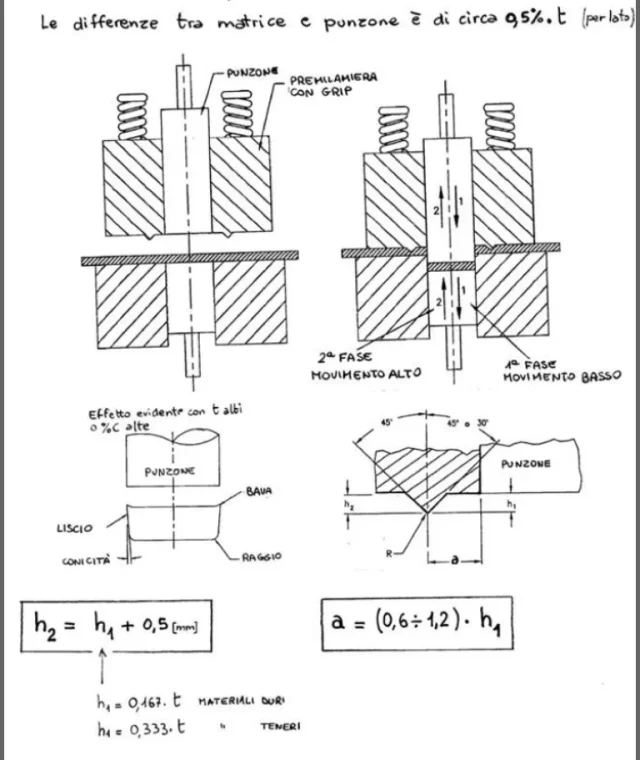
 
if you increase the game surely the contact zone deforms more by increasing the drag of the grains and then round the fracture by moving the material.
the primer should not be smooth but with the teeth that do not flow the material and have springs with high load.
 
Unfortunately the hole is executed on a pre-cut piece and I have very little material around the drilling point.
 
if you make fine hairstyle you should do not more than 0.01 mm radial game.
I'll attach the pattern you usually use. if you have little material you have to act the same as pattern.wp_ss_20170730_0001.webpas you see the radial game between matrix and punch is 0.5% thick....so nothing really.
 
If you just want to get a good result in addition to what you said before you have to make a lower spring counter so keep the central area while pulling it....see image above. It is very different than to draw in the vacuum of the matrix that does not support the rash.
 
It's certainly interesting. but 0.5% of these thicknesses is very little and we enter the field of microns.
of certain holes carried out to the milling and then alesed are not suitable.. .

it would be interesting to hear someone who analyzed the rotondity of small holes in the fine hairstyle.
 
That is, here also the game between compasses and columns of the stash can make a difference.

sheet metal moulds ?
 
surely the holes are made of electroerosion.
I deal with many things and among these special molds project for a type of processing to joint two sheet strips.
However, in the field I have put in service several presses so equipped. . ..sickness 0.2 up to 6 mm, steel...inox... raw and cooked aluminum, brass etc.
the columns certainly have their importance but already the high games you have cannot do miracles.
 
certainly today modern electroerosions offer high performances but I can't tell if they can produce holes
with micrometric tolerances. In the past I used 80's dip em and it was a nice mess to respect tolerances and finishes.. . .
I know that there are micro drilling machines, which are probably more suitable for the execution of precision holes.
for holes perhaps better a coordinate grinding. . .
 
Last edited:

Forum statistics

Threads
44,997
Messages
339,767
Members
4
Latest member
ibt

Members online

No members online now.
Back
Top