• This forum is the machine-generated translation of www.cad3d.it/forum1 - the Italian design community. Several terms are not translated correctly.

section size, point load, welding

vincenzoarricale

Guest
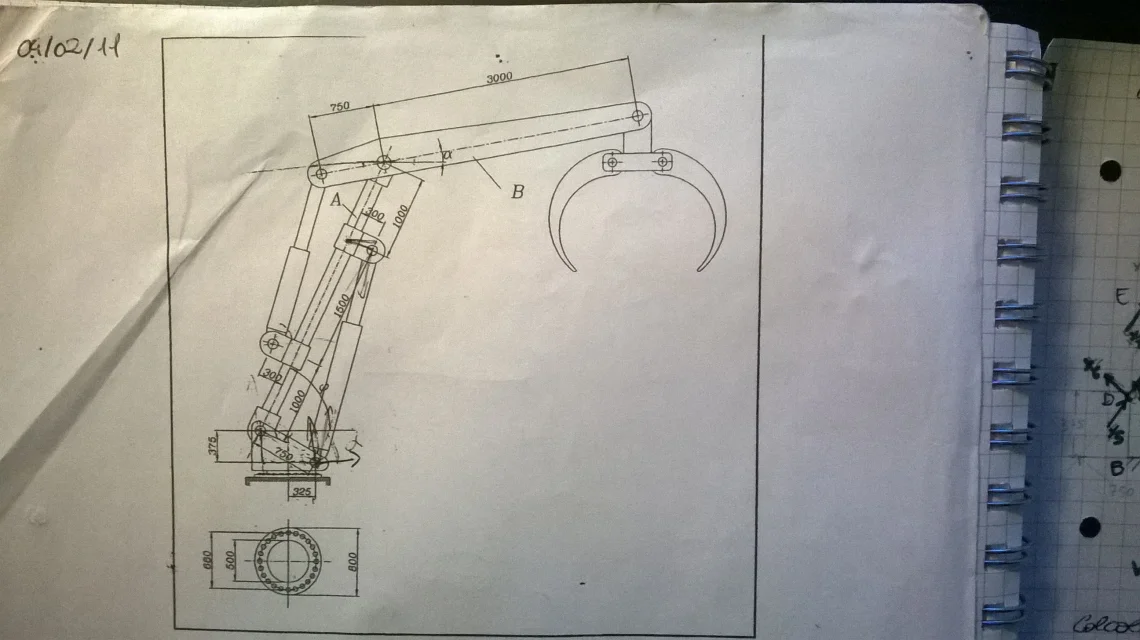
Hello, I am struggling with this test of construction of machines:WP_20150211_08_20_32_Pro.webpWP_20150211_17_32_01_Pro.webpIs the way to proceed correct? I have some doubt about the calculation of reactions.
Thank you.
 
the method is to first consider the unit structure and obtain external reactions, then break the various rods and make the reactions to the knots using also those of the previous point
 
then do the internal actions on each beam. then take the requested sections and impose that the true sigma is lower than the admissible one of the material. so revenues the size of section.
from the mobile I see everything small and I don't read, so I'll explain what you do typically
 
then do the internal actions on each beam. then take the requested sections and impose that the true sigma is lower than the admissible one of the material. so revenues the size of section.
from the mobile I see everything small and I don't read, so I'll explain what you do typically
Thanks for the answer. the biggest doubt I have is:
1. Should the pointer/trailer have the opposite forces as drawn in the figure, or on the other piece of beam the strength of the dot/trailer act in the same direction?
2. in the sizing of a section, if I, for example, cut(,moment, normal effort) positive to left and negative to right, take the maximum value or absolute value of the positive and negative?

Thank you very much
 
for point 1, keep in mind that you must first come to solve external reactions considering the reticular structure a unique body if it is isostatic and not labile.

for point 2, you have to sit on the beam, looking in front of you and marking what you see, so for the cut or on or on depending on the sign, traction see if the tip moves away or not and so also for moments.

clearly you must first mark the conventions of sign for internal actions and then you know the direction of forces/moments.

graphically you mark the line -.-.-.- as for the drawing sections and direction arrows from where you look and so it works. It is equal to sit on the beam and look forward in direction of section arrows.
what you have behind your back does not exist because it is worth everything that is an infiniteism ahead of you
 
for point 1, keep in mind that you must first come to solve external reactions considering the reticular structure a unique body if it is isostatic and not labile.

for point 2, you have to sit on the beam, looking in front of you and marking what you see, so for the cut or on or on depending on the sign, traction see if the tip moves away or not and so also for moments.

clearly you must first mark the conventions of sign for internal actions and then you know the direction of forces/moments.

graphically you mark the line -.-.-.- as for the drawing sections and direction arrows from where you look and so it works. It is equal to sit on the beam and look forward in direction of section arrows.
what you have behind your back does not exist because it is worth everything that is an infiniteism ahead of you
2. Therefore, being the most solicited sez c, I will size it to mf=24,9*10^6 nmm, t=24930n, n=80874 n (photo1)


1. Okay, I make a global balance first, finding my first reactions, from there, I don't know if when I go to disconnect the bodies, these reactions I have to consider them the same way or the opposite. I'll explain better with a photo

(photo2 structure, photo3 schematization, photo4 calculation reactions overall balance and first piece, photo5 calculation reaction for other pieces considering those of the previous piece of opposite direction)


I hope it is clearer the doubt I have. i.e. if when I disagree and go to consider the other piece the reaction I have to insert in the same verse or in the opposite one, and if I have to do it also for the tiranti and the dots, as I have been "litigando" for days with my girlfriend, which says that they should not be changed as the constraints are not internal but intermediate. Thank you very much.
 

Attachments

  • WP_20150213_07_28_36_Pro.webp
    WP_20150213_07_28_36_Pro.webp
    536.5 KB · Views: 15
  • WP_20150213_07_27_22_Pro.webp
    WP_20150213_07_27_22_Pro.webp
    575 KB · Views: 14
  • WP_20150213_07_27_47_Pro.webp
    WP_20150213_07_27_47_Pro.webp
    575.3 KB · Views: 12
  • WP_20150213_07_28_08_Pro.webp
    WP_20150213_07_28_08_Pro.webp
    493.3 KB · Views: 12
  • WP_20150213_07_28_21_Pro.webp
    WP_20150213_07_28_21_Pro.webp
    617.1 KB · Views: 14
when I break a multilink structure I have to put actions and reactions to the detachment node.
on the first beam I will have verses and on the second beam I will have opposite them but on the same form.
external constraints are those with the fixed world. every zipper is certainly an internal bond. example the first almost horizontal beam has two pins to the right where there are internal constraints, piston and other beams.
The external forces are the only ones you can put right. When you break, you hypothesize a verse..
 

Forum statistics

Threads
44,997
Messages
339,767
Members
4
Latest member
ibt

Members online

No members online now.
Back
Top