• This forum is the machine-generated translation of www.cad3d.it/forum1 - the Italian design community. Several terms are not translated correctly.

servo motor

thomthomthom

Guest
Good morning, I wanted help.
I have a system with two reels one connected to a motor that rotates it by applying a pair and the other roller is connected to a spring that opposes resistance.
once I find the necessary torque as I find the suitable engine and how do I choose it?(I choose the engine that has that pair? )
 
reducer and motor will have to meet necessary movement speed and torque.
Engines are usually constant torque from zero to base speed...so work there.
 
Do you have a servo motor? Can't you use an alternating current squirrel cage motor? Do you have to mount encoder? I think I understand that his school exercise... what basics do you have to choose engine technology? I can give you a three-phase asynchronous vector like the bqar series sicme engines.
you look at the catalog as you draw the engine curves. then see for your application that torque and power and turns you need. You put them on chart and you have to stay with your point below the engine curve.
 
thanks for the availability , my problem we say that it looks a bit like a conveyor belt . by making assumptions I find that n = 12.73 rpm, c=5.83 nm (I guess all the resistant moments) and p=7.75 w. I have to find a servomotor with endless screw reducer for force because so the professor wants . what do I recommend to take ?(I am not very experienced in displaying and choosing engines and gearboxes
 
Usually, the choices imposed by professors do not follow logic of productivity and corporate feasibility. an endless screw reducer has a performance of 60/70% if done very well and is used to increase the ability to irreversibility of the motorcycle.
Since the power in play is very low you have to go on engines with high-speed gearboxes.
right to have an idea, the engines normally have a base rpm of 1000/1500/2000rpm, so in your case that you have 12rpm on the load you must have at least one gearbox from i=90/100 to get at least 1000rpm.
Whereas you need 8w on the load and if everything was conservative you want an 8w engine.
We're talking about a very small engine.
the panadonic series https://industrial.panasonic.com/content/data/mt/pdf/geared_e_all.pdf is formed by motors from a few w to climb, with multistage epicycloidal gear to be mounted frontally.
I repeat....just a dementer mounts a screw without a big end 20 times for such an application...unless you have wronged the accounts and you need 8kw and then we can feel that we have something industrially bigger manageable.

here. http://www.opis.cz/panasonic/pdf/panasonic-3-series-catalogue.pdf There is the complete catalog of the engines you need to use. it may be that you do not have to reduce too much with the reducer because some engines turn to lower regimes.
 
Since sleep doesn't come, I'm looking at you on the last catalog that you need a 10w square 70x70 engine, with i=120 gearbox. If you want to go exactly at your speed you will have to mount an inverter.
see page b19 of pdf. I leave you to compose the code of the engine and the reducer.

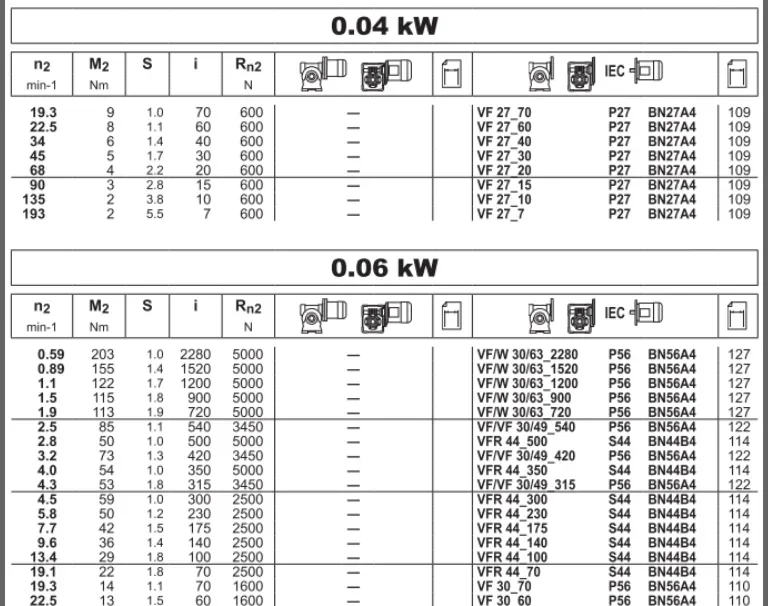
as we have to make the prof happy, who has no idea that a servomotor does not mount on a gearbox vsf, let's see what bonfiglioli provides us from this catalog https://www.bonfiglioli.it/media/fi...77-33de455a8439/br_cat_vf-w_std_ita_r02_1.pdfwe are talking about squirrel cage engines, normal three-phase on which you have to mount an encoder to manage them in retroaction, especially if you want to have maximum torque at speed nothing. Moreover you will have to put an inverter for the adjustment of the turns if you want to force the exact speed from theoretical calculation.

therefore solution 1 can be engine from 0.04kw i.e. 40w and i=70 reducer and with inverter calibrate the engine turns.
solution 2 can be 0.06kw engine and i=100 gearbox and you're practically there....put the inverter if you want.
wp_ss_20171220_0001.webpThese two solutions are theoretically more economical than the servomotor including drives, management etc. clearly are two different technologies but equivalent. the dimensions are clearly different and energy expenditure is different.
 
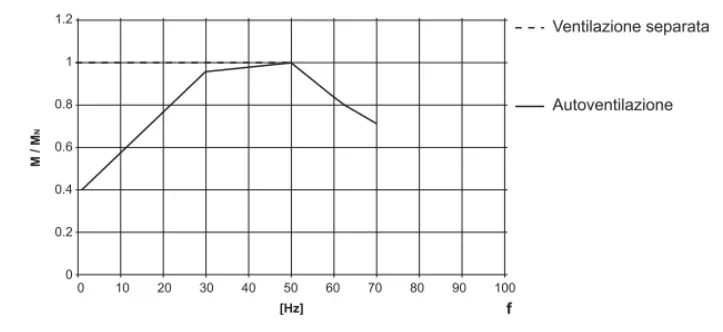
your gearbox with attached motor will have these dimensions and as you can see the engine is a 4 pole at 1350rpm actual if powered at 50hz.wp_ss_20171220_0002.webplooking at this graph, we see that at the nominal level the motor being self-ventilated (the motor shaft fan), can at 1350rpm (50hz) provide our maximum power. from that number of turns on, you have a decrease and torque up to 70hz keeping the power constant. then the power falls.
wp_ss_20171220_0003.webp
 
I place my considerations here if you want to take a look in case I made a mistake and thank you again for what you already told me.
It's a conveyor belt type problem I have: d= 0.150 m ,m=5 kg, resistant pairs = 4 nm,
ft=0.5*5*9.81=24.5
pair = 24.5*0.075= 1.83 nm
speed= ipotice for my use a speed of 0.1 m/s
w=v/r=0.1/0.075=1.33
n= w*60/6.28= 12.74 rpm
p=cw=(4+1.83)*1.33=7.75 watts
 
if 0.5 is the friction coefficient that multiplies the weight by gravitational acceleration.... does not bend.
Keep in mind that normally to keep a conveyor belt in motion you don't need many kw but you need more to turn on or brake because everything is still and you have to win the inertias of the rollers and the carpet and the leaning mass.
so I suggest you check what is called "transitional" i.e. the "non-regulation", i.e. the departure or stop. keep in mind that the engine I chose above the bonfiglioli is able to provide double the nominal torque.
 

Forum statistics

Threads
44,997
Messages
339,767
Members
4
Latest member
ibt

Members online

No members online now.
Back
Top