
• This forum is the machine-generated translation of www.cad3d.it/forum1 - the Italian design community. Several terms are not translated correctly.

sheet metal

  • Thread starter Thread starter folle76
  • Start date Start date

folle76

Guest
Hello.
provided that of proe something I understand, but of sheet metal processing technology are totally fasting, how can I create a piece as an attachment (.iges, .prt (wf 5)) so that it is obtainable by bending? so as is the flattening feature I fail.
Thank you.
 

Attachments

Hello.
provided that of proe something I understand, but of sheet metal processing technology are totally fasting, how can I create a piece as an attachment (.iges, .prt (wf 5)) so that it is obtainable by bending? so as is the flattening feature I fail.
Thank you.
I'm not very expert on sheet metal either, but I'm afraid that piece as it is not developable, in the sense that it's more of a printed / unpublished piece than bent. Maybe we should insert cuts in the proximity of the folds.

ready to be denied anyway.
 
pro/e would not have problems developing geometries of this type but, however, it is not possible to make pieces in dieping.
the piece in question however has a problem, the tapered part is too high and you can develop up to a height of 12-13 mm.

I add pictures.
 

Attachments

  • Immagine1.webp
    Immagine1.webp
    72.1 KB · Views: 43
  • Immagine2.webp
    Immagine2.webp
    80.7 KB · Views: 32
Thank you. It's very clear now. but the question persists. What should I do to make it available from sheet metal? I don't think it's time to shake the welds.
 
Thank you. It's very clear now. but the question persists. What should I do to make it available from sheet metal? I don't think it's time to shake the welds.
the problem is that a certain part of the artifact does not undergo a bending but a funnel with consequent stretching of the material, from my experience I believe that the piece is feasible for deformation (without making cuts) then to determine the geometry of the development I usually in similar situations I go for attempts, I try to approach as much as possible taking into account that the unpublished part that will have a greater elongation (this requires that before the mold is built for the seeds

p.s.
keep in mind that I do not know the size of the tea piece posted because unable to open it (use wf3)
 
edit
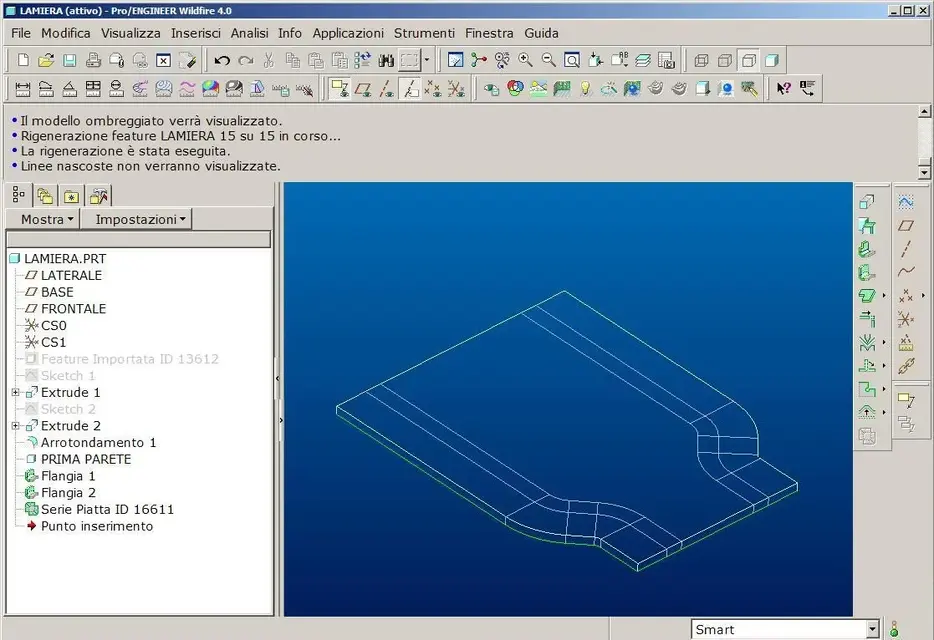
I did not realize that there was also a .igs, I opened it now and honestly it is worse than I thought (I was based on the photo posted by maxopus) however the thing I think is still feasible but with several risks and extra difficulty (of course the ears must be folded first)
 
with the wf4 I couldn't open the original prt, so I reconstructed it grossly.

the piece can be realized with a bending press only making cuts to the base and then towel them, otherwise it is necessary to resort to a funnel mold.

I attach the file with the hope that it can help you.

greetings
 

Attachments

with the wf4 I couldn't open the original prt, so I reconstructed it grossly.

the piece can be realized with a bending press only making cuts to the base and then towel them, otherwise it is necessary to resort to a funnel mold.

I attach the file with the hope that it can help you.

greetings
great!!! It's a solution I like and it makes me learn some new features in the sheet module that I know very little. but, let me understand better.. .
If I do it with the funnel mold then I can still get the development plan, right? for me it would be very useful for you to sketch out the same solution you have done now through the fun. .
Thanks again.
 
the development of a flat sheet destined to be folded to a bending press, with a bit of experience and using the right parameters is relatively simple and you can get pieces with the costs contained also for small batches.

the flat state of a sheet destined to funnel is bound very much to the type of mold, to the speed and power of printed, if made in cold or hot besides of course to the type of material, so in the end I believe that only the moldist is able to define a certain development, maybe after doing some tests. I don't know if pro-e has any function in that sense.

in any case I suggest you take the molding road only if the pieces to do are many, because the equipment costs are remarkable, both money and time intervals
 
with the wf4 I couldn't open the original prt, so I reconstructed it grossly.

the piece can be realized with a bending press only making cuts to the base and then towel them, otherwise it is necessary to resort to a funnel mold.

I attach the file with the hope that it can help you.

greetings
Hello, dani-3d,
I looked at the file you attached and I don't understand:

1. when you make the conversion into sheet metal and select the proe bending uses rays that sincerely do not understand from where they go to take.... .

2. by double-clicking the curvature rays I can go to change them manually, is this procedure correct?

3. together with the rays you see also a 20dev.l what is it? If I change it, I know that it stretches my facades when I make flat series. ?

Thank you.
bb
 
Bye-bye
I suggest you change the odds by not making us double clik, but:
change definition on the feature conver lam, then bending > define > select all > end > ray > input value .... ok > ok

for point 3 I do not understand the use of quota
 
Bye to all,
I attach a sheet that I have made, my problem is that I want to stretch it 300 mm from the straight side, how can I do it? of course without having to remake.... .

Then I would like to ask moderators to open a space dedicated to the world of sheet metal in which everyone can post their own examples of processing, coming from the most diverse sectors in order to make this fascinating world more understandable and learn the various approaches to the design of sheet metal artifacts.

I hope that the proposal will be accepted and accepted by many.... .

Thank you.
bb
 

Attachments

the bending radius, divided the thickness,
by a coefficient indicating the ironing of the sheet
should be applied to each fold. .
 
hi, to stretch 300 mm just change the length of the first wall. But be careful that there is an extra "extrude" feature that is useless.
 
Bye-bye

Unfortunately I can't open the files of the wf5, so I can't give you a tip for how to stretch your piece.
if you can be useful I attach you two examples of how you get the pattern of the piece.

greetings
 

Attachments

hi, to stretch 300 mm just change the length of the first wall. But be careful that there is an extra "extrude" feature that is useless.
My problem is that I started with a symmetrical protusion of the wall, and then I did some work related together... .

Of course I wouldn't want to lose these co-relationships, so I need to add a piece of 300 mm on the right side....I guess I thought I would add a new piece of sheet metal and then get one with some command type merge walls.....I don't know:confused:

bb
 

Forum statistics

Threads
44,997
Messages
339,767
Members
4
Latest member
ibt

Members online

No members online now.
Back
Top