• This forum is the machine-generated translation of www.cad3d.it/forum1 - the Italian design community. Several terms are not translated correctly.

single welding test

  • Thread starter Thread starter Marco93!
  • Start date Start date

Marco93!

Guest
in the office they asked me to dimension to static and fatigue a welding.

when I saw her I was falling from the chair. there is no way to make changes.

is in practice a shelf of a cantilever (c) welded only above. and welded only outside. is loaded at the end by a force fz. the fz force will always have direction down.

I attach image on how I would calculate welding stresses.

What do you think?
 

Attachments

  • C657C5DD-D988-45F6-8A49-B9902438567F.webp
    C657C5DD-D988-45F6-8A49-B9902438567F.webp
    147.3 KB · Views: 54
I add my point of view.

when they rise, the welding, will pull up the profile to c by not supporting the underlying part of the profile. when the load will be affixed, the welding will be deformed plastically until the bottom is supported.

therefore the calculation reported in the first place of the orth sigma is incorrect, instead of the height “h” there goes the thickness of the profile to “c”.
 
First of all, it is necessary to establish with what standard and what criterion is being tested. a cnr 10011 no longer exists for decades. uni en iso 1993-1-8, which is Eurocode 3 is valid and active. alternative ntc 2018.
first you have to calculate the welding reactions.
If you apply vertically downwards, you will get only one vertical force to the top equal and opposite to fz.
as fz is at a distance the moment generates and then generates a horizontal reaction for=fz•l/h.
then apply the directional method of tensions in the throat section and do static verification.
for that dynamic you must find the corresponding figure to determine the ∆s and then calculate the duration in cycles. use miner in Annex 5.
Alternatively, you can use hot spot voltage.quiquiDo you have any numbers so we compare?
 
Last edited:
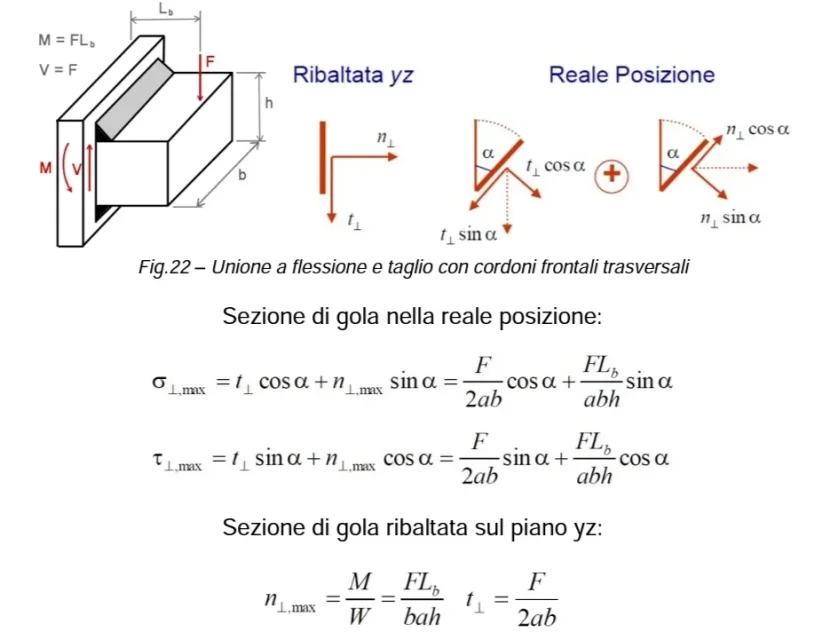
another discussion where the formulas of throat tensions are reported is This is what.

with the notation of the former cnr 10011 ie with the actions in the throat section but overturned (uni en iso 1993-1-8), we have:
Screenshot_20230628_233146.jpgevaluating with a similar example:Screenshot_20230628_233022.webpwhere however the area of the cords will be half the above indicated as there is only the upper cord.
 
Last edited:
just for completeness I attach you all the reactions according to its regulations.... so you have the full version. of course the cordon area is half the one indicated below.Screenshot_20230628_235939.webp
 
Thank you.

I use the simplified method for static verification even if more cautionary usually.

regarding fatigue testing I refer to recommendations for fatigue design of welded joints and components of the iiw recovering eurocide of fatigue.

In this case not having a soldering below I wondered how to treat the problem. Now I have seen that you too would take the compressed feedback below given by the dishes. I hope I explained.

If I can ask you something else.
If that cord was solicited to twist as you would hold it?
in the books I have seen the twist always spread on two strings.

I would find tau parr =( mt / jp) r

where mt is the torque moment
jp polar inertia rectangular section
r distance between welding center and point to check, in this case l/2 where l is welding length.
 
if the beam was solicited torsion, (not welding) it would be subject to a kind of traction.
the method you have indicated is correct even if it would actually apply to circular or closed sections which therefore resemble a closed path. you have to calculate the moment of inertia of the welding cord....and obviously not being symmetric will come what will come. the center of application of the torque moment is known.... It will be the distribution of the efforts that will go on a single cord. If the radius tends to infinite, you will get a pure traction to the cord. if however the distance of the rotation center is at least two orders of magnitude you could determine on the cord the traction component like f=mt/r.
 
for fatigue testing it is necessary to determine the class of the joint. with that calculate the ratio of cycles. That's the chapter. clearly if it is done fully you have a higher veracity.
 
if the beam was solicited torsion, (not welding) it would be subject to a kind of traction.
the method you have indicated is correct even if it would actually apply to circular or closed sections which therefore resemble a closed path. you have to calculate the moment of inertia of the welding cord....and obviously not being symmetric will come what will come. the center of application of the torque moment is known.... It will be the distribution of the efforts that will go on a single cord. If the radius tends to infinite, you will get a pure traction to the cord. if however the distance of the rotation center is at least two orders of magnitude you could determine on the cord the traction component like f=mt/r.
I don't get much back when you talk about traction welding. I see more of the parallel tau due to the twist.

allego accounts of welding verification
 

Attachments

  • 2CABF95B-B7BF-45D2-B31E-B4466A384F8A.webp
    2CABF95B-B7BF-45D2-B31E-B4466A384F8A.webp
    130.7 KB · Views: 33
the parallel tau voltage is the tension on the throat section generated by the cord traction.
the cord traction can be caused by a direct force or a twist with a large distance from the center of rotation.
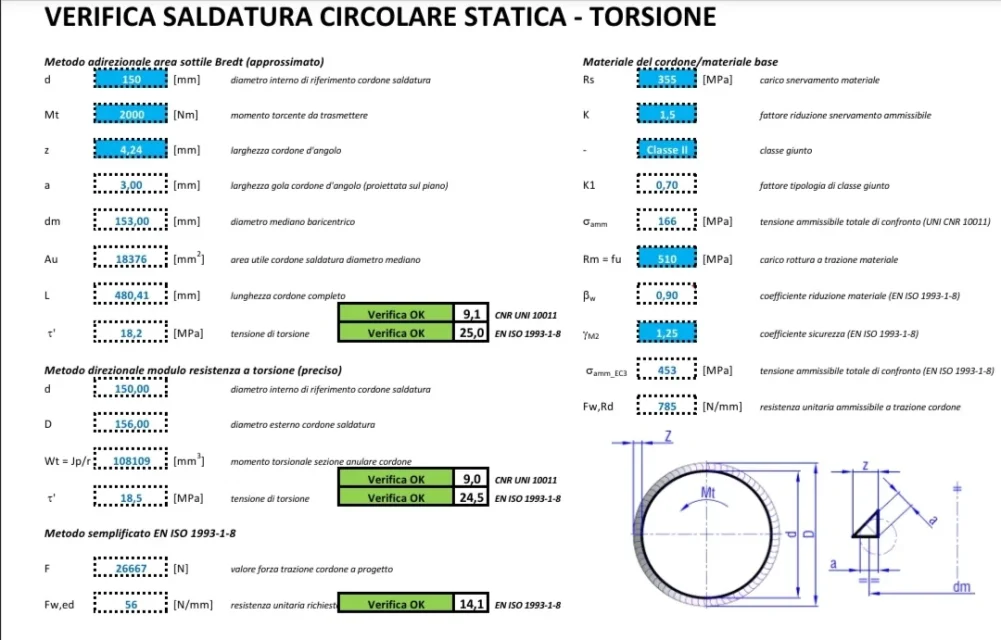
If you use uni en iso 1993-1-8 with the simplified method calculations a cord resistance which is a tau cut but the cord can take on efforts in all directions.Screenshot_20230629_214310.webpOf course if the radius is small you make a bigger mistake.
 
the comparison with a diameter pipe 150mm to which a pair of 2000nm is applied.
we have a tau voltage of 18mpa.
Screenshot_20230630_002243.webpif the cord on the iron to c is shorter, being only one, it must be by force that the tension is higher.

I'm not sure your moment of polar inertia is right.

the example that is reported for the analysis of a force outside center that leads to cutting and twisting is analyzed thus:
Screenshot_20230629_233848.jpgfrom here assess the two tau.
Moreover if the pair is 2000nm at a distance of 75mm generates a force of 26'660n=27kn.

so doing we have a voltage of 60mpa.
Screenshot_20230630_001753.jpg
 
Last edited:
I take you back correctly s355 the image above....which was for s235.
Screenshot_20230630_002607.webpas you see the relationship tensions single cord/tube is of 60/18=3,3.
this is also seen by comparing the length of the two strings....480/150.
from here you can see plus the cord is long and more load can carry. the famous capacity per meter of the eurocode in the simplified method.

then you have to determine the strength on your single cord as:[math]f=\frac{mt}{y}[/math]Surely a good fem analysis will help you solve the puzzle.

for fatigue resistance you have to see the 1993-1-9 part of the Eurocode. you will find many interesting things.
 

Forum statistics

Threads
44,997
Messages
339,767
Members
4
Latest member
ibt

Members online

No members online now.
Back
Top