• This forum is the machine-generated translation of www.cad3d.it/forum1 - the Italian design community. Several terms are not translated correctly.

small footprint motor for tape

  • Thread starter Thread starter LabelMan
  • Start date Start date

LabelMan

Guest
Good morning to all,

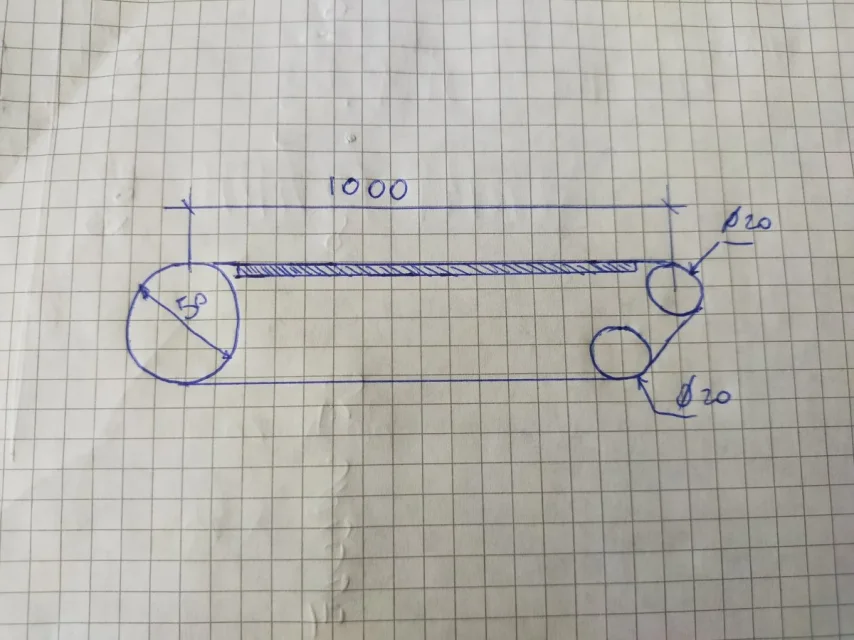
I am making a prototype for a conveyor belt that runs smoothly with the following measures:
1000mm interasses, width 300mm and height 50mm.
I'd like to use a step-by-step motor for tapes or a minimumtor with an incumbent that's inside 50mm or is slightly higher. It is only for an aesthetic question.

the drive diameter is 50mm while in the crazy part has a diam.20mm roller in tangence with that drive and at lower level another diam.20mm roller to allow a final inclination. (I attach image)

data for sizing are as follows:
v= 30m/s
linear mass = 10kg/m
transportable product mass = <1kg

I have not been able to find the friction coeff between steel and canvas, being the plane on which it flows in aisi 304 while the tape is a canvas tape with negative pyramid cover in polyurethane. I do not know if negligible there is a central guide that is rubber that serves for the centering and acts only on the drive roller and the crazy rollers.

the idea was not to spend a capital clearly but something economic but at the same time durable.
 

Attachments

  • IMG20230527153029.webp
    IMG20230527153029.webp
    97 KB · Views: 12
there are so-called "motorulli", with motor integrated directly into the roller. Rulmeca definitely does it but there will also be many other producers.
 
there are so-called "motorulli", with motor integrated directly into the roller. Rulmeca definitely does it but there will also be many other producers.
I tried to look, you turned my day I didn't know them! !

Have you ever tried them? how long duration and reliability?
Do you also know if they heat up like a motor?
 
I tried to look, you turned my day I didn't know them! !

Have you ever tried them? how long duration and reliability?
Do you also know if they heat up like a motor?
are consolidated components for years, I think if dimensioned well they do not give surprises. If your conveyor is heat sensitive, you may contact a manufacturer for clarification on this point.
 
Good morning to all,

I am making a prototype for a conveyor belt that runs smoothly with the following measures:
1000mm interasses, width 300mm and height 50mm.
I'd like to use a step-by-step motor for tapes or a minimumtor with an incumbent that's inside 50mm or is slightly higher. It is only for an aesthetic question.

the drive diameter is 50mm while in the crazy part has a diam.20mm roller in tangence with that drive and at lower level another diam.20mm roller to allow a final inclination. (I attach image)

data for sizing are as follows:
v= 30m/s
linear mass = 10kg/m
transportable product mass = <1kg

I have not been able to find the friction coeff between steel and canvas, being the plane on which it flows in aisi 304 while the tape is a canvas tape with negative pyramid cover in polyurethane. I do not know if negligible there is a central guide that is rubber that serves for the centering and acts only on the drive roller and the crazy rollers.

the idea was not to spend a capital clearly but something economic but at the same time durable.
These transport tapes I have always made them with a good screw reducer without fine bonfiglioli and a motor from 0.18/0,37kw 4 poli 400v.

for the friction coefficient I recommend you to take a piece of tape even worn and put it on a sloping plane of stainless steel and through the angle in which it begins to move you determined with the arctangent the friction coefficient. However it will not be very different than steel on canvas.
coefficient friction tape/plane sliding:pe on steel = 0.15
pp on steel = 0.26
pom on steel = 0.2
pvc/urethane on steel = 0,5
polyamide/polyestrian steel = 0.3

if you are looking on the forum we have talked several times how to calculate the motorization of a conveyor belt.

If you start making some calculations and places we can look at it.

I was doing two accounts ....but 30m/s are 1800m/min and if it is true....you have to put 1,3kw with 85% return to make it turn with on the ribbon full of products that weigh in total 10kg.... but are you sure of the data?
I used an antistatic cv10 andreoli with polyester traction fibers and under polyester ribbon canvased on satin iron plane.

the driving trapezoidal belt affects marginally on the power but ensures that the carpet remains on track.
 
Last edited:
These transport tapes I have always made them with a good screw reducer without fine bonfiglioli and a motor from 0.18/0,37kw 4 poli 400v.

for the friction coefficient I recommend you to take a piece of tape even worn and put it on a sloping plane of stainless steel and through the angle in which it begins to move you determined with the arctangent the friction coefficient. However it will not be very different than steel on canvas.
coefficient friction tape/plane sliding:pe on steel = 0.15
pp on steel = 0.26
pom on steel = 0.2
pvc/urethane on steel = 0,5
polyamide/polyestrian steel = 0.3

if you are looking on the forum we have talked several times how to calculate the motorization of a conveyor belt.

If you start making some calculations and places we can look at it.

I was doing two accounts ....but 30m/s are 1800m/min and if it is true....you have to put 1,3kw with 85% return to make it turn with on the ribbon full of products that weigh in total 10kg.... but are you sure of the data?
I used an antistatic cv10 andreoli with polyester traction fibers and under polyester ribbon canvased on satin iron plane.

the driving trapezoidal belt affects marginally on the power but ensures that the carpet remains on track.
Thank you for your complete answer.

Forgive me but I was wrong to write is 30 m/min....sorry :(

I was evaluating the motor drums recommended by hunter, but I'm not sure I understood how to grind it. . .

considering that I know that I want to travel to 30 m/min and that the total weight to carry is 10kg (beyond friction), in theory I just need to know the kw of the motorlump, correct?
Forgive me but I'm not very clever, because it would seem that even without reduction I can move it but it seems very strange
 
These transport tapes I have always made them with a good screw reducer without fine bonfiglioli and a motor from 0.18/0,37kw 4 poli 400v.

for the friction coefficient I recommend you to take a piece of tape even worn and put it on a sloping plane of stainless steel and through the angle in which it begins to move you determined with the arctangent the friction coefficient. However it will not be very different than steel on canvas.
coefficient friction tape/plane sliding:pe on steel = 0.15
pp on steel = 0.26
pom on steel = 0.2
pvc/urethane on steel = 0,5
polyamide/polyestrian steel = 0.3

if you are looking on the forum we have talked several times how to calculate the motorization of a conveyor belt.

If you start making some calculations and places we can look at it.

I was doing two accounts ....but 30m/s are 1800m/min and if it is true....you have to put 1,3kw with 85% return to make it turn with on the ribbon full of products that weigh in total 10kg.... but are you sure of the data?
I used an antistatic cv10 andreoli with polyester traction fibers and under polyester ribbon canvased on satin iron plane.

the driving trapezoidal belt affects marginally on the power but ensures that the carpet remains on track.
ah already precise that my is a solution to replace the asynchronous motor with endless screw reducer due to its encumbrance.

I would like to have a tape in which the engine is inside its encumbrance and then within the 50mm of the diameter
 
These transport tapes I have always made them with a good screw reducer without fine bonfiglioli and a motor from 0.18/0,37kw 4 poli 400v.

for the friction coefficient I recommend you to take a piece of tape even worn and put it on a sloping plane of stainless steel and through the angle in which it begins to move you determined with the arctangent the friction coefficient. However it will not be very different than steel on canvas.
coefficient friction tape/plane sliding:pe on steel = 0.15
pp on steel = 0.26
pom on steel = 0.2
pvc/urethane on steel = 0,5
polyamide/polyestrian steel = 0.3

if you are looking on the forum we have talked several times how to calculate the motorization of a conveyor belt.

If you start making some calculations and places we can look at it.

I was doing two accounts ....but 30m/s are 1800m/min and if it is true....you have to put 1,3kw with 85% return to make it turn with on the ribbon full of products that weigh in total 10kg.... but are you sure of the data?
I used an antistatic cv10 andreoli with polyester traction fibers and under polyester ribbon canvased on satin iron plane.

the driving trapezoidal belt affects marginally on the power but ensures that the carpet remains on track.
Then I take the ball to the leap and try to make two accounts:

tape speed = v=30 m/min = 0.66 m/s
transportable mass = m= 10kg
diameter roller drive = d=55mm= 0.025 m (rough)

to date I use an asynchronous motor therefore:

engine turns = 1400 rpm = 23,33 rpm
spindle roller = v/ (2*)dic*r)= 3,18 r/s

reduction ratio = i= 23,33/3,18= 7
coeff attrito= u =0.25

required force = u*m*9.81= 24.52 n
required torque = f*r= 0.61 nm
angle speed = v/r = 20 rad/s

low performance 0.5

power required=pn= (cn/w)/u)/1000 = 0.025 kw

calculation also the torque
banally cn*3= 1.84 nm

and the torque in point 0 that will have to be greater than 0.25 n/m (cs/i)

I said that if everything had to be corrected....Constated that these are the data I have a number of problems choosing the motor or motor drum.

For example, I link to a catalogue, assuming that I wanted to choose a motor vehicle of this house (I attach links to a really randomly built house, without any connection to me) cataloguefor example on page 28 seem to be 50 diameter motors, among other things also with donkey back that I would not mind.

what should be chosen with the above figures? I can't make an assessment. . .
 
Thank you for your complete answer.

Forgive me but I was wrong to write is 30 m/min....sorry :(

I was evaluating the motor drums recommended by hunter, but I'm not sure I understood how to grind it. . .

considering that I know that I want to travel to 30 m/min and that the total weight to carry is 10kg (beyond friction), in theory I just need to know the kw of the motorlump, correct?
Forgive me but I'm not very clever, because it would seem that even without reduction I can move it but it seems very strange
If you mount a torque engine, made of permanent magnets, specially built you can not mount the reducer.
probably a step-by-step motor of some watts can turn to the necessary regime....but since the base spins at high turns....I know you're not going.

everything is in the torque provided by the motor to the rotation turns. if not enough you put the reducer to sleep the turns and increase the available couple. but this is so with all the motorizations of any object that does something.

then going to 30m/min ....it takes about 20w to spin the tape.
the drum turns to 191rpm.

If you don't find a motorboat that can deliver this you have to pass by a gearbox.
 
Then I take the ball to the leap and try to make two accounts:

tape speed = v=30 m/min = 0.66 m/s
transportable mass = m= 10kg
diameter roller drive = d=55mm= 0.025 m (rough)

to date I use an asynchronous motor therefore:

engine turns = 1400 rpm = 23,33 rpm
spindle roller = v/ (2*)dic*r)= 3,18 r/s

reduction ratio = i= 23,33/3,18= 7
coeff attrito= u =0.25

required force = u*m*9.81= 24.52 n
required torque = f*r= 0.61 nm
angle speed = v/r = 20 rad/s

low performance 0.5

power required=pn= (cn/w)/u)/1000 = 0.025 kw

calculation also the torque
banally cn*3= 1.84 nm

and the torque in point 0 that will have to be greater than 0.25 n/m (cs/i)

I said that if everything had to be corrected....Constated that these are the data I have a number of problems choosing the motor or motor drum.

For example, I link to a catalogue, assuming that I wanted to choose a motor vehicle of this house (I attach links to a really randomly built house, without any connection to me) cataloguefor example on page 28 seem to be 50 diameter motors, among other things also with donkey back that I would not mind.

what should be chosen with the above figures? I can't make an assessment. . .
the pair is in n•m not n/m
 
Then I take the ball to the leap and try to make two accounts:

tape speed = v=30 m/min = 0.66 m/s
transportable mass = m= 10kg
diameter roller drive = d=55mm= 0.025 m (rough)

to date I use an asynchronous motor therefore:

engine turns = 1400 rpm = 23,33 rpm
spindle roller = v/ (2*)dic*r)= 3,18 r/s

reduction ratio = i= 23,33/3,18= 7
coeff attrito= u =0.25

required force = u*m*9.81= 24.52 n
required torque = f*r= 0.61 nm
angle speed = v/r = 20 rad/s

low performance 0.5

power required=pn= (cn/w)/u)/1000 = 0.025 kw

calculation also the torque
banally cn*3= 1.84 nm

and the torque in point 0 that will have to be greater than 0.25 n/m (cs/i)

I said that if everything had to be corrected....Constated that these are the data I have a number of problems choosing the motor or motor drum.

For example, I link to a catalogue, assuming that I wanted to choose a motor vehicle of this house (I attach links to a really randomly built house, without any connection to me) cataloguefor example on page 28 seem to be 50 diameter motors, among other things also with donkey back that I would not mind.

what should be chosen with the above figures? I can't make an assessment. . .
Take one that has power over 20w and with speed that does from zero or slightly more up to something over 30m/min. It takes the speed regulator.
just read the coding of this brand to understand.
the first thing to do is read and try to understand. Usually the catalogs are made to be able to choose things enough without too many paranoids.
this....as you see it also has the internal reducer....Screenshot_20230528_200743~2.webp
 
Last edited:
Take one that has power over 20w and with speed that does from zero or slightly more up to something over 30m/min. It takes the speed regulator.
just read the coding of this brand to understand.
the first thing to do is read and try to understand. Usually the catalogs are made to be able to choose things enough without too many paranoids.
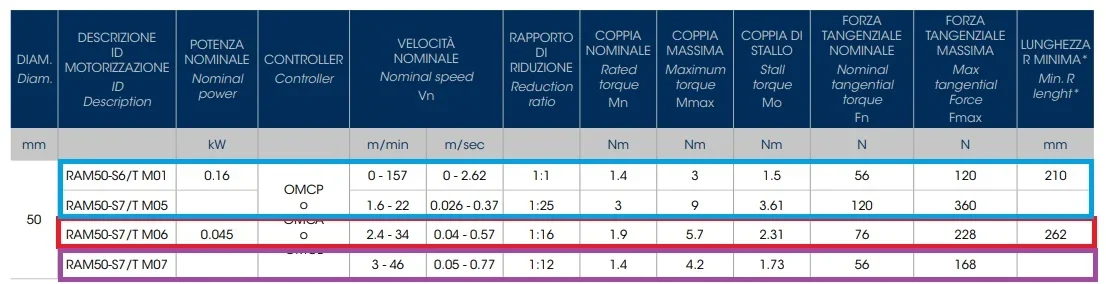
ok perfect seems to me all clear...just to confirm I attach an image.

that highlighted in red would be perfect for my application because it has a power greater than 20w (maybe even oversized I do not know if this creates problems) and a nominal speed ranging from 2.4 to 34 m/min therefore takes the 30 m/min required, possibly making it go to the maximum having a reduction ratio 1:16 can decrease speed increasing the torque for a possible weight slightly greater?

While those in blue are not good because the pyrmo has a power lower than my request, i.e. 20w while the second does not reach the speeds I require.

Finally the last in purple is oversized therefore unnecessary costs.

Only one thing... when you tell me 20w they'd be enough, is it influential that 25w came out in the calculation?

thank you very much again for your availability
 

Attachments

  • esempio.webp
    esempio.webp
    37.1 KB · Views: 8
you used a performance of 50% me by 85%. with 20 or 25w what changes if you take a 45w? You have to sell it... .
if you go further in the catalog you have the types of regulators and how they work. you have the curved torque speed.... you are in there....just look with your application here and is the best.
the available pair is written in the catalogue. then compare with the adjustment curve. outside and above does not go.


Still need 20w and you have 45 then take to spans almost 20kg.... .
 

Forum statistics

Threads
44,997
Messages
339,767
Members
4
Latest member
ibt

Members online

No members online now.
ciao
Back
Top