• This forum is the machine-generated translation of www.cad3d.it/forum1 - the Italian design community. Several terms are not translated correctly.

solidworks and foundry processes

  • Thread starter Thread starter Vit1
  • Start date Start date

Vit1

Guest
Good morning, everyone.

are a novello user of solidworks and I am trying to learn with the various tutors available directly in the program.

I would like to try using software for simulation of a foundry process, as I am studying in the degree program in mechanical engineering that I am following.

basically I should start from the design of the finished (a very simple geometry object) that I have already realized to get to the design of the model, on which then to do the thermal analysis (through the thermal modules), the dimensioning of the materozza, the study of the casting system, the description of the forming process and conclude with the analysis of the metallostatic spins.

I have many questions to ask, first of all I would ask you if according to you there is a software more indicated than solidworks with which to proceed.

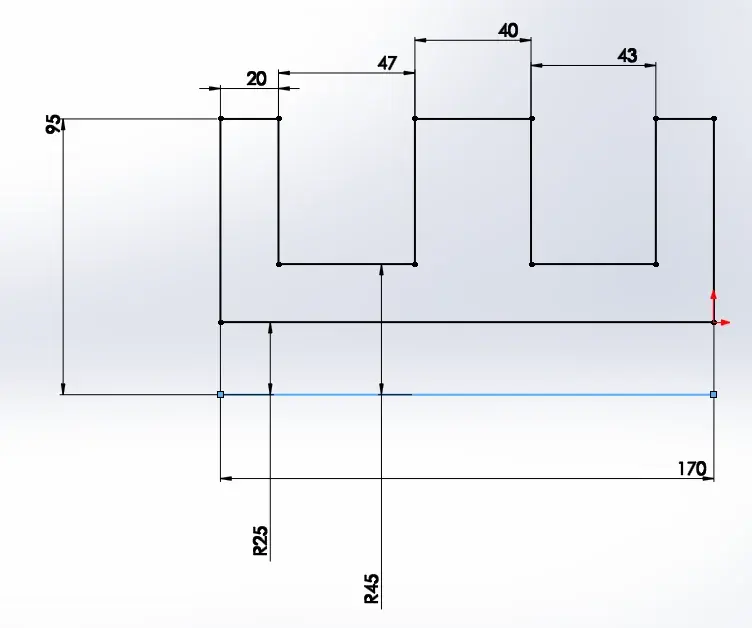
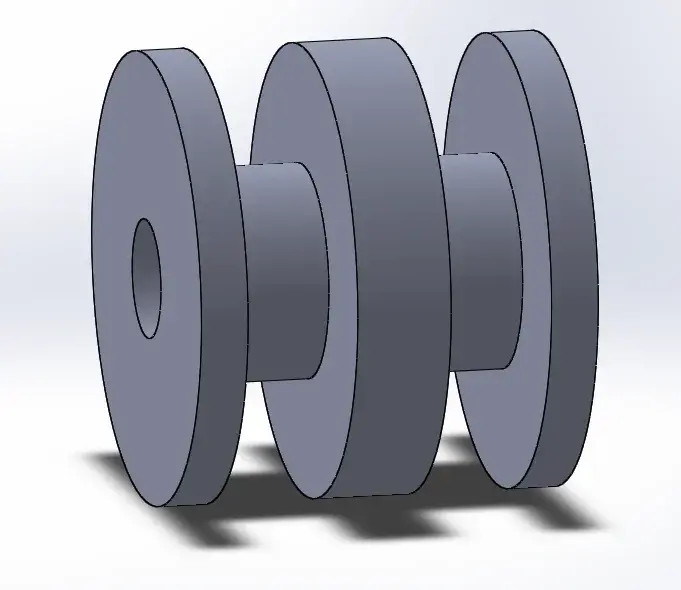
I attach a couple of screenshots of the end.

I hope that it will be all right if I ask the debate with doubts and questions about how to proceed in solidworks to get the results I need.
 

Attachments

  • Oggetto3D.webp
    Oggetto3D.webp
    14.3 KB · Views: 21
  • Quote.webp
    Quote.webp
    7.2 KB · Views: 19
the first step to do is to contemplate overmetals, sforms, fitting rays and what competes with the retreats; at that point you will have in hand the model (net of the two appendices necessary to obtain in the negatives the supports for the soul) to realize the two semi-stamps on earth (remaining that you are studying a process of fusion on earth... )
 
Thank you.
being an application linked to what illustrated by the teacher at lesson I will follow his procedure.
I will gladly take advantage of your help and try to keep the discussion up to date with various doubts and questions.
 
a first update.

the resolve procedure has been divided into the following macrophases:

1) drawing of the crude.
2) model design.
3) feeding system: Materozze.
4) casting system
5) training project and brackets.
6) metallostatic spins.

I attach some files to give an idea of the work I got to. I have basically finished phases 1 and 2 succeeding in doing almost everything I had set myself up.

for phase 3 I need to divide my model into subfolders and calculate exchange surfaces, in practice surfaces that are not in contact with other solid surfaces.

I see if I can, for now I am trying to use the measuring instrument to calculate the surfaces.
 

Attachments

  • AngoliDiSforno.webp
    AngoliDiSforno.webp
    80.3 KB · Views: 27
  • DisegnoDelFinito.webp
    DisegnoDelFinito.webp
    34.8 KB · Views: 19
  • Finito.webp
    Finito.webp
    92.3 KB · Views: 16
  • Sovrametallo02.webp
    Sovrametallo02.webp
    64.7 KB · Views: 16
Hi.
you could also add a central soul more or less dia.30
you must collect the dia 45 with the flanges and of course collect the flanges

Thank you very much
 
Thank you for the answer. the drawing of the crude is what you see attached.

the proposed solution is that turned in the classroom, I did not add practically anything of mine, I limited myself to understand and repeat. later I may try to create my own solution, but I am at a stage where I still do not feel I have all the tools to do so.

a central soul was not used but two lateral and the model is piece.

were not considered fitting rays (I will see if to add them) and the sforno angles were neglected in the treatment.
 

Attachments

  • DisegnoDelGrezzo.webp
    DisegnoDelGrezzo.webp
    74.1 KB · Views: 20
I need help. I would like to quickly divide the crude (my current model 3d) into subvolumes of which to calculate volume and surface exchange (surfaces not in contact with other surfaces belonging to the model itself; to imagine that the metal is liquid the surfaces of exchange are those not in contact with liquid metal).

I've already used a "manual" procedure, but I'd like to know how to make solidworks.

I would basically like to:

a) divide the model into multiple submodels.
b) of each submodel I have to calculate the volume (I should know how to do it) and the exchange surface described (I don't know how to instruct the program to calculate the total surface less than the common one with another submodel).

the result should look like the sketch attached in photoshop, perhaps adding the odds.
 

Attachments

  • PROVA-Moduli.webp
    PROVA-Moduli.webp
    89.6 KB · Views: 3
I managed to use the split function and create a set of .sldprt files and my original file is .sldprt; Now I'm trying to figure out how to reopen everything together in a single set without actually having to create a new set from the .sldprt parts

I see if I can, otherwise I will turn to you again.
 
I've created a set from the various parts and an explosive view. now I have a problem with quotas: I would like to quote the various elements of the axieme and make a screen of the screen. quotas however appear on the level of belonging and not "to the observer", as from attached image.

Is there a way to make them rotate dynamically so they roar with the visual? Can I change the color?
 

Attachments

  • Moduli-VolumiQuote.webp
    Moduli-VolumiQuote.webp
    115.9 KB · Views: 10
Thank you for the answer. the drawing of the crude is what you see attached.

the proposed solution is that turned in the classroom, I did not add practically anything of mine, I limited myself to understand and repeat. later I may try to create my own solution, but I am at a stage where I still do not feel I have all the tools to do so.

a central soul was not used but two lateral and the model is piece.

were not considered fitting rays (I will see if to add them) and the sforno angles were neglected in the treatment.
that convice little is the absence of a central soul: belong the fact that it costs you the wrath of God to pierce from the full a piece of the like regarding the inserting a passing soul, but the thing that leaves perplexed is that with all that material to solidify could arise in the middle of defects from withdrawal (or unwanted segregations). If they remain confined to the volume of the finished hole, it is fine, but if they appear on horseback between the volume of the finished and the volume of the hole you will find yourself after drilling to have a sliced piece.
 
that convice little is the absence of a central soul: belong the fact that it costs you the wrath of God to pierce from the full a piece of the like regarding the inserting a passing soul, but the thing that leaves perplexed is that with all that material to solidify could arise in the middle of defects from withdrawal (or unwanted segregations). If they remain confined to the volume of the finished hole, it is fine, but if they appear on horseback between the volume of the finished and the volume of the hole you will find yourself after drilling to have a sliced piece.
Thank you for your considerations.

the idea of a passing soul has been evaluated but discarded, having used as a criterion the table of a reference foundry that has as "input" the thickness and the diameter and returns as output the maximum length of the soul (both blind hole and passing hole). in practice the longest possible soul was put (it is actually longer than 1mm compared to the recommended measure).

with regard to the withdrawal, completed the study of the thermal modules, must be chosen the position of one (or more) matezza to compensate for the withdrawal in liquid phase and, for the withdrawal in solid phase, the foundry crude will be oversized according to the material used in the fusory process (we should be around 1.8% oversized).

the text of the exercise provides for the request of a single piece. I have no idea what the cost of drilling is, in any case the chosen metal has been chosen also by virtue of good machine tool processing (as seen from the supermetals a surface and the passing hole must in any case be processed).
 
Thank you for your considerations.

the idea of a passing soul has been evaluated but discarded, having used as a criterion the table of a reference foundry that has as "input" the thickness and the diameter and returns as output the maximum length of the soul (both blind hole and passing hole). in practice the longest possible soul was put (it is actually longer than 1mm compared to the recommended measure).

with regard to the withdrawal, completed the study of the thermal modules, must be chosen the position of one (or more) matezza to compensate for the withdrawal in liquid phase and, for the withdrawal in solid phase, the foundry crude will be oversized according to the material used in the fusory process (we should be around 1.8% oversized).

the text of the exercise provides for the request of a single piece. I have no idea what the cost of drilling is, in any case the chosen metal has been chosen also by virtue of good machine tool processing (as seen from the supermetals a surface and the passing hole must in any case be processed).
Hi.
I'm having a hard time following all the considerations
I do not know where you have found the tables of the souls or what foundry gives similar indications
this piece is done with central soul
the withdrawal has nothing to do with the bats
if you apply a withdrawal of 8% only means you have to have a steel casting
the matarities serve other
in case you have to do the full piece without soul in addition to the bats you have to insert between the flanges of metal coolers
I'll tie you a sketch to be a lighter moment
I can't understand why you need to sub-assiste me sw helps you in calculating weight volume surfaces
if you want to calculate each part of your mathematical model individually to calculate directional solidification
you do it with heuvers circles
Maybe we're out of technological reality, the prob we're cutting out is too much at school level.
Sorry
Thank you very much
 

Attachments

  • Immagine.webp
    Immagine.webp
    13.6 KB · Views: 24
  • Immagine.2.webp
    Immagine.2.webp
    31.8 KB · Views: 29
  • DisegnoDelFinito.webp
    DisegnoDelFinito.webp
    38.7 KB · Views: 21
thanks again for your interest! having a person to reason with can only help learning. Thank you very much for the time you're giving me.

Unfortunately I don't have the slightest direct experience on the field, but I'm lucky to have a teacher who is very close to the subject (takes various samples to class, such as anime, crude, finished pieces etc.; shows movies, he proposed a visit to foundry etc.).

I try to explain why my previous statements, apologising if I write obvious, repeating helps me understand better.

The annex contains the table for souls. what I learned is that, if the thickness (s in the figure) exceeds a certain value than the size of the diameter (d) then it is not possible to insert a passing soul because of the metallostatic spins that, always from what I understood, could move the soul or even break it. in general, we have been explained, the souls “tozze” (i.e. with a height lower than the diameter) do not give problems, while for the others you have to pay particular attention. you are talking about souls in non-metallic material (on the ground, possibly with reinforcement).

The materozzes, from what I have understood, serve precisely to compensate for the withdrawal in liquid phase, providing the liquid metal, are a kind of fuel tank. the withdrawal cone (and attached problems, blows/porosity) will be created only in the materozza and not inside the piece.

What is the function of materozze?

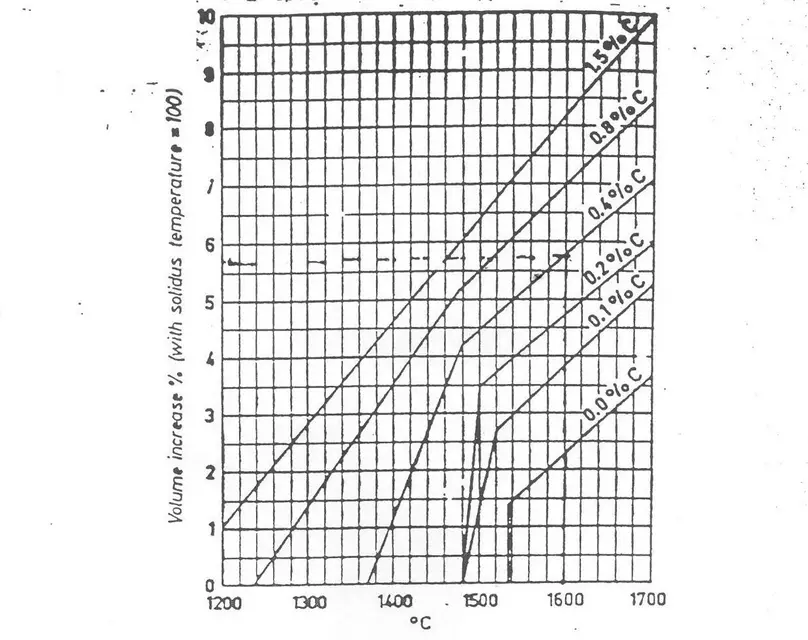
the withdrawal in liquid phase calculation according to two parameters (other attachment): the molten temperature and the percentage of steel. In this case, reading on the chart, I get a withdrawal rate of about 4% (1.8% is related to the solid phase).

with regard to the speed of cooling, the method of hoover circles, having some limits (circles in the plane, approximation of non-circular geometries, etc.), was, in this specific application (but also in general, from what we were told) replaced by the method of thermal modules.

for the method of the modules it is necessary to divide in subfolds the total volume, and to calculate for each subvolume effective exchange surface and volume
I needed help to calculate exchange surfaces and volumes of the individual subvolumes, I don’t know how to use the software well and I didn’t find a function to find the subvolume of an area and the total external surface not common to other surfaces (I managed it a bit slender, drawing the edges of the surfaces where it does not happen exchange as you can see in one of the previous slides).

2 coolers were provided (in 2 and 4) and an insulating system (in 1) so that you can put a single central materozza (in 3), sized according to the table (in input I have the thermal module of the materozza, obtained by multiplying by 1.2 the thermal module of zone 3). the objective is to have in the central area the highest module (superied only from that of the materozza) and the increasingly smaller modules away from it, remembering in any case that the module of two adjacent areas should not differ more than 30%.

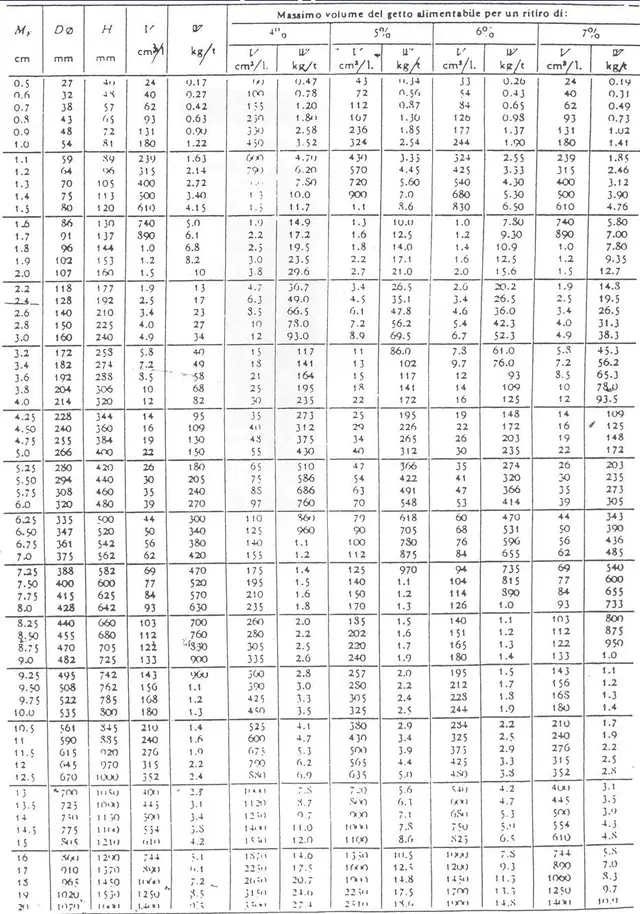
I have a table (alleged) in which, entering with the thermal module and the percentage of withdrawal of the liquid, I obtain a series of information on the materozza (in the table it is assumed that it is cylindrical) including dimensions and maximum feedable volume. if the volume of the jet is lower than the maximum volume feedable by the materozza you can use a single materozza (in my case it turns out that it is enough a materozza, since the volume to be fed, that is the volume of the crude, is about 3liters and the materozza that corresponds to the module to us useful is able to feed 3.8litri).

do you know a software that can help me calculate directional solidification alternative to modules method and hoover circles? Is there a solidworks function I can do with?

I hope I have made some clear why some of my previous statements. I see to finish all the procedure and prepare a presentation that I will attach in order to better verify any inconsistencies and errors.
 

Attachments

  • TabellaAnime.webp
    TabellaAnime.webp
    91.9 KB · Views: 23
  • TabellaMaterozzeCilindriche.webp
    TabellaMaterozzeCilindriche.webp
    220.2 KB · Views: 23
  • TabellaVariazioneVolumeLiquido.webp
    TabellaVariazioneVolumeLiquido.webp
    124.1 KB · Views: 18
Hello there
Sorry the delay in the answer
then
All you've written at an academic level is fine
what I wanted to convey to you and that in reality a piece of this kind is produced more or less according to what sketch I posted
1 the prob of the soul big way dia 40
Actually, but how do you explain to the client that you can't put the soul on it because the table tickles you or shit says that you can't put it
by experience they answer you give me the drill pieces to the lathe etc.
in order to avoid the prog, the prob
when we talk about withdrawal 1.8 is the withdrawal to be applied to the model
for the withdrawal that you have calculated 4% and the reference for the calculation of the bats
mo in reality we put your weight 100kg it takes almost 50 kg of bats
if you have a spheroid cast iron, let's go to 14% of the molten weight
as you see the sole rightly teaches you the due
but practice is a different moment
when it comes to solidwork is a work tool that helps you perform your work
but you have to put it on your own
However if the moderator of the sw area can indicate any form for foundry
a useful program for foundry and magma
Thank you very much
 
first of all thank you again for the answer.

as soon as I finish the exercise load here also the pdf file so you can tell me what you think.

to this address: https://forum.solidworks.com/message/325345 are found various software for the foundry, but I don't know what to choose, among other things they are all paid if I didn't understand badly.
 
try using the procast for casting simulation... It's great. to get the central hole you need a central soul.... what kind of casting do you want to use?
 
Thank you, too. I sent an email to more than one software house including esi italia (procast) to know if they have versions of their software for students. I also found at least one software in non-original version, but I have no software not original in the pc (among the few to have sw for students) and I would like to avoid installing it.

as casting I chose a casting from the bottom, by gravity, only attack (central ring), land with good performance. I almost finished the whole thing, and if I can, I'm trying to get a hand from the teacher tomorrow.
 

Forum statistics

Threads
44,997
Messages
339,767
Members
4
Latest member
ibt

Members online

No members online now.
Back
Top