• This forum is the machine-generated translation of www.cad3d.it/forum1 - the Italian design community. Several terms are not translated correctly.

Soppalco sizing

  • Thread starter Thread starter lelepanz
  • Start date Start date
I start with your last statement.
in the civil field the tas are no longer used unless, I think, in limited cases, see here:http://www.edilnotizie.it/2009/05/n...-14-gennaio-2008-in-vigore-dal-1-luglio-2009/will your loft be deposited? You should contact the technical office of the municipality where the artifact will be installed.
Either way, I don't know them, and I couldn't help you.

coming to the study in question I imagine that a and b you have already sized them (you have made a due assessment of the loads agents and distributed for the zones of influence).
If you have done the above you are able to study the beam c.
I'm telling you that now you have only one part of the actions that push the mountaineers (and the fixings to the ground), to have all the actions you have to study also the beam d.
You will conclude that the mounts are subject to deviated displacement.
Hi.
Okay.
Thank you.
We start from the first point:
I don't have to deposit anything, so it's good for me to dimensionalize with the ta method.
a and b I sized them starting from the assumption (perhaps wrong) that they are 2 beams stuck at the ends subjected to 4 loads concentrated in proximity to the supports of the feet (as from drawing attached).
then carry the binding reactions of the beams to and b on c.
and the beam will be subject to bending-torsion (imagining it stuck).
Right?
 
Okay.
Thank you.
We start from the first point:
I don't have to deposit anything, so it's good for me to dimensionalize with the ta method.
a and b I sized them starting from the assumption (perhaps wrong) that they are 2 beams stuck at the ends subjected to 4 loads concentrated in proximity to the supports of the feet (as from drawing attached).
then carry the binding reactions of the beams to and b on c.
and the beam will be subject to bending-torsion (imagining it stuck).
Right?
In fact, I wondered what those green rectangles were:biggrin:, I thought about pillars, but I was convinced that I had no intermediate support.
if it is so the static scheme to solve to (or b) is quite complex, it is a 5 span beam doubled with a distribution of uneven loads, I looked on my texts but I did not find solution for such a complex hyperstatic.
Perhaps you should simplify, for example, studies the most stressed section among the 5 that make up the beam, treating it as doublely framed beam subject to uniform load, for the action on and studies the travail that insists on it; It is useless to argue so much to find the above solution since in the continuation you will have to make choices and simplifications that will move you from the real case. first choice you have made is to consider the beam a (and b) doublely framed, I think it is fine, but it is precautionary for bending stresses.
for the rest is ok, remember, however, before facing the pillars to the knots 1,2,3 and 4 to study the beam d.
Hi.
 
Hello and excuse the new delay.
I read your message.

But I could also simplify this:
Let us imagine that we have no secondary beams I study the beam a and b normally.
and I throw binding reactions of a and b on c. mi studio c.
Now we imagine that we only have secondary beams (which will also be smaller than a and b).
I'm studying long beams at this point.
I basically "oversized" all the beams, then finding myself on the side of reason, didn't I?

because in theory at the intersection of the beams to with the perpendicular in a certain pedestal, the force goes to end in percentage x on the beam to and in percentage y on the perpendicular one.

If I divide the beam a and b into 5 "subtraves" as you told me, what weight do I consider for example in a stretch?
I could also believe that the force acting on the single stroke is the sum of the weight that acts on the two feet that delimit its exterminities.
I could also have her act in the center of the beam that "deformation" is the worst case.
otherwise we lifted the 2 "delimiting" weights / beam length and see what can happen.

Now I'm doing some evidence.

question 2 : is it better to make continuous beams 2 long beams a and b or their perpendicular ones?
 
I am going to ask you something:
[U%s causes 300 - [/U]condition condition incastro-incastro at the ends (as from attached image). the distributed force is the weight of the beam. the concentrated forces are the loads transmitted to the ground from the machine ( assuming that only these 2 beams exist).
I find in the node h and in the node k the binding reactions.
I find deformed at the maximum point (about half beam). the value is about 1.17 mm.

in subsequent graphs I bring you momentum and vertical force value transmitted in junction knots with the main beams.
a vertical reaction is transmitted to the main beams + a moment. I take greater binding reactions.
Question: Can you study the beam and consider only vertical actions and study separately the flexo-torsional instability?
 

Attachments

  • TRAVE_A-CARICHI - [INCASTRO].webp
    TRAVE_A-CARICHI - [INCASTRO].webp
    45.3 KB · Views: 24
  • TRAVE_A-DEFORMATA - [INCASTRO].webp
    TRAVE_A-DEFORMATA - [INCASTRO].webp
    47.2 KB · Views: 16
  • TRAVE_A-NODO-K - [APPOGGIO].webp
    TRAVE_A-NODO-K - [APPOGGIO].webp
    25.3 KB · Views: 14
  • TRAVE_A-NODO-H - [INCASTRO].webp
    TRAVE_A-NODO-H - [INCASTRO].webp
    49.3 KB · Views: 16
case supported in this case you can see how deformed takes on more important levels. in fact it goes to about 5.5 mm as a max arrow.
but the support-supporting bond also transmits different forces (as from attached image) and in particular to the exterms does not take any moment. Right?

If I make a pure verification,
sigmax = mmax/wf = 31.000.000.000 (n*mm)/557 (mm^3) = 55.65 n/mmq.
 

Attachments

  • TRAVE_A-DEFORMATA - [APPOGGIO].webp
    TRAVE_A-DEFORMATA - [APPOGGIO].webp
    40.4 KB · Views: 11
  • TRAVE_A-NODO-K - [APPOGGIO].webp
    TRAVE_A-NODO-K - [APPOGGIO].webp
    25.3 KB · Views: 8
  • TRAVE_A-MOMENTI - [APPOGGIO].webp
    TRAVE_A-MOMENTI - [APPOGGIO].webp
    21.7 KB · Views: 8
grass c e d.I'll take the worst case.
I have done the two cases: incaster and support.
through then the moments transmitted by a and b I can study the flexo-torsianel instability. Right?

and then, the beam c and d must then be divided, and bolted into the yard through plate.
How can I behave in this case?

the moment to be transmitted is that on chart, so I can size plate and bolts (especially the latter) that must transmit the calculated moment. Am I right?
 

Attachments

  • TRAVE_C-DEFORMATA - [APPOGGIO].webp
    TRAVE_C-DEFORMATA - [APPOGGIO].webp
    56 KB · Views: 9
  • TRAVE_C-DEFORMATA - [INCASTRO].webp
    TRAVE_C-DEFORMATA - [INCASTRO].webp
    25.9 KB · Views: 6
  • TRAVE_C-NODO1 - [INCASTRO].webp
    TRAVE_C-NODO1 - [INCASTRO].webp
    27 KB · Views: 5
  • TRAVE_C-NODO2 - [INCASTRO].webp
    TRAVE_C-NODO2 - [INCASTRO].webp
    24.4 KB · Views: 11
But I could also simplify this:
Let us imagine that we have no secondary beams I study the beam a and b normally.
and I throw binding reactions of a and b on c. mi studio c.
Now we imagine that we only have secondary beams (which will also be smaller than a and b).
I'm studying long beams at this point.
I basically "oversized" all the beams, then finding myself on the side of reason, didn't I?
I would not adopt this simplification, it leads you to a huge oversized.
the secondary ornamentation, of connection, is not constituted by a beam but by pieces of beams that converge on the beams a, b and of discharge on the pillars.
because in theory at the intersection of the beams to with the perpendicular in a certain pedestal, the force goes to end in percentage x on the beam to and in percentage y on the perpendicular one.in general the beams of connection with the load are not sized, we say that they only hold themselves and the load due to the elements that constitute the structure; In your case, however, the structure seems weak in the connection between a and b :confused: attentive to the intersection between a and b, among other things there is also bolting. try to make a bug as from the following procedure.
If I divide the beam a and b into 5 "subtraves" as you told me, what weight do I consider for example in a stretch?
I could also believe that the force acting on the single stroke is the sum of the weight that acts on the two feet that delimit its exterminities.
I could also have her act in the center of the beam that "deformation" is the worst case.
if you do not find explicit the static scheme of a beam to 5 doublely framed, but also hinged could go, loaded by uneven load (I arrive at 3 camps) I would go to look for the worst case (oversized), that is where a trait of beam is located "cover" of the above machine, then:
weight of the machine/sqm of its projection in plant=a
a/width flu band=q
use q as a distributed load for the double framed beam.
of course you must also evaluate the weight of the structure and accidental loads.
otherwise we lifted the 2 "delimiting" weights / beam length and see what can happen.
non ho capito :confused:
question 2 : is it better to make continuous beams 2 long beams a and b or their perpendicular ones? given the size in the plant that are comparable is that it changes much, it is enough to reshape the main and secondary vegetable.
 
I'm basically "oversized" everything.
I would not adopt this simplification, it leads you to a huge oversized.
the secondary ornamentation, of connection, is not constituted by a beam but by pieces of beams that converge on the beams a, b and of discharge on the pillars.
In practice you tell me that usually the secondary ornament the only weight you have to bear is the weight of the primary beam?
However, it would seem right to size a and b as if they were not "supported" by other secondary beams. also because a and b in the center is not supported on anything.
in practice the beams a and b are supported only to the exterminities and inside there is nothing).
then on the beam there end the 2 forces that I found (due to the weight of the machine and the weight of the beam) while on what end? go to finish 5 forces that are the binding reactions due to the weight of the beam itself and the primary beams?
so until the sizing of c should be correct cmq, right?
then sized d and carry the bonds to the knots, right?
And the traversies?
in general the beams of connection with the load are not sized, we say that they only hold themselves and the load due to the elements that constitute the structure; In your case, however, the structure seems weak precisely in the connection between a and b attentive to the intersection between a and b, among other things there is also bolting. try to make a bug as from the following procedure.
Unfortunately, as from attached image, we usually split the loft in 2 half. and the division takes place both for the big beams and for the connecting traversines.
the intersection between a and b is the intersection that is on the feet of the machine.
How can I proceed for the sizing then of bolts?
if you do not find explicit the static scheme of a beam to 5 doublely framed, but also hinged could go, loaded by uneven load (I arrive at 3 camps) I would go to look for the worst case (oversized), that is where a trait of beam is located "cover" of the above machine, then:
But is it right to hypothesize the beam to like a 5 span beam?
always if I realized it's the one with five camps.
in practice the green rectangles (the famous rectangles) are not columns, but the support points of the machine above the mezzanine).....

Question : On the beam there are two vertical binding reactions or should I also have a torque moment (i.e. the binding reaction of the beam to the disaster with c) ?
or I go to check only the local flexo-torsional instability.

question 2 : the columns.
in theory on the columns goes to finish a vertical component and a moment (which is the binding reaction of c + in theory what I get from d).
What is the static scheme to solve the columns?? which will logically be subjected to deviated compression.

Question 3 : You talked about accidental loads. How much must they amount?
 

Attachments

  • MEZZO_SOPPALCO.webp
    MEZZO_SOPPALCO.webp
    36.5 KB · Views: 27
in practice the green rectangles (the famous rectangles) are not columns, but the support points of the machine above the mezzanine).....This is a node of the matter, sorry I misinterpreted the scheme.
So as not said for the static scheme of a (or b) (traves to 5 doublely framed camps)....it turns out all much easier....maybe you could have made me notice first misunderstanding :biggrin:
in fact you would have had a saddle of useless pillars
I'm running now, I'm calmly concerned.
Hi.
 
in practice the green rectangles (the famous rectangles) are not columns, but the support points of the machine above the mezzanine).....This is a node of the matter, sorry I misinterpreted the scheme.
So as not said for the static scheme of a (or b) (traves to 5 doublely framed camps)....it turns out all much easier....maybe you could have made me notice first misunderstanding :biggrin:
in fact you would have had a saddle of useless pillars
I'm running now, I'm calmly concerned.
Hi.
when I read well and carefully what you meant for 5 camps I said... but maybe we are confusing... hehe...
I'm sorry...
 
when I read well and carefully what you meant for 5 camps I said... but maybe we are confusing... hehe...
I'm sorry...
:biggrin::biggrin: go again.

I would take the simplification of considering the discharge beam (only structural loads), which simplifies your life because you have to study only the most solicited to and c and on the pillars evaluate the only actions deriving from c.
we proceed:
depending on the interaxes you have the influence zones on a (=b), you will get a band width l (symmetric for simplicity, even if it is not).
for the beam I would adopt the static scheme of a beam doublely framed with uniform load in the central area ( easier to find, but if you have or build a beam scheme doublely framed with 4 concentrated loads so much better).
the load agent q (the car, I discard the own weights, but you do not:finger:!) goes 1⁄2 up to and 1⁄2 on b.
therefore your q (kg/m) will be (q/2)/l.
calculations binding reactions, moments of disaster and max time.
now you have the actions on the portal (constituted by the beam c and the pillars on which it is mounted).
the reactions you had found on to are the normal loads on c and those reactions, using a static pattern that you find quietly in literature, you study the portal.
In addition, you will have the moments of encroachment of what are the torque pairs for c and flender, on the orthogonal plane to the portal, for the pillars (subject to deviated displacement).
Hi.
 
:biggrin::biggrin: go again.

I would take the simplification of considering the discharge beam (only structural loads), which simplifies your life because you have to study only the most solicited to and c and on the pillars evaluate the only actions deriving from c.
we proceed:
depending on the interaxes you have the influence zones on a (=b), you will get a band width l (symmetric for simplicity, even if it is not).
for the beam I would adopt the static scheme of a beam doublely framed with uniform load in the central area ( easier to find, but if you have or build a beam scheme doublely framed with 4 concentrated loads so much better).
the load agent q (the car, I discard the own weights, but you do not:finger:!) goes 1⁄2 up to and 1⁄2 on b.
therefore your q (kg/m) will be (q/2)/l.
calculations binding reactions, moments of disaster and max time.
now you have the actions on the portal (constituted by the beam c and the pillars on which it is mounted).
the reactions you had found on to are the normal loads on c and those reactions, using a static pattern that you find quietly in literature, you study the portal.
In addition, you will have the moments of encroachment of what are the torque pairs for c and flender, on the orthogonal plane to the portal, for the pillars (subject to deviated displacement).
Hi.
Okay, thank you very much.
If you see more above the beam a and the beam b I have just verified it as double-ink beams with concentrated loads.
vertical binding reactions ended on the beam c (through them I will study as you said the portal).

I miss the beam but I have to check the trivial bending (vertical reactions) or I have to throw in the torque moment.

if it comes to the torque moment... how should it be verified (as red becomes:redface:?
a brutal tau=mt/wt and equivalent sigma : radq(sigmaflex^2+3*tau^2) me the cable?
and the torque moment (flender for the pillars) is then what will tend to tear bolts on the right columns?
 
I can't say that I can't: in theory it would be necessary to verify the lateral instability of the transom.
the tau=mt/wt has nothing to do with...
 
I can't say that I can't: in theory it would be necessary to verify the lateral instability of the transom.
the tau=mt/wt has nothing to do with...
or it is recommended to calculate the tau on each section of which the beam is composed.
 
I miss the beam but I have to check the trivial bending (vertical reactions) or I have to throw in the torque moment.
If the torque moment comes in... how should it be verified?
a brutal tau=mt/wt and equivalent sigma : radq(sigmaflex^2+3*tau^2) me the cable?
That's right. you use von mises (3tau), but you may also use tresca (4tau) which is more prudent.
and the torque moment (flender for the pillars) is then what will tend to tear bolts on the right columns?Yes, the moments at the node of the portal stress bolts.
in theory it would be necessary to verify the lateral instability of the inflection beam.
the tau=mt/wt has nothing to do with...
I send you to par 7.4.1.2. of the cnr uni 10011, so you value diverted displacement and instability.
If you want to evaluate even the slippage, but it seems excessive, see par 7.4.2
Hi.
 
That's right. you use von mises (3tau), but you may also use tresca (4tau) which is more prudent.
Thank you.
a question about the wt though? I can't find anything on the ipe. it is possible to "summare" the individual rectangles of which the section is composed and finally sum the tau found?
or... where can I find the wt of an ipe?
 
Thank you.
a question about the wt though? I can't find anything on the ipe. it is possible to "summare" the individual rectangles of which the section is composed and finally sum the tau found?
or... where can I find the wt of an ipe?

I think there's nothing to do with the table, but you'll have to do the calculation.

τ max = (mt / it) * bmax
bmax is the maximum thickness of the various rectangle components the section
it is the factor of torsion stiffness – it = signa*b^3 (a and b are the size of rectangles, b is the thickness)

wt = en/bmax
Hi.
 
Thanks :)
.
here if you can interest a sections profile. with also jt for open sections:http://www.google.it/url?sa=t&sourc...sg=afqjcnf7f3ls2g1lt8v6f1dzetpqty4c3w&cad=rjacmq is evident that these open sections badly bear torsion.
now I try to verify, otherwise I change bond with support-support and joint type zipper.
or nerve and kick the joint.

In practice (if my accounts are correct) with a mt=21.3kn*m (which is the binding reaction calculated at the time) I would have a tau=2.36 kn/mm^2 (only tangential effort).
in practice they are out only with this, but I should cmq use "enormous" profiles to be able to have the torsion verification....
Things are 2:
or cmq cross-sections help to "compensate the torsion" or as mentioned before I must assimilate the joint to a hinge.
 
I send you to par 7.4.1.2. of the cnr uni 10011, so you value diverted displacement and instability.
If you want to evaluate even the slippage, but it seems excessive, see par 7.4.2
Thank you.
I studied the column both with a heb200 and with a heb220.
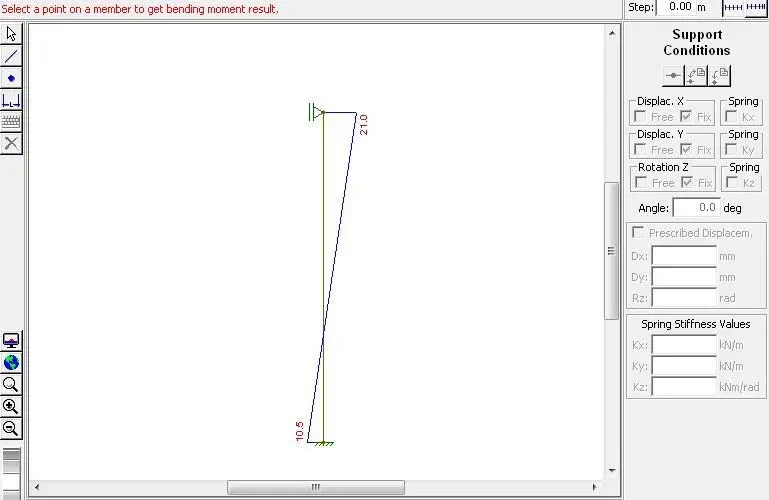
I have reported both on x and on y at the same time (21 kn*m which is the value of the flender moment "ported" from the beam c incastro-incastro), remaining on the side of the reason. among other things the moment on y (only door structure is about an order of magnitude less than the actual).

if instead I consider the front portal I have a flenching moment of about 13 knm.
from attached image I studied precisely slenderness, w, sigmacr, according to the formula of chapter 7.4.2 of the cnr 10011.

I have a doubt what is the right time value to use?
meq= 1.3 mm?
where mm is the upper and lower middle moment (21 above and 10.5 below) according to chapter 7.4.1, or should I use the pure mf (21 knm) ?
I hope I've explained... or perhaps brings me in confusion the chapter 7.4.1.1...
 

Attachments

  • PORTALE-FRONTE.webp
    PORTALE-FRONTE.webp
    14.2 KB · Views: 24
  • COLONNA_FORZE.webp
    COLONNA_FORZE.webp
    23.4 KB · Views: 9
  • COLONNA_MOM.webp
    COLONNA_MOM.webp
    20.6 KB · Views: 8

Forum statistics

Threads
44,997
Messages
339,767
Members
4
Latest member
ibt

Members online

No members online now.
ciao
Back
Top