
• This forum is the machine-generated translation of www.cad3d.it/forum1 - the Italian design community. Several terms are not translated correctly.

"sponse of the framework" command

  • Thread starter Thread starter cacciatorino
  • Start date Start date

cacciatorino

Guest
What I've lost so far to not knowing this command is very powerful! :-)

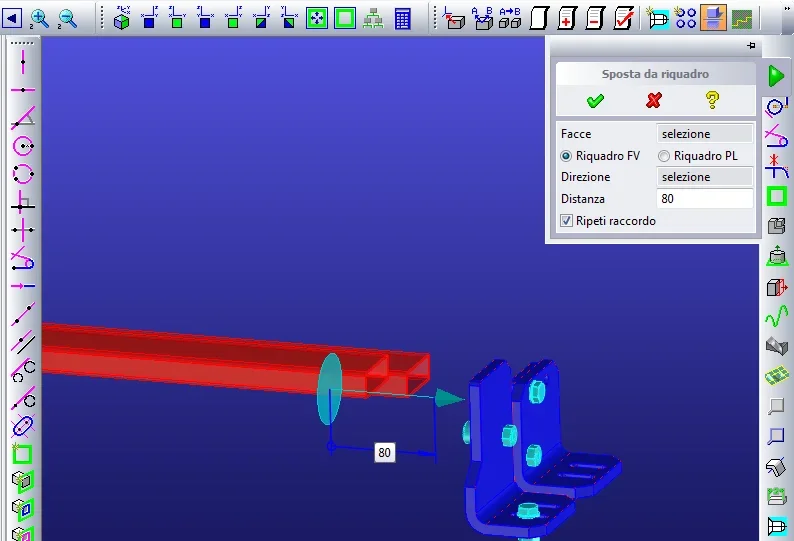
practically I draw a window of elements to move: the elements entirely included in the window (parts or groups) are moved, instead those partially included are ironed.

example: in one shot I can stretch a column, moving the flange and end screws, and ironing the tubular. It's a command that really speeds up work, publishes this post for the benefit of those who didn't know him. . .
 

Attachments

  • Immagine.webp
    Immagine.webp
    35.2 KB · Views: 19
What I've lost so far to not knowing this command is very powerful! :-)

practically I draw a window of elements to move: the elements entirely included in the window (parts or groups) are moved, instead those partially included are ironed.

example: in one shot I can stretch a column, moving the flange and end screws, and ironing the tubular. It's a command that really speeds up work, publishes this post for the benefit of those who didn't know him. . .
It was enough for me to ask............the old one a little command from nothing, I consumed it.......:redface:
 
I try to explain. the command is completely disrespectful of the structure of the groups. Imagine having a subgroup, if you move it by selecting the structure, you move its image into your group, with the window command you move all the components that will move even in shared groups. try to see how the mm reacts. Of course if you work with u pkg.... :-)
 
I try to explain. the command is completely disrespectful of the structure of the groups. Imagine having a subgroup, if you move it by selecting the structure, you move its image into your group, with the window command you move all the components that will move even in shared groups. try to see how the mm reacts. Of course if you work with u pkg.... :-)
Actually, if the group is fully understood in the window, it is moved to the level of its reference frame, that is to say that the instances shared outside the box are not touched (perhaps the command has been perfected compared to the past).

if the window only includes some components, if they are under pdm I am forbidden the change in case the group is not reserved. If the group is reserved or I work outside the pdm I don't know, I didn't try.
 
I also work very well and often use it, the only problems can be when there are shared parts oriented opposite to the direction of deformation and when a part contains inside a container, instead it should work well if the end part is linked to a stock part.
But be careful that, at least until version 17, the function moves from pane is unbalanced when a configuration is activated.
 
I associate myself with what I said from hunter, I just tried this command on a text set and the modification I wanted to make was performed in lightning. what is reported in the help is quite explicit: "When moving a face, the geometry attached to it extends so as to increase or reduce the size of the part. If you select groups or whole parts to move with your face, the parts will be repositioned." This soliddesigner really starts to like me;)
 
describe, often share solves (at least in part) the problem.
I don't know where to start, it's just a continuous succession of small hitches... I don't even know if it's the fault of cad or pdm, or the management of the site too complicated, because since I use cocreate I spend 30% of the time solving various problems or looking at the wheel that turns, while when I used solid edge or solidworks the working time was working time and not maintenance time. Sincerely today I'm a little discouraged, it'll be the fault of too close project deadlines that I don't know if I'm gonna be able to respect because of this vague cad mine that stops too easily. ...
 
I don't know where to start, it's just a continuous succession of small hitches... I don't even know if it's the fault of cad or pdm, or the management of the site too complicated, because since I use cocreate I spend 30% of the time solving various problems or looking at the wheel that turns, while when I used solid edge or solidworks the working time was working time and not maintenance time. Sincerely today I'm a little discouraged, it'll be the fault of too close project deadlines that I don't know if I'm gonna be able to respect because of this vague cad mine that stops too easily. ...
but it would not be better to work "off-line" and then insert the projects from the customer, I have the impression that the management of the consignment to the pdm is, in fact, ineffective.
 
but it would not be better to work "off-line" and then insert the projects from the customer, I have the impression that the management of the consignment to the pdm is, in fact, ineffective.
No, this is not possible because I have to continuously access the database for questions or reuse of library parts.

p.s. better explain:

The problem is that the model manager database is encrypted. When I work with solid edge, I replicated the library file folder on my server, which are simple side files. being clearly visible on the file system, I don't need to question the sql server to know that the part "vite teci m8x16" corresponds to the file d:/cocreate/file_storage/xwtr34/asq3w/pokrte/45lkipe.sdp.
with solid edge or solidworks I simply take it from the folder d:/libreria/viti/tcei/ and drag it into the cad.
 
I would not like to appear too far, but once again I agree with the President. I work on a single cad station, so I do not use mm, and without exaggerating using osd I would say I almost doubled productivity. abandoning the parametric, I spend less time editing quotas and setting father-son ties with all the speech of the addictions that follows, moving/replaceing a component in a set does not fall all, and slowly I am discovering several commands that in proe manco I dreamed of them. everything depends on what you have to accomplish, of course, regarding my current activity without doubt I can say that osd is 100% suitable for my needs. then generating development in .mi format, it obviously interfaces perfectly with trutops, and also this is another advantage. the only aspect that still appears to me obscure, is how to associate the parameters (spearing to the proe) to each part/axieme. in the chart see position/name/quantity is often insufficient, and to customize some characteristics of osd you have to jump to headfit on the lisp almost as if they say "ok, do you want to customize your projects? by yourself you can't do it, turn to a company that advises you ...", but this attitude has also decreed the end of eit, and however now remains nothing but to arrange and deepen some themes from self-taught, otherwise here is an endless monetary outlay:)
 
almost as if they say "ok, do you want to customize your projects? by yourself you can't do it, turn to a company that advises you ...", but this attitude has also decreed the end of eit, and however now remains nothing but to arrange and deepen some themes from self-taught, otherwise here is an endless monetary outlay:)
You hit the subject. As long as you adapt to basic use, i.e. tecnigraph 3d, osd is fine (yes to say). as soon as you try to go in the direction of design automation begin the pains: all things for which with osd you have to pay a programmer, such as creating a self-compiling cartiglio or a table layout list parts, with other systems are within reach of the common user.

Sincerely, you have to edit lisp files for any minimum customization, with the risk that if you are wrong to put a comma or if you use notepad instead of notepad++ then you don't leave anything anymore, it seems to me a legacy of an unix world that now has no right to citizenship.
 
hunter, I agree to 1000% with what you said, it is also known that the syntax lisp is not the easiest to manage, today 99% of the cads (in fact all except osd), load system dll that you can write in any programming language, typically vc++. not a madman would use osd for design automation, as callaghan said "every man must know his own limits" ...;) as to the speech of the encrypted db, I would say that "crypt" likes the genial minds of ptc, perhaps because it remembers the crypttonite and makes them feel of the supermen :) at the time of intralink, the files were clearly stored in the massive wscriptscript client, after with wc everything was encrypted use. this is the contagious trend, don't be surprised if soon sw and if they cript everything. They're all in agreement, and marketing isn't in charge. Just sell.
 
as to the speech of the encrypted db, I would say that "crip" likes the genius minds of ptc, perhaps because it remembers the crypttonite and makes them feel supermen :) at the time of intralink, the files were clearly stored in the client ws, after with wc everything was encrypted, with massive use of javascript+html+sql wisely mixed. this is the contagious trend, don't be surprised if soon sw and if they cript everything. They're all in agreement, and marketing isn't in charge. Just sell.
I don't see her like that. encrypted db is a methodology of work by large companies, made specifically to prevent designers stealing projects by copying them on a key or similar. ptc and osd come from an ancient world in which these systems were used only by large corporations in which the use of sequel-based pdms was the norm, in fact they have data storage systems that without pdm become hardly manageable.

modern windows-based products save on file-systems and continue to do so, because they are born for small companies where if you talk about encrypted databases you are immediately accompanied to the door.
 

Forum statistics

Threads
44,997
Messages
339,767
Members
4
Latest member
ibt

Members online

No members online now.
Back
Top