• This forum is the machine-generated translation of www.cad3d.it/forum1 - the Italian design community. Several terms are not translated correctly.

subsquadro panel

  • Thread starter Thread starter jugerman
  • Start date Start date

jugerman

Guest
Hello everyone, I am new to the forum and I would like a quick advice.
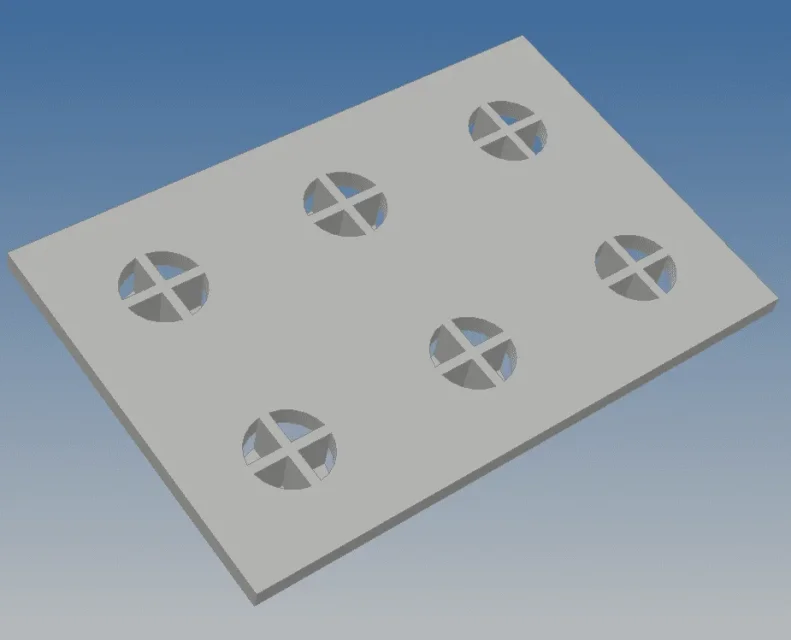
I am now approaching industrial molding and I would like to know from an allied eye if the attached piece can be produced for molding as reported.
what steps should I use to achieve this result? is it possible to create a plastic panel that has such protrusions? Thank you.Pannello_superiore.webp
 
it is not simple but you can do it.
It also depends on the wholeness and size of those "sports".
there are also many other considerations to be made, any deformations, retreats, junction lines etc.
 
to do it you do but make it stay straight is another story... If you can't post the model at least a couple of photos with 4 odds just to figure out if we talk about meters or cm, try to insert ribs and post a lower view and a section with listed thicknesses.
 
to do it you do but make it stay straight is another story... If you can't post the model at least a couple of photos with 4 odds just to figure out if we talk about meters or cm, try to insert ribs and post a lower view and a section with listed thicknesses.
You're right, the only photo is useless for an evaluation.
we are talking about a 200x300 mm panel that will have to constitute the top panel of box to contain e-commerce packages. I press that this is only a draft, I will certainly have to improve in terms of thicknesses and ribs.

I attach a pdf with quotas. just to understand the method, could you tell me summarily what needs to be improved and what measures should be taken so that such geometry can be realized?
Thank you very much for the answers.
 

Attachments

the first thing I know is that you have very different thicknesses between them, this leads to retreats that, aesthetically, may not be acceptable.
I would try to uniform them by creating a plot of ribs in the base and replacing the ø16 with a cross or similar in order to have the same thickness.
there is then the subsquadro speech on the heads of the pins, 12 mm of running are not few.
There are systems on the market to open subsquadri of the genus but I doubt they make such a big race.
the solution can be to make trolleys but you have a number of difficulties.
First of all the space is not much, then you have to invent a wedge that moves the same and also makes part of the figure, specifically on the plane.
With this system, however, you'll have some lines of junction of the trucks themselves on the floor, and I don't know if it's acceptable.
 
I confirm what technomodel said, rinse the base to keep it straight, try to keep the nerves at 1/3 of the thickness to reduce the deformations due to resurface and weight. the space for trolleys is very little interpella who will build the mould to verify feasibility. I don't know what it is to have this panel or the numbers you need to develop, it's not a simple mold eye to costs. choose a loaded material helps to contain the retreats and maintain the squadrons. as you define the model helped with a simulation of streams that can also highlight the rites and post molding deformations.
 
elements that are placed from the panel, leaving aside the use, must be able to sustain at least the total weight of the container + its content. for this at the moment I'm considering oversized thicknesses, I'm not very familiar with plastics.

What software do I recommend to use for stream simulation, which is intuitive and easy to use?
 
simulation software are not many, Moldovaflow, Moldovaex 3d, visi flow and little more.
are expensive and not quite intuitive software, especially for those who do not have good bases related to molding.
without these maybe some nice colored bar pulls out, the interpretation of the results is then another question.
also because the same are influenced by the input data.
 
as software I use solidworks that has a part dedicated to the molds and plastic dedicated to simulations, it is not at levels of Moldovaflow but is reliable regarding the simulation of the flow and a discreet idea of post-extracting deformations. it is not difficult to use but if you do not have molding experience you will struggle to interpret the results and enter the parameters. With regard to the material to be chosen, it is essential to evaluate the use and the working environment, the characteristics of ''plastica' are infinite, impact resistance, traction, acids/hydrocarbons, extinguishing cars etc. you may need a 2 euro/kg pp or need a 50-50 carbon fiber pa from 20 euro per kg. If you are approaching the mold you are advised by the printer and/or the tool that will then do the job. It is an environment where experience is slowly looking and listening and where errors pay dear.
 
If the round heads are not indispensable, you can obtain ellipses by making the subsquadra part on the opposite side. the mold would be a simple open-close without movements. but you find the exhaust holes on your face.
if all this is acceptable you no longer have dimensional constraints (other than various retreats)
 
If the round heads are not indispensable, you can obtain ellipses by making the subsquadra part on the opposite side. the mold would be a simple open-close without movements. but you find the exhaust holes on your face.
if all this is acceptable you no longer have dimensional constraints (other than various retreats)
I don't understand how you suggest you make those pins.
 
I don't have a Cad right now.
My suggestion is this: instead of a cylinder surmounted by a larger disk (your drawing) realizes a cylinder surmounted by two protuberances (seen in section one t) and the two parts that would undersquadra ler revenues for male-female intersection of the mold. but this creates holes on the plate. the mold is certainly much easier to make and you are much more free on the size of these protuberances.
I hope I've been quite clear.
 
if you agree to drill the base, you can maintain many more details of the original project. See below.
Cop1.webp
Cop2.webpIt should be said, however, that this is not a particular feasible as well as designed. making a 10 mm thick base in injection is an absurd, they are things that you do not. The other 5 mm thicknesses are also useless if not unrealizable.

the design of these details requires knowledge of the basics of thermoplastic injection: the fluid dynamic simulation plug-in on the cad is not enough to become designers!
 
the solution with the four discharges, for normal thicknesses (3-4mm), I see a little weak. It should also be understood what loads should actually hold. Moreover, done in this way, the protrusions are missing that allow to cling objects. It seemed necessary.
I agree that the thicknesses indicated in pdf are absurd and would lead to a completely deformed piece.
as already suggested by others: download the thicknesses to 2 or 3mm (low command) and add reinforcement ribs of max 2mm.
about the material: pieces of this size can get them with abs, pp or pp+fv; depends on the cost you want and the mechanical characteristics you need.
I'm a warning: you can't change material once the mold is done, so settle with a molder which is the most suitable one.
In reality you can change the material even after, but the retreats are different and also the final behavior is different (you can find a piece too small that dances in the home or the pins that do not do their work optimally). and be careful not to change the stamping cycle (maybe to accelerate production): also this has a strong influence on the final piece.
Finally, I agree that a programme is not enough to make a designer.
for my experience, when I had to make a new piece that presented critical points, I made a sketch to discuss it with the trusted molder (or who would later make the mold): Some solutions do not know them and others do not recommend them.
 
I don't have a Cad right now.
My suggestion is this: instead of a cylinder surmounted by a larger disk (your drawing) realizes a cylinder surmounted by two protuberances (seen in section one t) and the two parts that would undersquadra ler revenues for male-female intersection of the mold. but this creates holes on the plate. the mold is certainly much easier to make and you are much more free on the size of these protuberances.
I hope I've been quite clear.
ora ho capito, buona idea.
 
the solution with the four discharges, for normal thicknesses (3-4mm), I see a little weak. It should also be understood what loads should actually hold. Moreover, done in this way, the protrusions are missing that allow to cling objects. It seemed necessary.
I agree that the thicknesses indicated in pdf are absurd and would lead to a completely deformed piece.
as already suggested by others: download the thicknesses to 2 or 3mm (low command) and add reinforcement ribs of max 2mm.
about the material: pieces of this size can get them with abs, pp or pp+fv; depends on the cost you want and the mechanical characteristics you need.
I'm a warning: you can't change material once the mold is done, so settle with a molder which is the most suitable one.
In reality you can change the material even after, but the retreats are different and also the final behavior is different (you can find a piece too small that dances in the home or the pins that do not do their work optimally). and be careful not to change the stamping cycle (maybe to accelerate production): also this has a strong influence on the final piece.
Finally, I agree that a programme is not enough to make a designer.
for my experience, when I had to make a new piece that presented critical points, I made a sketch to discuss it with the trusted molder (or who would later make the mold): Some solutions do not know them and others do not recommend them.
I agree, only precisely on the ribs, it is good to maintain the thickness within 75% of the thickness piece, better yet to 50%.
this to avoid retreats on the opposite surface.
 
I press that I am not a molding expert, but seeing your design comes spontaneously to me the question: is it really necessary to realize the component in a single piece?

I tend to make the pieces thinking about the technologies that I have in the house, I would have designed it as a simple sheet, drilled in correspondence of the "presins", eventualmente svasando or lamando the holes, and then realized the "presins" perforated and threaded axially, joining all with screws.

especially if it is a small prototypal production, save a lot on the cost of the mold.
 
without knowing how many pieces will be produced and what material should be made ( presumably) the particular, difficult to give sensible indications, at least in my opinion.
 

Forum statistics

Threads
44,997
Messages
339,767
Members
4
Latest member
ibt

Members online

No members online now.
Back
Top