
• This forum is the machine-generated translation of www.cad3d.it/forum1 - the Italian design community. Several terms are not translated correctly.

sudden breakage tubular arm

  • Thread starter Thread starter UnderPressure
  • Start date Start date

UnderPressure

Guest
Hello everyone,
I hope this discussion is not off topic, however in these days there was a terrible incident in ohio where a carousel called "fireball" caused the death of a boy and the wounding of other 7 visitors because of the sudden breakup of a metal arm carrying 4 passengers.
Unfortunately the chilling video has made the round of the world and is useful to understand those could be the causes of sudden breakup, since you feel very distinctly a bang at the time of breakup.
at the moment the media have advanced some theories that I think unfounded, since they speak of wrong welding performed, when instead from the photo that was published, it is well seen that the section did not present welding at that point.
personally seeing the photo, my theory is that very simply the internal oxidation caused a metal corrosion causing a decrease in the thickness of the box (has about 20 years of work, the carousel), up to the structural failure.
What do you think?
Thank you.
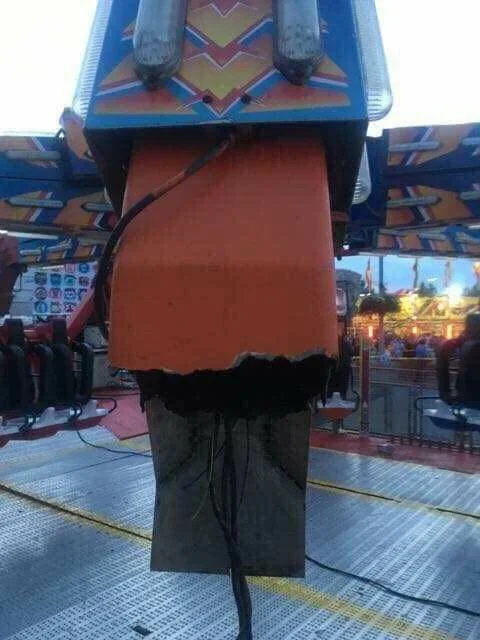
las.webp
 
I'm not sure I'm 20 years of exercise, these rides have been around for several years, but 20 seem to me a lot. difficult to understand what is due to the fracture looking only a photo, but what is certain is that the field of rides is a difficult sector, especially when it comes to mobile playgrounds like the one in question. the carousel of the photo was produced by the kmg, Dutch company very renowned in the field and not by an improvised producer and this makes think even more. probably a fifteen-year-old has them and since then many things have changed in the industry since the methods of calculation. at the time the rides were calculated according to din 4112, then passed to din15018, then there was a transitory with the din 15018 with a declassification of the tensions and today it is calculated according to Eurocode and the checks require a minimum life of 35,000 hours for the bearing structures (it does not mean that after 35000 hours the ride breaks). without too much credit, I think the main problem is in missing ndt controls. a structure like this can have problems, who is in the industry knows it and only periodically checking the structure it is possible to have a high safety standard. a fatigue break can be detected early when the first clique starts. very often these controls are done for nothing (and less bad), but there are many cases where, checking for time, you have identified cracks and you have run away before you have an accident.
As for the triggering of the break, the whole section should be well seen, sometimes the cracks start from a welding of secondary (non-structural) elements that alter the material at a point, perhaps very stressed and then propagate where tensions run. At the moment I stop here, on this theme you could write a book. What is certain is that a person climbs into a carousel to have fun and these things should not happen.
 
since the structure has successfully erected for many years, I think that the problem is not possible welds (which are not seen) or in the material, intense as absolute resistance.

The first things that come to my mind are
1) maintenance: were there any oxidation to compromise the profile?
2) fatigue resistance: I suppose the piece passed many times, suddenly from almost zero to very high tensions. in the long run could compromise the mechanical characteristics.

but are assumptions based on nothing, without a thorough analysis of the piece, without the documentation of the project, are chatting from bar.
 
hello thanks for your answer first, however the carousel was built in 98 as by documentation that you can find on the internet, so 19 years of work are not few. I agree with your hypothesis of fatigue breaking that is generally detected by micro cracks even if as already anticipated, according to me there is a good possibility that a phenomenon has occurred quite well known but that it tends not to evaluate in the design phase that is that of the internal condensation to the canned. In fact, the condensation that is formed inside of any recess that has a difference of temperature / humidity considerable, in the long term it is very dangerous in the
For this reason, I believe that manufacturers have not yet studied solutions that are valid to eliminate and/or reduce internal condensation, even if to say so, a machine that has done almost 20 years of work should still be put out of service.
 
I am certainly only hypotheses but in my opinion not so imprecise that I can be considered by "bar".
However I agree on point 1 but above all on the 2, i.e. the fatigue break for what is commonly called "iron fil effect" i.e. when a metal is placed under mechanical stress until the point that there are phenomena of yielding and breaking, worse still if then as hypothesized, they are of partially corroded metal.
 
from industry gossip seems that the most accredited reason is corrosion. this attraction spent 3 months/year at sea for trips and this definitely accelerated the process. in a normal 20-year environment is not enough to determine a significant thickness loss on a structural part of that type.
 
from industry gossip seems that the most accredited reason is corrosion. this attraction spent 3 months/year at sea for trips and this definitely accelerated the process. in a normal 20-year environment is not enough to determine a significant thickness loss on a structural part of that type.
I did not know that this carousel had also worked at the sea; now it seems more plausible. what is not explained, is how all the controls before each installation have been successfully passed (the documents signed with approval of 2017 were published).
apparently the technician focused on all the controls of the bolt lock, leaving the controls of the structural elements perhaps because from the outside they appeared intact.
 
I did not know that this carousel had also worked at the sea; now it seems more plausible. what is not explained, is how all the controls before each installation have been successfully passed (the documents signed with approval of 2017 were published).
apparently the technician focused on all the controls of the bolt lock, leaving the controls of the structural elements perhaps because from the outside they appeared intact.
the installation controls concern the correct assembly, no control is made on the structure. ndt controls are shown on the manual of use and maintenance and it is the task of the exercising to take charge of it. the outcome of these controls must be reported on the log book, but as far as I see it this is part of the en13814 and therefore it concerns Europe. I honestly don't know how these controls are managed outside the union, using other rules.
 
If the problem is the internal oxidation of the profile I wonder why.
I suppose these structures are subjected to galvanization before painting.
I suppose the piece was designed in such a way as to allow galvanization even within the profile.

I operate in the building field, and in my field is worth the uni en iso 14713-1 with which I could classify the carousel in the c5 (costal areas). for a maximum duration of 20 years a thickness of 85micron zinc is sufficient. nothing extraordinarily.

Supposing the same principles in the mechanical sector, will the conditions above be met? the inside of the profile, in the photo is very dark and you do not see, but if it is so dark, perhaps the galvanization, which is clear, there is.
 
Perhaps when it was built it was not foreseen the marine transport and the use was circumscribed to territorial areas reached only via land.
how to build a Po Valley kicker that will not be run beyond the leghist boundaries... but then the carousel pulls and begins to carry it beyond the boundaries that the American wants, the South Korean wants it and nobody comes to mind the salsedine and if even thinks it would mean not only to disassemble the machine, but to disassemble it, to galvanize it and heated... It would be less important to make it new. and kicking continues to spin.. .
is a pessimistic cynical hypothesis
 
If the problem is the internal oxidation of the profile I wonder why.
I suppose these structures are subjected to galvanization before painting.
I suppose the piece was designed in such a way as to allow galvanization even within the profile.

I operate in the building field, and in my field is worth the uni en iso 14713-1 with which I could classify the carousel in the c5 (costal areas). for a maximum duration of 20 years a thickness of 85micron zinc is sufficient. nothing extraordinarily.

Supposing the same principles in the mechanical sector, will the conditions above be met? the inside of the profile, in the photo is very dark and you do not see, but if it is so dark, perhaps the galvanization, which is clear, there is.
as I had already mentioned before, perhaps there was a problem of internal condensation that in the long term can also affect the galvanization if not performed as a rule of art (then you must see what type of galvanization was present, and if it was ).
Usually the galvanization takes place by immersion in special tanks and when the mechanical detail is completely closed there are holes to allow the passage also inside.
In my opinion there was total negligence on the part of those who were proposed to the controls; today with micro-cameras it is possible to inspect elements through a hole of 3 - 4 mm, therefore obviously they have been applied of the standard criteria that mainly arise on the control of the assembly and the torque of the elements that make up the structure.
I simply think it could be avoided very well, but above all I wonder how many other rides should be controlled now?
 

Forum statistics

Threads
44,997
Messages
339,767
Members
4
Latest member
ibt

Members online

No members online now.
Back
Top