• This forum is the machine-generated translation of www.cad3d.it/forum1 - the Italian design community. Several terms are not translated correctly.

swept variable on the right path

  • Thread starter Thread starter Parametric_Ozzy
  • Start date Start date
If I were a creo user, I'd start to get confused... :smile:

However, leaving aside the names of the commands with which a bit of confusion has been made, between thread titles and clarifications within the threads themselves, I think I have understood to great lines as in creo sketches are managed in these functions.
Sorry marcof.
external sketch = drawing always first sketches and then create function
internal sketch = drawing sketches within the command

for certain functions is better internal, for others it is better external, the important thing is to have the possibility of choice.
Pat wanted to say inside, he's still drawing the christmas chapter:biggrin:
other than capitulate...:biggrin:
 
While I have cleared the uses of the functions proposed in the thread, although many do not use them and therefore I cannot make my contribution, I ask you, if you can, to post a practical example (i.e. a real piece) of use of this function. I never used it like that personally.
 
While I have cleared the uses of the functions proposed in the thread, although many do not use them and therefore I cannot make my contribution, I ask you, if you can, to post a practical example (i.e. a real piece) of use of this function. I never used it like that personally.
think of exhaust collectors and suction for cars or the metal structure of a design table.
turbine blades are also variable section sweeps, from a somewhat more complex section of a rectangle ... but this is about.
 
think of exhaust collectors and suction for cars or the metal structure of a design table.
Usually these elements are not made with a 'direct' sweep but there is need for a guide-trajectory.
turbine blades are also variable section sweeps, from a somewhat more complex section of a rectangle ... but this is about.
the geometry of the blades has always been given strictly Shooting for obvious reasons.:cool:
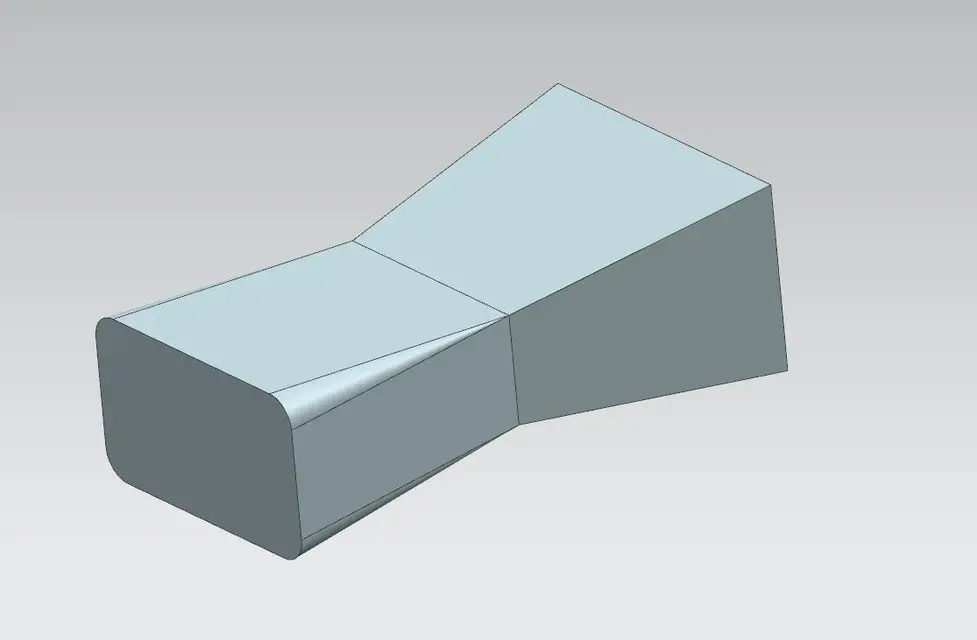
instead I used it to do things like those in figure that have a particularity: sections do not have the same number of segments (those that seem to blend are not). How do you do this sweep with other cads?
 

Attachments

  • thc1.webp
    thc1.webp
    14.9 KB · Views: 5
instead I used it to do things like those in figure that have a particularity: sections do not have the same number of segments (those that seem to blend are not). How do you do this sweep with other cads?
for all those who intervene: remember that the discussions were opened having as interest the usability of the functions by the average user. If we go instead on the pure power, perhaps it is better to open new discussions outside this area.

then you know me, the discussions must have real foundation based on the practical importance of the proposed functions, and not have a "demonstrative" purpose on the power of this or that cad.... :finger:
 
for all those who intervene: remember that the discussions were opened having as interest the usability of the functions by the average user. If we go instead on the pure power, perhaps it is better to open new discussions outside this area.

then you know me, the discussions must have real foundation based on the practical importance of the proposed functions, and not have a "demonstrative" purpose on the power of this or that cad.... :finger:
He doesn't want to be and if I gave this impression I apologize. in my work I almost never use 'automatic' functions of which I do not have complete control. to tell you the hole command for me may not exist. the example of the 'sweep straight' is symptomatic because the interpolation it does may not go well (see case of sections with different sides) so I use the command with one of the options it has and this makes the command 'usable'.
 
He doesn't want to be and if I gave this impression I apologize.
No problem, no problem, no matter what, I just quoted your surgery because it was the last one! :wink:
My concern was just to avoid the discussion from the established tracks.

In fact, I've never done a sweep or a loft or anything like that in my professional career, and so I think 95% of Italian designers, so these two #9 and #10 tests didn't seem very relevant to the topic offered.
But I do design pieces that will then be built with lathe and milling machine, so I don't know the world of those who make design objects or print. for those needs we can also open another series of tests, if you suggest the arguments. Since I don't know the field, maybe you'll give me some concrete examples of where certain functions are used.
 
Usually these elements are not made with a 'direct' sweep but there is need for a guide-trajectory.
the geometry of the blades has always been given strictly Shooting for obvious reasons.:cool:
instead I used it to do things like those in figure that have a particularity: sections do not have the same number of segments (those that seem to blend are not). How do you do this sweep with other cads?
I thought you were referring to the sweep.

I confirm that the sweeps of the turbine blades are "dritte", the sections are made on parallel planes (in creo they are called blend).
for what you indicate in the figure, in I create it is enough to divide the different sections into an equal number of segments.
if from a circle you have to "reach" to a quadrilateral, divide the circle into 4 parts and get the result.
 
but the blades of the turbines do not make themselves with the blends even if they are straight, because you have to have the control of the curvature that the blend does not allow you to have, but the principle is that I agree.:wink:
 
I thought you were referring to the sweep.

I confirm that the sweeps of the turbine blades are "dritte", the sections are made on parallel planes (in creo they are called blend).
I know but I've never done it because, first I don't have the skills, then those I've seen have come directly from superlindate computation centers and that they hold us a lot to their knowledge.:cool::cool::
for what you indicate in the figure, in I create it is enough to divide the different sections into an equal number of segments.
if from a circle you have to "reach" to a quadrilateral, divide the circle into 4 parts and get the result.
splitting the circle into other parts is not difficult, it is to divide a rectangle. in the example posted was chosen the alignment option for points (which is present in the command) so I can match two or more points of one section with only one point of the other.
 
splitting the circle into other parts is not difficult, it is to divide a rectangle. in the example posted was chosen the alignment option for points (which is present in the command) so I can match two or more points of one section with only one point of the other.
No problem, where is the difficulty? cmq as said hunter, better open another discussion for other kind of comparison. :rolleyes:
 
in the example posted was chosen the alignment option for points (which is present in the command) so I can match two or more points of one section with only one point of the other.
I often do it with swx for sheet metal carpentry, it is structural "tramogge" with a different number of sides between the two sections.
to align the points I create a series of curves (3 clicks per curve) that passing through 2 points become straight trajectory.
I'll give you an example tomorrow, with the iPad, it's a little long. .

if hunter prefers place in a new discussion.
 
I do not care that it is identical at the level of quotas, I only care to see the method of creation, you have to create 3 different sections (possibly rectangular) on a straight path.
here are variable sweeps on straight path away from origin with basic module of solids and not of external sketches with building plans
[youtube]7mbipojcucq[/youtube]

ciao rs4
 

Forum statistics

Threads
44,997
Messages
339,767
Members
4
Latest member
ibt

Members online

No members online now.
Back
Top