• This forum is the machine-generated translation of www.cad3d.it/forum1 - the Italian design community. Several terms are not translated correctly.

symmetry

  • Thread starter Thread starter panormus
  • Start date Start date

panormus

Guest
Hey, guys.

I'm designing a wooden workbench and I'm making the two left legs with the two crosses making the first leg and the second as a copy of the first. now the need to make breaks on both legs but symmetrically. if I make a first run with the "tasca" on the first bodypart it automatically generates on the second one a pocket (interesting and comfortable), but not in a symmetric way as I would like.

If I work on the second leg by applying a symmetry, in addition to changing the first bodypart, which should be firm, I create a bodypart that is the union of the symmetrical part :eek: (nice, new term, all rights :biggrin:) and symmetrical.

I don't know if it's clear. I hope so. Can you give me some tips?

Say hi.
 
In fact, it's very clear, but I'm gonna ask you a question: Why did you use different leotards for such a simple object?

Greeting! ! !


of the noble
 
In fact, it's very clear, but I'm gonna ask you a question: Why did you use different leotards for such a simple object?

Greeting! ! !


of the noble
because what I know is the result of a slow discovery.
What is not clear?
I have to work on an object and automatically you have to replicate on the second symmetrically; That's all.

greetings
 
because what I know is the result of a slow discovery.
What is not clear?
I have to work on an object and automatically you have to replicate on the second symmetrically; That's all.

greetings
I don't know if I understand...

but I think you have to create a catpart "a" then make a copy with connection and save it as a catpart "b". on the catpart "b" executes the mirror.
Now. all changes you will make on catpart "a" will be transmitted to catpart "b" , but speculate
 
much more simply the problem you can face in two ways:
work at part level (gamba part.jpg)
shape the leg
creates a symmetry plan
you create the mirror
wanting to add a workmanship stands as "object in work" prisma.1, you make the changes and then puts "object in work" partbody.
automatically the processing will mirror.
This method contemplates a part composed of the object and its mirror.

product level work
you create a set composed of table and leg
binds the leg
a symmetry of the leg(gamba product)
or
binds a second leg in the correct position symmetrically (leg together)

in all these cases making a change to the leg it will be repeated on the other components
Mar
 

Attachments

  • Gamba part.webp
    Gamba part.webp
    14.3 KB · Views: 13
  • Gamba Product.webp
    Gamba Product.webp
    37.3 KB · Views: 8
  • Gamba Assieme.webp
    Gamba Assieme.webp
    33.1 KB · Views: 7
much more simply the problem you can face in two ways:
work at part level (gamba part.jpg)
shape the leg
creates a symmetry plan
you create the mirror
wanting to add a workmanship stands as "object in work" prisma.1, you make the changes and then puts "object in work" partbody.
automatically the processing will mirror.
This method contemplates a part composed of the object and its mirror.

product level work
you create a set composed of table and leg
binds the leg
a symmetry of the leg(gamba product)
or
binds a second leg in the correct position symmetrically (leg together)

in all these cases making a change to the leg it will be repeated on the other components
Mar
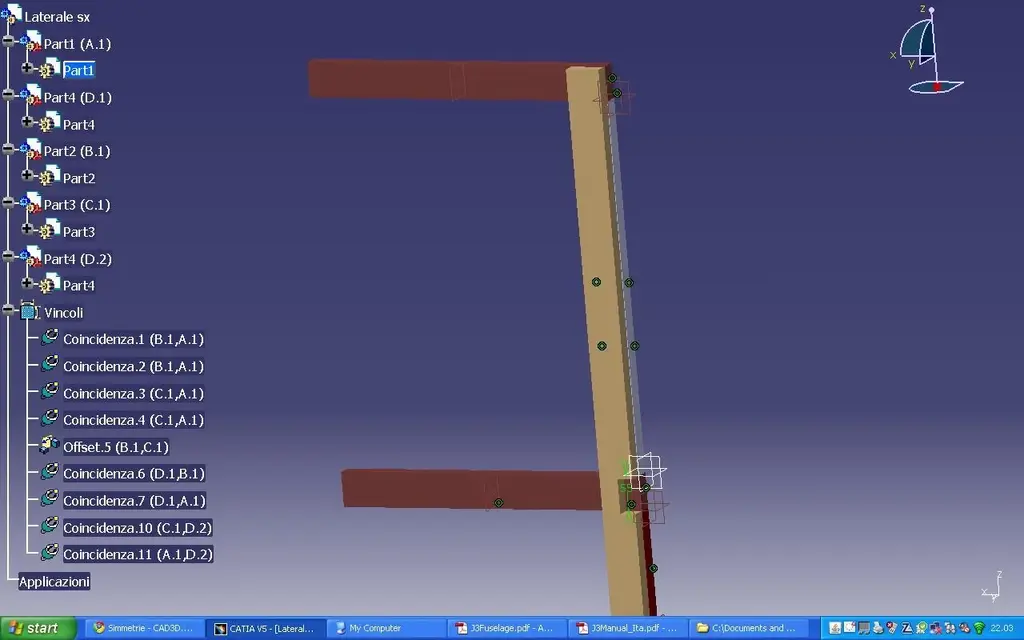
the first for me seemed more complex (considered that I recently installed the sw), the first most feasible but .. I always have problems:
1-cree a symmetry plan
2-selections the 3 parts that make up the first leg (a1,b1 and c1)
3-apply the symmetry, but it moves to and only to the longest leg with the dig (see print screen) when I would like an exact copy of the first group called a2,b2 and c2.
What am I wrong with you?
 

Attachments

  • catia_ps.webp
    catia_ps.webp
    58.5 KB · Views: 9
you can not make a symmetry of 3 parts simultaneously
do 3 symmetries compared to the same level of the three parts
or
do a subaxieme a1 b1 c1 and then do a single subaxieme symmetry
Mar
 

Forum statistics

Threads
44,997
Messages
339,767
Members
4
Latest member
ibt

Members online

No members online now.
Back
Top