• This forum is the machine-generated translation of www.cad3d.it/forum1 - the Italian design community. Several terms are not translated correctly.

technical analysis of titan

  • Thread starter Thread starter Archimed&
  • Start date Start date

Archimed&

Guest
Bye to all,
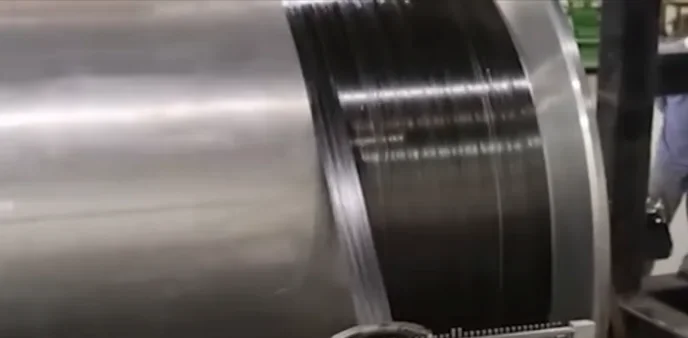
I come back to write because, leaving the human regret that I tried for the affair, I find it really interesting to discuss the technical part of the disaster that concerned the implosion of the titan submarine. I found this video on a fem made by a German ing. I am not expert in materials or even less carbon fiber (other than an examination given centuries ago on the subject) so I would like your opinion on the veracity of the fem or cmq according to you on how things might have gone. The only thing I remember and quoted from my university book on materials (smith) is that if the reinforcement fiber is wrapped for winding filaments (as seen in the video) then. .
"This method provides extremely high mechanical resistance to hollow cylinders. applications are tanks for chemicals, pressure tanks and missile engines containers."

I imagine however it refers to tensile strength and not compression.

I leave you cmq video
ps. I apologize if the section in which I posted is not the correct one, since there was also the naval section. . .
 
hi archimed
on the resistance of both carbon fiber and compression, and traction, there is no doubt
resistance exceeds that of steel combined with extreme lightness.
However, here, the problem is not resistance, but instability to depression.
water pressure at 4 km depth is scary.
at 1 m of depth the pressure is 1000 kg/m2.
at 4000 m deep the pressure is 4000000 kg/m2, or if you prefer 4000 tons to m2.
I checked some tanks at both pressure and depression.
Pressure calculation is quite simple and safe.
circular shape makes the traction material work and there are no problems of instability.
but if the tank works in depression, the material is compressed and goes in instability long before reaching the limit resistance.
the calculation is much more complex and less reliable because very dependent on imperfections.
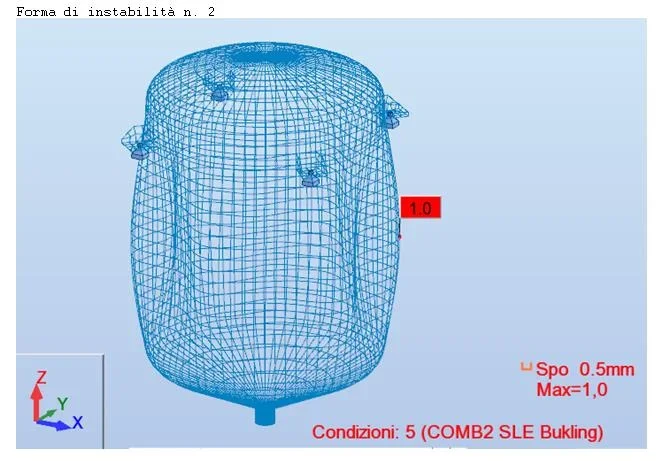
below you see a deformed instability (bukling) of a tank subject to depression.
the resistance values you get are very low.
I don't even know how one can think that a submarine resists those depressions.
Hi.Immagine Prova.webp
 
from what little I have followed, and also according to some expert, the problem seems not to have been in the mantle itself but in the connection zone between the mantle and the front vent in titanium, in particular in the area of the hinges that allow the opening.. .
certainly the design was risky, and poorly tested, after a few dives and laughter occurred the tragedy.
 
very interesting to drink your simulation, thanks, even to stevie.

with few dives can you talk about fatigue? I don't think so.
 
very interesting to drink your simulation, thanks, even to stevie.

with few dives can you talk about fatigue? I don't think so.
I believe that this is a hyper-accelerated case of oligocyclic fatigue, if it is true that the boat was at its 7th official mission, on a total of about 50 dives considering also the tests...
to make hypotheses and distance conjectures, however, is unrealistic, and I believe that even the investigations will not be easy given the conditions of the wreck (when recovered the scraps deriving from the implosion will be complicated to establish what it has given before).
from the structural point of view the most critical part is certainly that of the joint between carbon cape and titanium cap, because of the different behaviour of the materials and the relative deformations.
It seems to me that cameron, a great expert in submarine technology, has said that you always avoid using materials so different in the construction of batiscafi.
 
I believe that this is a hyper-accelerated case of oligocyclic fatigue, if it is true that the boat was at its 7th official mission, on a total of about 50 dives considering also the tests...
to make hypotheses and distance conjectures, however, is unrealistic, and I believe that even the investigations will not be easy given the conditions of the wreck (when recovered the scraps deriving from the implosion will be complicated to establish what it has given before).
from the structural point of view the most critical part is certainly that of the joint between carbon cape and titanium cap, because of the different behaviour of the materials and the relative deformations.
It seems to me that cameron, a great expert in submarine technology, has said that you always avoid using materials so different in the construction of batiscafi.
It seems to me that from the recovered wreck there are no traces of the carbon fiber body (as if it were completely disintegrated). vice versa, the titanium flange seemed to be almost unharmed and also other parts of the outer cover, presumably made in steel, despite large folds and tears did not seem completely destroyed.
 
also some critical points that I found online:
- for the carbon fiber body a very abundant thickness has been chosen, but only one direction of lamination of the fiber was chosen (this according to the naives for the type of effort it had to endure)
- the fixing between the carbon body and the titanium flange has been performed with bonding. the operation was not carried out in a protected environment (powders, temperature and controlled humidity), but in a shipyard. This could have led to particle inclusions during the process.
- there are doubts about the glue used, in particular it is believed that in order to obtain the necessary viscosity no consonant methods were used but simple additives
- many doubts about the length of the coupling between flange and body
- it would always be that for the titanium door closure bolts on the titanium flange a torque control evening key (dynamic), but a pneumatic screwdriver
 
hi andrea, with the type of realization of the fiber (for winding, as you see in the video) I knew that in this way you work in several directions, but maybe I'm mistaken
 
hi andrea, with the type of realization of the fiber (for winding, as you see in the video) I knew that in this way you work in several directions, but maybe I'm mistaken
If I understood your question well, for the carbon fiber body, only one winding direction was chosen. Imagine that the fiber was wrapped like a elbow of string to understand us. this generally does not do and direction or winding axes are multiple. the choice was made because the body of the submarine should not have resisted to torsion stresses. the main doubts are related to possible problems of delamination and propagation "cracks". but consider that the body was often more than 12 cm and had many layers and therefore it is many difficult to make assumptions. I think, however, that when we talk about carbon fiber in general there is no yet solid know how to speak with certainty and in the end these are also simple speculations.
 
For example, you are still studying the possible problems in cutting carbon fiber with water-jet technologies. this precisely for problems of delamination
 
If I understood your question well, for the carbon fiber body, only one winding direction was chosen. Imagine that the fiber was wrapped like a elbow of string to understand us. this generally does not do and direction or winding axes are multiple. the choice was made because the body of the submarine should not have resisted to torsion stresses. the main doubts are related to possible problems of delamination and propagation "cracks". but consider that the body was often more than 12 cm and had many layers and therefore it is many difficult to make assumptions. I think, however, that when we talk about carbon fiber in general there is no yet solid know how to speak with certainty and in the end these are also simple speculations.
Actually gomitol of spagus is perhaps not the most appropriate example. to think back maybe we have more directions. Anyway I hope I've made hahahaha. I try to find some pictures if I can.
 

Forum statistics

Threads
44,997
Messages
339,767
Members
4
Latest member
ibt

Members online

No members online now.
Back
Top