• This forum is the machine-generated translation of www.cad3d.it/forum1 - the Italian design community. Several terms are not translated correctly.

test job interview

  • Thread starter Thread starter exxon
  • Start date Start date
Good zeigs!

the test done to the candidates was precisely aimed at this verification. the test is not a trivial exercise of physics1, but it has a fundamental importance in the nailed and bolted joints, where the joint seal is given by that of the nail or bolt regardless of the preload applied.
perhaps you wanted to say “regardless of the applied external load” and not from the preload, if as seal we mean resistance to separation of parts.
and also this is not true in general, because tense part (victims) and compressed parts have their finite stiffness, and therefore take a share of the external load according to their stiffness. It is then obvious that you try to be very flexible tense part and very rigid tablets parts, to approach the limit condition of your exercise (the one with the spring): in that case, in fact, the puller takes the load only after the separation of the plate (or however a very low share of the external load).
 
in the passage you reported I have actually expressed unclearly. In fact, interpretation is not what you gave.

a more understandable expression is replaced by "the joint" with "the last of the system".
... the last seal of the system is given by that of the nail or bolt regardless of the preload applied.
If you want to be lazy you should specify other boundary conditions, but the concept should now be clear.
 
the first consideration (all but trivial) is that the weight force (up to 2 n) not sum to the tension of the wire. there are those who had supported the opposite, and the initial test (now perfectly superimposed to the system described in #114) aimed precisely at evaluating the ability to realize it.
It seems to me that the question (on the fact that the load is not added to the pre-tension) has been resolved now definitively from #86. at that point, even those who supported the opposite had recognized the result. your #107 scheme is great and further simplifies the matter.

the open question, however, is that of the inextensibility of the tie. fulvio attacked her by hinting at hyperstaticity and the principle of virtual work. In my humble opinion the objection is not enough, first of all because I am not convinced that the system is hyperstatic. I think the matter is faced by another perspective, but before expressing myself I want to follow the steps you propose.
lacks little to the complete definition of the system:
"What happens in #114 when the weight force is greater than 2 n? "
when q > t is obtained in or reaction: (q - t); while the rope tension: τ = |q|.
 
Good. you would have "passed" the test... :

Ultimately, when the load exceeds the initial tension of the wire, it is only this to establish its intensity.

on the question of hyperstaticity, the system is hyperstatic, but this does not entail any limitation since the movements are always null, in all conditions. if hyperstaticity can be a problem (even serious) in some practical applications, when working at a sufficient abstraction level, the same does not imped any impediment to the application of the own concepts of static.

It should be pointed out that we are talking about hyperstaticity and not contrasting constraints that is quite different.

a typical example of exercise with a hyperstatic system is that of the rigid beam leaning on more (two) points with concentrated load at any other point. if the binding reactions are asked, the same are calculated without having any problem.
 
not the separation of the plates.

bolt break (or ripple) if the precarious is not superior to the critical one, both occur to already separated sheets and consequently the only agent force is that of separation (independent by precarious).
 
@exxon in the case of indeformable plates you are right (the external load goes first to download the plates and only after loading the tie), but in the general case of finite stiffness also of these, a part of the external load takes the tie, while another part goes to download the plates, because of the relative stiffnesses. therefore, if you have tightened very close to the ribbing and if the tie is rigid (coupling designed badly), it can be that you also dine to connected plates.
 
not the separation of the plates.

bolt break (or ripple) if the precarious is not superior to the critical one, both occur to already separated sheets and consequently the only agent force is that of separation (independent by precarious).
As a rule, the separation of the parts takes place before the disnervation of the tirant/vite...even if I know for certain applications in which the clamping is carried out until yielding, guess why?
 
Good. you would have "passed" the test... :
I hope so, otherwise I'd better change my job.
on the question of hyperstaticity, the system is hyperstatic, but this does not entail any limitation since the movements are always null, in all conditions.
Well, it depends on how you impose constraints. in the scheme that I had posted are represented only two opposing supports, are sufficient to provide behaviour equivalent to the one required and isostatic. In fact, by suppressing a degree of freedom in one of the constraints (i.e. the bond itself) you get an hypostatic system.
if hyperstaticity can be a problem (even serious) in some practical applications, when working at a sufficient abstraction level, the same does not imped any impediment to the application of the own concepts of static.
remaining on the theorist, a hyperstatic system is statically indeterminate, or does not admit solutions for the cardinal equations of the static. then there are other methods for resolution, but they require assumptions that come into contradiction with the initial postulate of infinite rigidity and null movements.

According to me the question of the inextensible thread with initial tension is resolved with one of the fundamental axioms of static (although they are rarely enunciated with the same precision that is used for example in Euclid geometry) which states that the result of internal tensions of the rigid body is always zero. In short, the rigid body is always in balance and cannot provide a pretension, otherwise it generates a paradox, or an indefinite case.

but you this inconvenience has brilliantly surpassed it in your last scheme that can quietly be constituted by an inextensible rope and to which it is legitimately applied, in fact, a tension.
 
Last edited by a moderator:
on the question of hyperstaticity, the system is hyperstatic, but this does not entail any limitation since the movements are always null, in all conditions. if hyperstaticity can be a problem (even serious) in some practical applications, when working at a sufficient abstraction level, the same does not imped any impediment to the application of the own concepts of static.
a typical example of exercise with a hyperstatic system is that of the rigid beam leaning on more (two) points with concentrated load at any other point. if the binding reactions are asked, the same are calculated without having any problem.
but this example does not solve it with the only equations of static: you have three incognite vertical reactions and two only balance equations available (constraint grades higher than degrees of freedom, hyperstaticity concept): vertical translation and rotation. as you know this exercise typically solves by unravelling at one point (for example central support, but you could unravel it in another of the two points) and replacing the bond with its vertical reaction. At this point you will find a "calculable" isostatic beam with the above balances, and you will calculate the vertical arrow at the junction point: first considering only the external load, and then considering only the fictitious reaction. you must equal it, since in the point of support the beam cannot have relative shift (by hypothesis of continuity of the beam) and therefore calculates from this equality the fictitious reaction, which is the binding reaction sought.
as you see, however, we have brought forth the labor-deformation law (to calculate the arrow).

I could also replace the central support with a zipper, introducing as fictitious reactions of the moments then: I would have always been brought back to an isostatic (supported at the ends), and with the same method I would have found the fictitious moments imposing relative rotation of nothing of the two beams. Here too, however, to determine the rotations, I have to pull the hypothesis of elastic element (in both cases, you have to introduce the module of young to calculate the arrows and rotations - rotations understood as deformation obviously, not rigid motions!).

I would say that to solve a hyperstatic system (determinate its reactions) it is necessary always consider deformation (and therefore relate stress and deformation) something not necessary for an isostatic system in which it is enough to consider bodies as rigid (for reactions) and consider only the equations of static.
 
@paolocolombaniSorry but the last scheme – where the tension is demanded – I can't solve it like you said: (maybe I lose myself in a glass of water...so please give an eye to the reasoning below): At the moment when I put the wire in or, and I suppose there is also the reaction in c on the plate (plate/support contact), I find four unknowns and three equations only: I am again in the case of hyperstaticity. if I consider the soft wire (not tense) is as if I said that the wire does not exist, and the system is resolved (back to having two unknowns and two equations), but it is not the proposed system. if I considered the thread in or but hypothesized absence of contact between the plate and the support I would lose an unknown and therefore the system would be solved (isostatic), but there would be no contact that was in the hypotheses. I should – in essence – with a factory, hypothesize once again arbitrarily a tension or a reaction. or, hypothesize a deformation somewhere (for example in the thread connecting or to the p mass), and then solve the hyperstatic problem. Am I right? If so, where? Thank you! ;)
1.webpbalance to translation in or: t2-ro=0
balance to translation in p: t1-p-t2=0
balance to translation in c: t1-q-rc=0
if I do not define at least a voltage (or a reaction) I cannot solve it, in the hypothesis of contemporary presence of contact in c and wire in or (which may have a voltage t2, generally different from t1).

Instead, I convinced myself that the very first question made sense, at least mathematically speaking: the balance to the vertical translation of the piattello (of weight q) would be in fact (verse positive upwards: reaction plate/plate r turned down, voltage t turned upward):
t – q – r = 0if the question was: “What is the tension of the wire?” or “what is the binding reaction r?”, since I have two unknowns and one equation. imposing (at the purely theoretical level) a voltage t = 2 n constant the above equation can be resolved, and shows that r = t – q = 2 n when q = 0, and it is worth 0 when q = 2 n (flat). this is clearly a non-physical situation, in which we “forced” an inextensible thread (and therefore by definition devoid of the ability to preload) to have a precarious. Let's say that mathematically, but I don't seem to see backgrounds. remains the fact that we “obligated” the voltage t to be constant as long as the plates are in contact, when instead in a real bolted connection (where there is deformability both of tie and of plates) this is not in general physically true.

I believe that we could have reached the same result more intuitively and with greater physical significance always assuming the indeformable plates but the extremely deformable pull (mode with very low elastic constant, case among other things desirable in design). In this case, taking this tie, I do not go to crush the plates but only to stretch the tie itself. at the moment when I attach the load, the plates do not “feel” minimally (they are indeformable) and the tie can not charge further because it does not stretch, for the same reason (you must always be congruity of the movements – so much stretch the tie, so much crush the plates, and vice versa). the thief will go further only when we have the separation of the pillars.
for this, I think that the most correct scheme, which also puts the physics (though assuming indeformable plates) is the second exxon, the one with the spring. ;)
 
Last edited:
At the moment when I put the wire in or, and I suppose there is also the reaction in c on the plate (plate/support contact), I find four unknowns and three equations only: I am again in the case of hyperstaticity. ...
Yes, it is very likely that the system is not solved in absolute form.

the conditions of validity, or hypothesis of regularity, since the equations will necessarily be subject to the conditions inherent to the constraints and the same rope. For example, for the rope is valid [R+]; means that it cannot transmit negative values to the constraints (or vice versa depending on the direction of application).
in the field q < p the part of the rope op is discharged and disappears from the equation, which is equivalent to drawing the system without the constraint or. In fact, precisely because the bond or can react in one direction, we can quietly treat it (both physically and mathematically) as a simple support.

generalizing, we obtain that introducing the fields of validity is equivalent to dismantling the scheme according to the same. then, we have three fields of validity in which the system behaves like it was differently simplified:

1) q < p | without constraint or;
2) q = p | without constraints or c;
3) > p | without constraint c.

but it seems that each of these three cases is calculated.

I hope I have answered, if you have understood the question well.
 
Last edited by a moderator:
Yes, you got it right: apart from the q case<p, (un="" anche="" carichi="" compressione,="" con="" condizione="" condizioni="" cui="" definizione),="" di="" far="" filo="" il="" in="" isostatico="" la="" le="" ma="" non="" o="" per="" può="" q="" questa="" reagire="" reazione="" sistema="" sparendo="" sufficiente="" tornare="" è="">p are necessary but not enough. I would say that it is also necessary to make the rc reaction disappear, assuming that there is no more contact (for example by choosing appropriately the lengths six wires, something not discounted otherwise).
therefore need additional hypotheses, without which balance equations are not enough!
Thanks?</p,>
 
Oh, my God. Many of those who read are convinced that the solution to the problem is the opposite. It seems to me that those who have given a certain and motivated response are counting on the fingers of a hand.
remaining on the theorist, a hyperstatic system is statically indeterminate, or does not admit solutions for the cardinal equations of the static.
This phrase made me think a lot. I initially thought it was wrong because it would invalidate the system I had proposed as a test, then instead I realized that the error was not in that statement (absolutely correct), but in my previous statement that the system placed at its time in #1 was hyperstatic.

It's not. It is absolutely isostatic, and as such can be solved by traditional methods of static. I thought of a simple example to analyze the condition with the opposing constraints, and this came out.
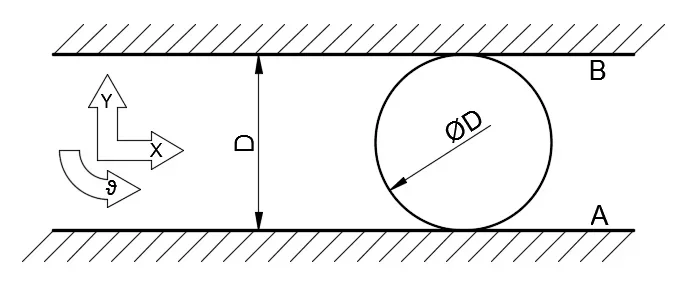
GDL1.webpin a two-dimensional plane reference system, identified by the Cartesian couple (x, y), together with the rotation direction θ and with the verses indicated in the figure, there are two linear, parallel constraints, a and b distance between them. between the constraints is placed the disk c, indeformable, of diameter d. the system is studied in relation to its degrees of freedom.

in a two-dimensional system, the degrees of freedom are 3: moving along the two axes and rotation on the plane. In reality, each degree of freedom can be in turn divided into positive and negative shift compared to the initial quiet condition.

looking at the system from the point of view of the disk c, the bond to prevent movement y in negative direction, while the bond b prevents movement y in positive direction. the other two degrees of freedom remain unchanged. in other words, the set of constraints a and b, reduces degrees of freedom from 3 to 2.

concentrating the analysis to the y direction, the system is not hyperlinked: removal of even one of the two constraints a or b, increases the freedom of the disk c, along the axis y. along this axis the system has zero degrees of freedom.

for the demonstration I deliberately chose an example that reduces the variables to the minimum indispensable and that shows how the two constraints, together, are the necessary condition, both sufficient to remove one and only one of the three degrees of freedom.

in the case of the inextensible thread stretched between a fixed point and an emphasis that prevents the collection (as is in #1), the situation is conceptually identical: the reduction of the degrees of freedom of any point of the wire is determined by the set of the two constraints, which act respectively in the two opposite verses of the same direction.
... the result of internal tensions of the rigid body is always zero. In short, the rigid body is always in balance and cannot provide a pretension, otherwise it generates a paradox, or an indefinite case.
I'm working on this, but I think there's something wrong with you. Unfortunately I am on the move and I have no access to all texts, but on the net I am still finding adequate material.
 
Your emails (referring to #131)
In the example I had done, the beam is supposedly indeformable, therefore speaking of arrow calculation does not make sense. I agree that the example I brought is not the best to discuss the subject.
Your emails (referring to #132)
the system solves it by imposing t2 = 0. this is not an arbitrary imposition, but a specific request requiring to "fix" the system without changing its variables. of the rest, t2 < 0 would not be possible because it is a thread, while t2 > 0 would mean deliberately impose a voltage on the lower section of wire.
 
Last edited by a moderator:
if the question was: “What is the tension of the wire?” or “what is the binding reaction r?”, since I have two unknowns and one equation.
Here, this is a statement that deserves much attention!

I believe instead that the trend is defined for all state variables. we see why:

The third principle establishes that
Newton said:
for every force that a body a exercises on another body b, there is instantaneously another equal in form and direction, but opposite in verse, caused by the body b that acts on the body a.
we know therefore that the reaction of the bond is equal and contrary to the force exercised by the plate, which in turn is given by the difference between tension and weight force. and they are all established.

binding reaction provides "the missing force" to maintain balance.

Perhaps in the interviews we had come to discuss this...
 
In my opinion, the question of the inextensible thread with initial tension is resolved with one of the fundamental axioms of static (...) which states that the result of internal tensions of the rigid body is always zero. In short, the rigid body is always in balance and cannot provide a pretension, otherwise it generates a paradox, or an indefinite case.
the first part of this statement is uncontrollable. It's an axiom, and it doesn't rain on it.
However, one cannot from this axiom draw the conclusion that a rigid body cannot be a means to apply a pretension. can do so when the necessary force is external to the body.

the most striking example is the force of gravity.
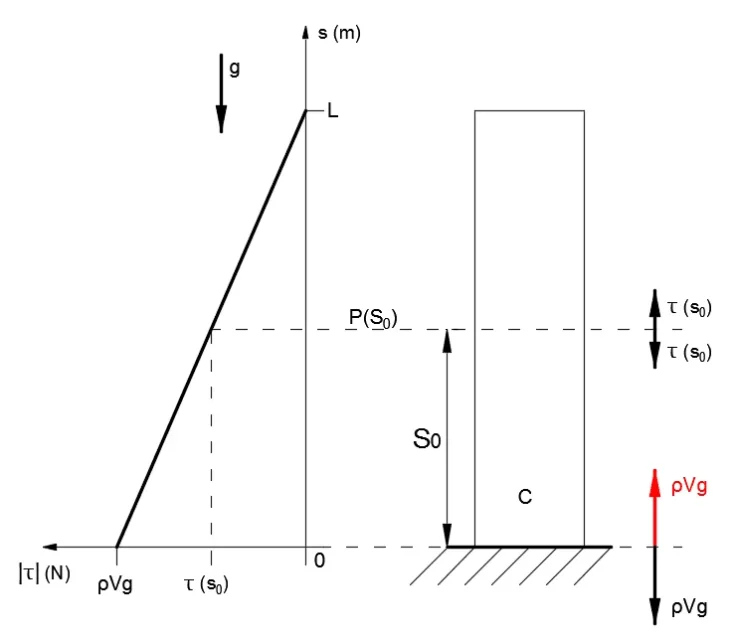
C2.webpwe take a rigid column c, homogeneous, length l, volume v and mass ρ, and we support it on an ideal plane in the presence of gravitational acceleration g.

for each ideal plane p with which the column, the voltage (in this case you should talk about compression, but consider it "negative voltage"), of the two column parts is equal and contrary.
this is also true at the top end of the column (and also beyond...) where such values reach zero. It is a consideration, if we want, obvious, since everything is quiet.

What happens with plan p(0), i.e. the surface of support? also there, of course, the forces balance, but one is the tension to the lower extreme face of the column, the other the binding reaction of the plane. appears as if the initial axiom had been violated, but this is not true at the time when you consider the weight force as external to the rigid body (or applied to its centerpiece, as is sometimes written in the texts).

the rigid body became a means to apply a voltage (compression) in a system. external force, arbitrarily imposed by gravitational acceleration. there is not only gravitational acceleration, but also other "surgents" of external forces to the medium with which to induce a desired tension in the rigid body without resorting to elastic means. The centrifugal force is an example, as are the magnetic attraction and electrostatic force.

when I wrote in #1
exxon said:
the plate supports the fixed support s, held in position from the initial voltage of the wire pairs to 2 n.
I have given the information that that initial tension is present, without affecting the method by which it would be generated. that the voltage comes from an electrostatic interaction, or magnetic, little matter: to analyze the system it is sufficient to know that there is.
 
Your emails (referring to #131)
In the example I had done, the beam is supposedly indeformable, therefore speaking of arrow calculation does not make sense. I agree that the example I brought is not the best to discuss the subject.
In fact, I wanted to say that if you assume undeformable you cannot calculate the reactions with the only balances, unless you arbitrarily fix one.
 

Forum statistics

Threads
44,997
Messages
339,767
Members
4
Latest member
ibt

Members online

No members online now.
Back
Top