• This forum is the machine-generated translation of www.cad3d.it/forum1 - the Italian design community. Several terms are not translated correctly.

the humble servant

  • Thread starter Thread starter Fulvio Romano
  • Start date Start date
If I had a son, just to justify the purchase in my wife's eyes. .
Unfortunately the child is still small to be used as credible motivation. . .

Thank you for your appreciation. I'll move on as soon as possible.
Hi.
Remember the advertising of a car (I don't say which), where the father turned to a newborn, he turns saying that at 18 years he will be his, but for now he takes it?

p.
sometimes TV leads to do things "involuntarily" :biggrin:

a greeting
 
in addition to the toys mentioned above I remember very well the kits that you could buy to build robots with sensors and small learning skills in magazines type new electronic or electronic 2000.
 
Why did I tell this? not for self-incense, I should be ashamed, since this is the event that made me a disabled social .
Only an intelligence outside the city can describe itself in such a way.
fulvio compliments, I estimated you and I will continue to.
 
Come on!
I expected in the other thread that fulvio said if he did or not this new "history" and I have already lost 25 posts of the new thread! !
I started from the end, that now I have no time to read.
tonight I start, and if I see cats, dogs, or other hot blood animal (or cold) I pass on them with the front roller :smile: ... so I recommend, only beings driven by servomotors, encoder & c.
 
One question.
talking about a driverless vehicle like a uav, wikipedia from the following definition:
robots with limited decision-making capabilities, which can be remotely controlled

Is that correct?
I wonder what limited decision-making skills can have a drone like those attached (a diver and an airplane to please the "carrozzinate")
 

Attachments

  • DSCN0897.webp
    DSCN0897.webp
    38.5 KB · Views: 22
  • africa-drone-10192011.webp
    africa-drone-10192011.webp
    17.6 KB · Views: 23
fulvio :confused: but you... are you human, right?? ?

No, I'm asking you because I used to play with the turkeys and the trains at your age (when you tampered with the typewriter).

for the rest admiration and deference. :biggrin:

Hi.
 
Guys, thank you for your esteem and appreciation. Really.
One question.
talking about a driverless vehicle like a uav, wikipedia from the following definition:
robots with limited decision-making capabilities, which can be remotely controlled

Is that correct?
I wonder what limited decision-making skills can have a drone like those attached (a diver and an airplane to please the "carrozzinate")
certainly the construction of unmanned falls within the purposes of robotics (smart perception and action). To say that a uav is a robot, from my point of view, is reductive and partially incorrect.
of course it is a mechanical device, it is reproducible, etc. but the definition is border line.

the limited decision-making capacity is probably meant for the fact that they interact with a strongly unstructured environment, often unknown even in the primary fundamentals, so spontaneous interaction must be forcefully limited to prevent the failure of missions.

to understand, if the environment is strongly structured, but unknown, with strong interactions it is possible to reconstruct the position of the primitives. No, I said to understand, then, roomba moves in an unknown environment, but strongly structured. he knows that what he finds is either a closet, or a table, or a chair, or a carpet, or the stairs that descend (those that rise are like the closet).
interacting with the environment so it may want to say bang us against, rebuild it and then draw conclusions.

If you put roomba on a minefield and do not know the primitive "mine", it will have short life. better avoid interaction with the environment as far as possible.

I don't know if I explained. . .
 
Further there I will also talk about unmanned, android, insects and petioline herds, but I would first focus on industrial robots, also because they are those I know better.
So, before I start with the stuff a little more technical, I think I should recall the three laws of asimov robotics.
asimov, a science fiction writer, invented three laws to which all "robots", actually android, of his stories had to obey. science fiction laws, however, recall the philosophical aspect of creating machines capable of making decisions themselves. and this aspect is scary, so laws are necessary to instill deep into these machines to prevent them taking over their builders.
Of course, at least for now, in technology all this does not exist.

the three laws are these:

1. a robot cannot recarnate to a human being nor can it allow a human being to receive damage due to his failure to intervene.

2. a robot must obey the orders given by human beings, provided that such orders do not contravene the first law.

3. a robot must protect its existence, provided that this self-defense does not contrast with the first or second law.

each law is more important than all the following, and must prevail in case in a specific condition one or more laws come into conflict.
practically a consciousness inserted in machines without conscience.

some also include a "law 0": "a robot can not harm humanity, nor can it allow that, because of its failure to intervene, humanity receives damage." Actually, being humanity a set of human beings, for a robot law 0 is nothing but a recurring call of law 1. any programmer would horrify the thought of writing an additional law with the same informative content.

said this, for real robots, the three laws of robotics are summed up in the image below.
 

Attachments

  • machine-has-no-brain-use-your-own.webp
    machine-has-no-brain-use-your-own.webp
    42.8 KB · Views: 16
said this, for real robots, the three laws of robotics are summed up in the image below.
hahaha, I often use that in car safety courses! ! !
You copied it, didn't you? :

You are a well of wisdom! ! !
 
We briefly introduce two concepts. they will be resumed later, but they are useful to understand what we will say shortly.
the operating space, or Cartesian, and the space of the joints.

the operating space is the world in which the robot operates. It is a six-dimensional space, the first three are the known coordinates Cartesian x, y and z, and the other three are rotations around its axes. an exadimensional carrier expressed in the operating space therefore uniquely identifies a point in space and its complete orientation. the operating space is always six dimensions, because so many are the degrees of freedom.
the space of the task is a subspace of the operating space, and is that strictly necessary to a certain task. a generic task can naturally have a maximum of six degrees of freedom. If the task was for example “planting nails in wood” are enough three translations, then we have a task to three g.d.l. the task “to screw in the wood” instead requires four. three translations plus a rotation around the vertical axis.

the joint space instead is a space where the dimensions are the joint variables of the manipulator. has so many dimensions as the joints, that is the degrees of mobility. Rotary joints will have its size expressed in degrees, prismatic ones, in millimeters.
Incidentally, talking about “grades of freedom of a manipulator” is wrong. badly wrong. the manipulator has the degrees of mobility, the task (or the world) those of freedom.

what is the relationship between the degrees of mobility of a manipulator and the degrees of freedom of the most generic task that it can perform? the answer is not simple.
Certainly the number of gdl will never be greater than the number of gdm, I don't think there is need to prove it mathematically, it is quite intuitive. However imagine a snake made by many pieces connected by vertical axis rotary joints. the first joint (first gdm) adds the first gdl. the final point can be moved along a circumference. the second joint, the second gdl. now the final point will be able to move at any point of the plan, but it will not be possible to choose the orientation. it will function of the coordinates of the point.
add the third joint. we have reached the three degrees of freedom of the plan, in fact now the final point will be able to move in any point and with any orientation. if we add a fourth joint we notice that the manipulator to four gdm so realized can actually perform tasks at only three gdl (in the plane). He can't get out of the plan. the fourth gdm is therefore “redundant”, concept that we will resume later.

In short, there are ways of adding gdms to add gdl. and that is why it is vital not to confuse gdms with gdl.

Let us now see the main cinematic chains of manipulators. I describe in detail only those who have a commercial value. I will only nominate the others.
 

Attachments

  • serpente.webp
    serpente.webp
    6.1 KB · Views: 8
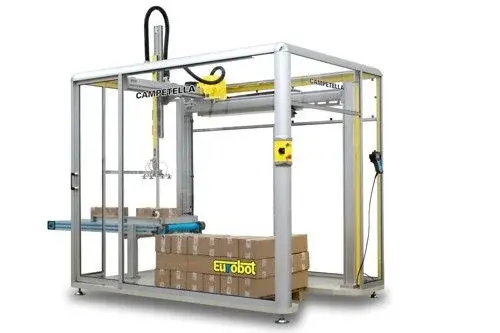
also called a portal manipulator, or robot gantry, if you pass me small philosophical differences, it is one of the first cinematic chains realized.
It consists of only linear joints. the peculiarity that jumps to the eye is that it is the only kinematic chain in which the operating space and the space of the joints coincide. This explains why it was the first realized chain. because the control of robots of this type is very simple, as we will see later.

the other characteristics are a high structural rigidity, a constant repeatability throughout the working space and the possibility to manipulate even very heavy objects.

on the contrary there are the joints, which are all linear. the linear joint in the industrial world has poor reliability, greater wear, difficulty of lubrication, wear of cables, need of chain of cable, more space, in short, is a harness.
In addition, the Cartesian manipulator is generally very bulky than the work volume. portal manipulators in particular are the only robots to be larger than the work volume itself.
 

Attachments

  • image003.webp
    image003.webp
    12.8 KB · Views: 17
  • eurobot.webp
    eurobot.webp
    14.7 KB · Views: 17
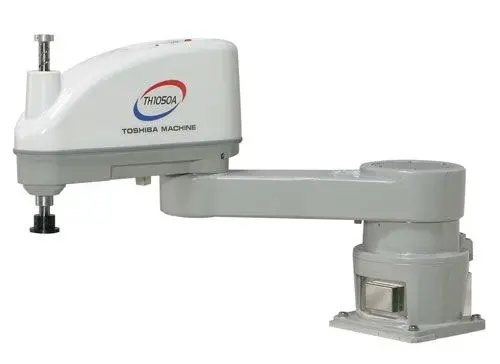
is the acronym of “selective compliant assembly robot arm” or “ robotic assembly arm for selective yielding.”
Yes, but what does that mean?
The waste robot is a four-axis manipulator (gdm) invented specifically for the construction of printed circuit boards. I take advantage of and briefly describe the process of construction of the cards, called “ad wave” now fallen into disuse from the birth of the smd components to surface assembly.
the invention of this process has allowed a considerable scale economy of electronic devices, drastically reducing production costs, and therefore prices.
We can say that this process, together with the invention of integrated circuits, has made possible the technology to which we are now accustomed.
immediately after the burning of the board, or the moulding of the tracks and the drilling, a scara robot, called “pick&place” mounts the electronic components by threading the reofors into the holes of the board. Seeing him working is a pleasure. you just distinguish components, accelerations are impressive, precision too. in a very short time all components are arranged in their position. the board comes to this point passed on a tank full of welding alloy (a sour alloy of tin) melted, put into circulation by a pump. liquid is forced to pass over a small bulkhead where it forms a wave. the board touches this wave by wetting just all the reofors that come from below. Here, in a moment all the components are welded.

The pick&place is a four-degree freedom task, so it is natural that a robot specially designed for this has only four degrees of mobility. three rotary and one linear.
the main problem of this task is to “push” downwards, to stick the component, but “go slowly” horizontally to compensate for positioning errors. robotics has not yet had the development we can see in our days, so the idea is to solve the problem mechanically.
in fact the cast has a rigid structure vertically, due to the inertias of the arms and the forks rotoid joints, but it is yielding in the horizontal plane because the joints make as pantograph. from here the name of manipulator to selective yielding.

for years the pick&place tasks have remained the prerogative of the waste. In recent years, for scale economy issues and why robot control has evolved enormously, pick&place tasks are entrusted to anthropomorphic robots.
 

Attachments

  • toshiba_scara_lg.webp
    toshiba_scara_lg.webp
    7.5 KB · Views: 19
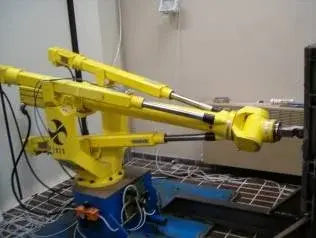
the parallel robot is so called because it is not constituted by a real “chain” cinematic. the joints are not in series, one behind the other, but in parallel.
the white flexpicker has four rotating joints. the first three in series move three levers and allow the positioning of the final point. the fourth, by means of a homokinetic joint allows the rotation of the tool around a vertical axis. the yellow robot instead has the three parallel joints replaced by linear drives (but in the concept nothing changes), and at the end is mounted a spherical wrist, which makes the system to six gdm.
But we'll talk about the wrist. the name of a cinematic chain is given exclusively by the type and positioning of the first three joints. All that comes later is part of the wrist. in this and in previous posts I made a small exception for four-gdm robots, because I don't feel like I define “polso” the only fourth rotational axis.

Therefore, the parallel robot is usually used for pick&place tasks. It is a little more complex than the waste, it has no yield in preferential directions, it can have a work space greater than a waste without weighing too much.

the main characteristics of parallel robots are the great rigidity and high speed. rigidity is given by the structure, as the arms form closed structural rings, while the high speed is given by the fact that, being the parallel cinematic structure, each joint must move one arm. in all series cinematic chains, however, each joint must move all arms, engines and gears of the joints that follow it.

This type of robot is widely used in canning plants, especially food.
in these videos you can see something:http://www.youtube.com/watch?v=0-kpv-zocky&feature=relatedhttp://www.youtube.com/watch?v=adlmxmxlry8http://www.youtube.com/watch?v=vxz5n2tnqou&feature=related :-)

in particular the so-called “tracking” of the material is noted. a camera observes the chaotic disposition of the pieces on the tape, takes a photo in a certain moment of time. the task is planned in terms of:
- position and orientation of the piece to take
- position and orientation of the place where to deposit it (for example to divide the cream croissants from those to jam)
- feasibility of the operation (often more robots are put online. if at a given moment there are too many pieces to process and the first robot knows not to do in time, report to the next those that will leave him, and so on)

at this point the “compito” is programmed as if the tape was still. is passed to the controller the structure of the task and the speed of the tape, and this will perform the task, adding the speed of the tape to that of the original task. a natural pursuit (tracking) of the tape, which is completely transparent to the operator. you notice especially in the first of the videos above.

the potential of this robot is great, although its applications are rather limited. in particular you can see the delicacy with which the brioches are manipulated, and instead the speed of the empty returns (see the extent of the race). cookies are usually manipulated with much less cautele, chocolates instead are a middle way.
looking at a chocolate boxing plant (on the tube I did not find any significant ones) you notice an interesting thing. speed is quite sustained, all of a sudden the accelerations fall to manipulate certain pieces, without any apparent reason. those are the liquor chocolates, if the accelerations were too high, the liqueur would burn the chocolate and would escape. Moreover, a vertical acceleration must correspond to a more energetic grip, otherwise the piece slips, and chocolates to the liqueur can not afford it.

another type of parallel robot is the so-called “esapode”, not to be confused with other hexapods, those who walk with six legs. a six gdm system with all linear actuators and all in parallel. I believe it is the only cinematic structure that although not having a pulse, can perform a task at six degrees of freedom.

with its extremely reduced workspace, this extremely rigid manipulator has no pick&place tasks, where 4 gdl are more than enough. is used above all, in the realization form called “stewart platform”, as a positioner. in fact has the characteristic of being able to place an object in the space to six gdl with very high precisions. is used for alignment of optics, for microsurgical operations, for inspection operations, to condition the curvature of the telescope mirrors, for alignment of the reflectors in radio telescopes, etc.
 

Attachments

  • 936976.webp
    936976.webp
    30.2 KB · Views: 4
  • robot1.webp
    robot1.webp
    12.7 KB · Views: 20
  • esapode.webp
    esapode.webp
    35.8 KB · Views: 18
in all robots so far treated the working spaces are quite intuitive. a parallelepiped for the Cartesian, a cylinder (less than an internal cylinder) for the discharge. a cylinder also for the parallel.

for the next robots will no longer be so intuitive.
 
Here we are finally talking about the industrial robot for antonomasia. the anthropomorphic robot.

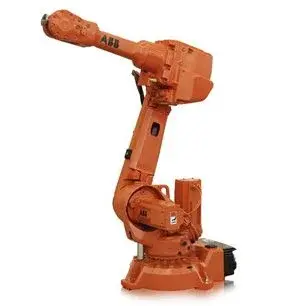
sometimes, fortunately not often, the anthropomorphic robot is confused with the humanoid robot, or android, that is the one with arms and legs. as already said is a mistake, the anthropomorphic robots are those in figure below.
the term “antropomorph” comes from the fact that this robot is similar to the human arm. a first vertical axis called “cinta”, a second orthogonal axis to the first, called “spalla”, and a third axis parallel to the second, called “gomito”. as already explained we stop here, because formally the other joints are part of the wrist.
the human arm is similar, but not equal, because it has an extra joint. The human shoulder is a three-axis joint, the anthropomorphic robot has only two, belt and shoulder. man's elbow is cinematically equal to that of the robot. the human wrist is then “spherical”, like those of the robots in the figures below (only the orange ones).
therefore the human arm has in all seven axes. is therefore “relevant” than any task, which at most may require six gdl. as announced some posts above in fact, redundancy is not a mistake, it is something very useful, in the following of this thread I will explain why. One thing that can be noticed right away is that by fixing the position and orientation of the final organ, a six gdm manipulator has only one useful configuration to its attainment (in reality a finite number of configurations, but we will see it later). a redundant manipulator instead has an infinite number of possible configurations. In fact, if you grab the edge of the table (then put the final organ of your arm, that is, the hand) and hold the shoulder, you can still move the elbow. This a six-axis robot cannot do it.

let's see the main features of an anthropomorphic robot. Its volume of work is a sphere that lacks ball pieces corresponding to the different combinations of the end of the joints. below you see a section passing through the center.
the joints are all rotoidal, the basic ones usually do not even need maintenance, the ones of the wrist need an oil change every about 60,000h, like the cars. the volume of work is very large compared to the encumbrance of the manipulator. a robot with two and a half meters of arm has a base 600x600 approximately. It's a pretty fast robot, although robots aren't usually made to compete in speed with custom machines, which they win anyway.

industrial robot manufacturers have focused on this kinematic chain, realizing important economies of scale. Today a anthropomorphic robot is extremely competitive in terms of price, reliability, maintenance and durability compared to any other machine, because the same robot, identical, can be used for a myriad of different tasks, in completely different areas. is the concept of “flexible automation”. I make a list of the main tasks in which anthropomorphic robots are used:

handling & loading/unloading
packaging
manipulation manipulation manipulation
welding points
continuous welding
laser cutting
waterjet cutting
paint painting
coating of adhesives and sealants
mechanical processing
foundry
mounting
servicing machine tools

the range of anthropomorphic robots is very wide. can rise from less than one kilo, up to 1200kg. half a meter to more than four meters.

anthropomorphic robots are normally built in two main forms. the first, classic six-axis, is the one that is seen under the “orange” robots. However, there is a second form of realization, that of the robots that are seen in white, that is a cinematic chain with only four axes. the robot continues to be “antropomorph”, because what is missing are the first two wrist joints. These robots can then position the terminal organ at any point (inside the work volume) but can guide it exclusively by turning it around a vertical axis. the manipulated piece will therefore always and only vertical. are the so-called “robots of palletization” and have practically the only purpose to pack and unpack pallets, or to manipulate objects in the world of packaging.

in the figures below you can notice how some robots have a parallelgram, or even two in the case of larger palletizers. the purpose of the parallelogram is to remote actuators. a robot without a parallelgram must necessarily have the first three engines in correspondence of the first three axes. in this way every motor must move all the following. It is important to consider that each engine carries with it the effect of its weight, the weight of the reducer, the inertia of its movement and the gyroscopic effect of its axis. each of these effects is heard by the engines preceding it, and must be predicted and compensated by the control. the addition of a parallelgram allows you to move the engines to the base, for example the engine of the axis three at the axis two, reducing these effects. Since the wrist of the palletizing robots has only one axis, it is geometrically possible to add a second parallelgram to reduce even more the scaled masses.

two side advantages of robots with parallelgram. the first is that the articulated structure is more rigid and weaker both under its own weight, and under the inertias of the masses in motion. the second is that by remoteizing the actuators and therefore reducing the masses to swing, it is possible to be more “generous” with the masses of the arms. in fact the robots with parallelgram are often all steel, those without parallelgram have often steel only the base and the first arm, the others are aluminum. the main problem of aluminum is that its thermal expansion is significantly greater than that of steel. an aluminum robot therefore, if used on processes in which for any reason there is a thermal transient, will have an effective repeatability less than a completely steel. while the latest controllers can estimate and compensate for the flexions of the arms due to weights and inertias, nothing can against thermal expansions.
However, the parallelogram prevents the turn of the robot, i.e. the rotation of the axle three over 90°. practically the robot with parallelgram can not take objects “behind the back”, but must necessarily rotate 180° the axis one.

Finally, you can notice how the robots with higher payload (transportable load) have a counterweight behind the shoulder. the most stressed joint of an anthropomorphic robot is that of axis 2. this actuator in fact for positive spins (in advance) must have a couple such as to compensate all the weight of the robot completely peeled. for negative rotations, those that “dazzle” the robot, instead couples are lower. the counterweight aims to center these two pairs compared to zero. practically “help” when the robot is peeled, and “reme against” when it is crouched. for some robots the counterweight consists of a large piece of steel or cast iron mounted behind the shoulder; for others instead is a large cylinder with inside one or more large springs that can exercise a push also of several tons. in the figures below you see examples of both types.
 

Attachments

  • robot2600.webp
    robot2600.webp
    6.8 KB · Views: 16
  • irb4400b.webp
    irb4400b.webp
    13.4 KB · Views: 20
  • 93836f.webp
    93836f.webp
    29.7 KB · Views: 8
  • 460.webp
    460.webp
    4.7 KB · Views: 21
  • IRB_2600_long_working_range.webp
    IRB_2600_long_working_range.webp
    12.2 KB · Views: 20

Forum statistics

Threads
44,997
Messages
339,767
Members
4
Latest member
ibt

Members online

No members online now.
Back
Top