• This forum is the machine-generated translation of www.cad3d.it/forum1 - the Italian design community. Several terms are not translated correctly.

the mystery of the "strange" vines

  • Thread starter Thread starter Meccbell
  • Start date Start date
because probably desmoire hypotheses the following condition. the two elements are connected with two flange attacks to and b. if the stress, which she assumed alternating, is of traction, that is to tend to get away from b, all the spacers placed on the face b are compressed while the corresponding on to are discharges. On the contrary, if the stress is compression, the opposite condition occurs.
I think he wanted to play it that way.
..uhmmm.
I would say that under traction the spacers are always compressed, both above and below (the screws with heads and dice always keep them compressed to its flange).
alternating in compression all the spacers (and therefore the screws) are discharged and the stress remains only between the flanges.
in practice screws and spacers (over and below) always work the same way, when alternating it does for everyone.. or all compressed or all downloads.. I can't believe

greetings
Marco:smile:
screwed on time.. .
That's what I meant. if I put in compression the chain
head-distantial-flangia-dado
or
head-flangia-distantial-dado
I don't think things change much.

in compression then, the screw does not notice anything. in fact the compression takes place exclusively on the flanges, and since the deformation of the spacer is great compared to that of the flange, the stem of the screw will not notice anything. This is exactly why the screws do not suffer fatigue (yes, okay, not the only one).

rest of the opinion that alternation is due to reasons of comfort of assembly. However I would have mounted them on-down-down and not on-down-up-up, because it would have been more comfortable.
 
...Monday morning and the mind is less fresh on Friday night...we see if I can get confused a bit more.

I agree with you, up or down they work identically. I don't even remember anymore because in the end I thought it was a structural choice. ..I remember only that I thought it would serve to share more homogeneous stresses on the whole flange in the presence of an alternating flexing moment.
but so much up or down nn changes nothing, if there is mf still work only connections from the traction side (compared to the neutral axis) and ciccia.

Um... I throw there another hypothesis: limit the decay of the mechanical characteristics of the flanges in correspondence of the welds of the spacers, sharing them in equal number on both.
 
Um... Yes, it could be that, perhaps even limit the deformation of the flange that would be welded only on one side. .
 
I looked at the pdf and it's very interesting. I'll look better calmly, now I have to work.. . .
have you noticed how they recommend placing the contradado on the last page? I have always seen the opposite in everyday practice.
What do you say?
...and now who tells it to the "chief" that we have always enlivened dado and controversial to the reverse?!? ! :eek::eek:

but the sacred texts of the drawing, how do they put them?
 
...and now who tells it to the "chief" that we have always enlivened dado and controversial to the reverse?!? ! :eek::eek:

but the sacred texts of the drawing, how do they put them?
So far I've always held back... but I've always seen them with that fat for the last... or the most equal.

more often equal, because otherwise threading the key becomes problematic. . .
 
I have always put them as in pdf, fighting with those in the workshop. very simple reason: what he actually holds is the external one, so it's right that he's the biggest one. when the worker took over the hammer I proposed the agreement: two identical dice.. .

the thread of the middle one is discharged as you pull the outside, so in practice it is the inner one that prevents the outside from unscrewing, not the vice as you (self) would be led to think.
the text files... niemann does not even consider it, relying on honestly more imaginative methods (besides the classic split rosettes), baldassini even. I begin to suspect that it is a secret handed down by engineer's mouth to engineer's ear in the last full moon night before the summer solstice

as to the alternation of the verse of the vines, I am led to think more of an aesthetic fact: compression thinks of the flange itself, so I do not see why to alternate positions. Maybe if I feel like a former professor, I ask him the question, he in these imaginative solutions,
 
... as to the alternation of the verse of the vines, I am led to think more of an aesthetic fact: compression thinks of the flange itself, so I do not see why to alternate positions. Maybe if I feel like a former professor, I ask him the question, he in these imaginative solutions,
eye that are not the vines to be alternating but, the spacers. the screws are all threaded from top to bottom.
 
Um... Yes, it could be that, perhaps even limit the deformation of the flange that would be welded only on one side. .
for me spacers are free, weld them would only serve to increase causes of further stress due to forced alignments.
 
...and now who tells it to the "chief" that we have always enlivened dado and controversial to the reverse?!? ! :eek::eek:

but the sacred texts of the drawing, how do they put them?
Don't tell him, "suggest him!"

p.s.: however just seen "quiet"!
:smile:
 
for me spacers are free, weld them would only serve to increase causes of further stress due to forced alignments.
..also because they should probably be replaced at each new installation (if they are thin tubes, as it seems, those are crushed and deformed under the tightening couple. spacers to put to "long the screws" should be much more "consistent".

greetings
Mar

p.s. yes I know, at first I had thought they were welded:
 
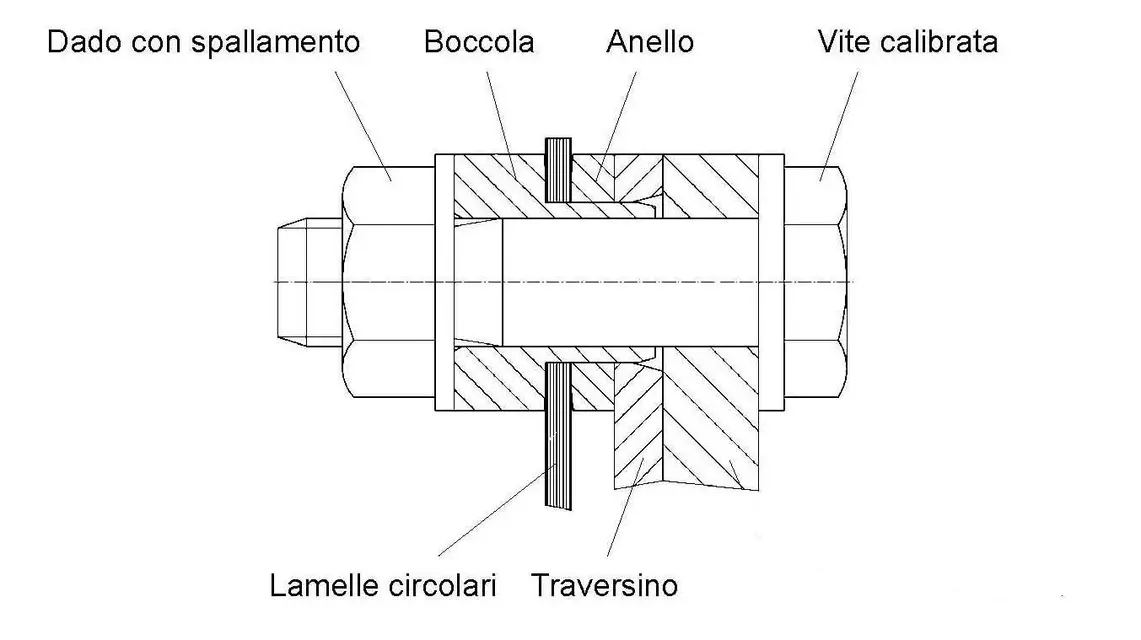
I don't think the screws are calibrated. and still don't work to cut.

However the samples in the drawing are wrong. . .
 
eye that are not the vines to be alternating but, the spacers. the screws are all threaded from top to bottom.
Yes, I have beaten writing for the rush

Zooming the image very much, the impression that they are welded is strong, especially on the left side, but it could be a play of shadows.
 

Forum statistics

Threads
44,997
Messages
339,767
Members
4
Latest member
ibt

Members online

No members online now.
Back
Top