• This forum is the machine-generated translation of www.cad3d.it/forum1 - the Italian design community. Several terms are not translated correctly.

throat and plug blocks thread

  • Thread starter Thread starter UADC
  • Start date Start date

UADC

Guest
Good morning to all, I would have some advice to ask you.

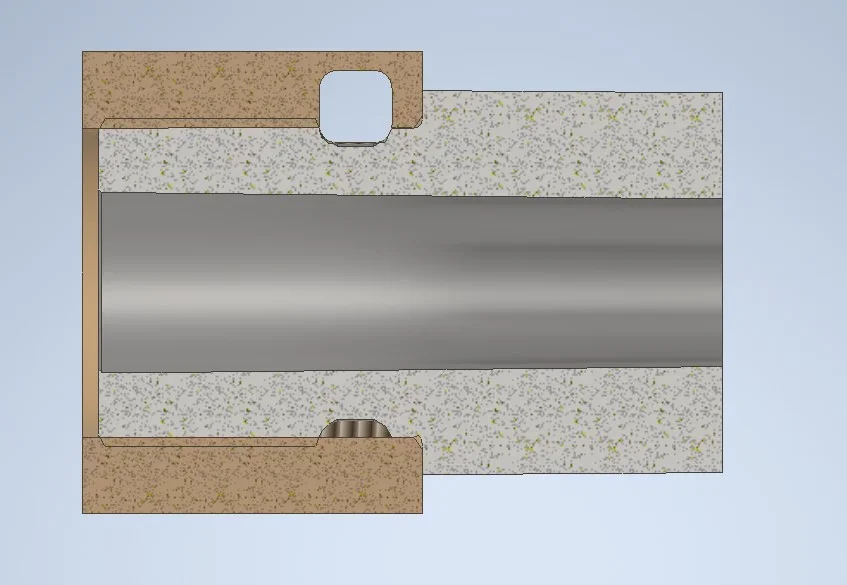
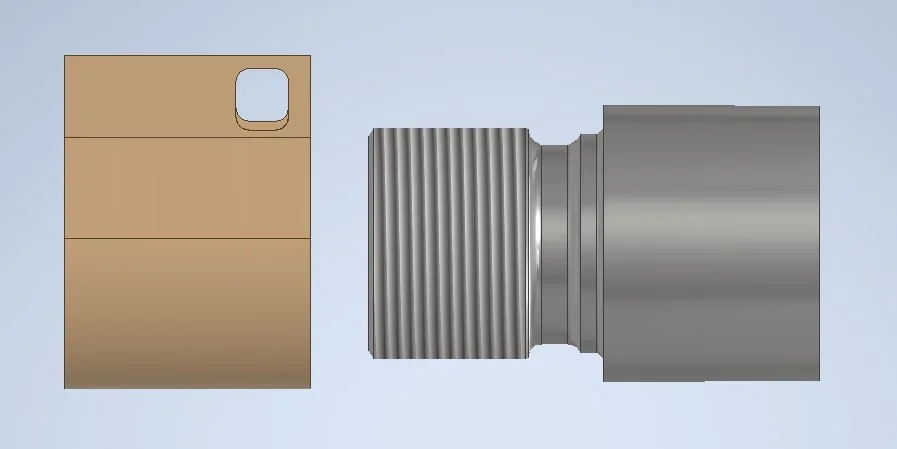
I have a fixed support, which acts as a madrevitis with a thread m27 x 1.5 along 26mm, in which a 300 mm long tube must be connected with an external diameter of 32 mm, and 14mm inner, which must bear nearer peaks with a maximum of 500 mpa. one of the ends of the tube also has a thread m27 x 1.5 long 24mm. the lock between the two is applied a force of 230 nm. both the tube and the support are of 416l steel.

This tube must be disassembled several times a day and I wondered if it was possible without the help of keys, to be able to insert a plug (not circular that will be tightened with 15 nm) in the outer part of the tube that does not rotate it, allowing the workers to be able to escape from the support operating only on the plug and manually unscrewing the tube after removal of this.

to do this I created a past throat between the support and the pipe.

My perplexity is:
1) Can the plug system create more vibrations?
2) the thread in contact with the plug would suffer deformations?

Would you have any further suggestions?

Thank you very much!! !
 

Attachments

  • Imm 1A.webp
    Imm 1A.webp
    7.3 KB · Views: 17
  • Imm 2A.webp
    Imm 2A.webp
    21.3 KB · Views: 17
  • Imm 3A.webp
    Imm 3A.webp
    15.4 KB · Views: 14
  • Imm 4A.webp
    Imm 4A.webp
    37.5 KB · Views: 15
  • Imm 5A.webp
    Imm 5A.webp
    37 KB · Views: 17
I honestly didn't understand the sense of plug.
the pipe must be screwed, it must be tightened with a certain force, what is the plug for?
 
I honestly didn't understand the sense of plug.
the pipe must be screwed, it must be tightened with a certain force, what is the plug for?
Perhaps to avoid a split, some kind of counter-dead? :unsures:

for sure that you do not recalculate the thread.. as it is about 500 mpa
the throat would be useful to move it away from the end of the filet.
2 gorges, one for the discharge of the fillet.. and the other the location of the wrench/spine
 
Last edited by a moderator:
there are rapid attacks that reach pressures of over 200bar.
could be a certified solution without inventing things that weaken.
Perhaps it would be more appropriate to use a flexible and not rigid pipe.
 
I honestly didn't understand the sense of plug.
the pipe must be screwed, it must be tightened with a certain force, what is the plug for?
I understand. despite the long description I didn't understand much.
only they have to remove and put the tube several times a day.
Screwing and unscrewing is a quick operation for sure.
The bayonet triggers are instantaneous and there are the lever ones....so strength reduction to graft and you can do it as well in pressure....depends on what and how.
 
there are rapid attacks that reach pressures of over 200bar.
could be a certified solution without inventing things that weaken.
Perhaps it would be more appropriate to use a flexible and not rigid pipe.
500 gpa sono 5000 bar
 
Perhaps to avoid a split, some kind of counter-dead? :unsures:

for sure that you do not recalculate the thread.. as it is about 500 mpa
the throat would be useful to move it away from the end of the filet.
2 gorges, one for the discharge of the fillet.. and the other the location of the wrench/spine
good afternoon victorious, I planned to try with a side screw (the same system of cabu rings) what do you think? 1 single screw or 2 at a distance of 90° would be enough, obviously with the 2 exhaust gorges as wisely recommended by you?
 
If the goal is not to let him unscrew. . definitely your second solution is the cheapest and at the same time effective. a life would be enough
 
Last edited by a moderator:
500 gpa sono 5000 bar
in the first post is written mpa that means micro pascal.
if one wants to write mega pascal writes mpa.

beyond this, are we sure that in a tube so we pass 5 milà bar?

5000 bar = 72'518 psi

the tube is 1/4" thickness 0.354"

here what approaches is 10 times less than 7'700 psi.... are we sure?
Screenshot_20230824_211859.webp
 
in the first post is written mpa that means micro pascal.
if one wants to write mega pascal writes mpa.

beyond this, we are sure that in a tube so we pass 5 milà ba
:roflmao::roflmao::roflmao: I realized after the minchiata. .
You're right. 5000 bar stuff from Gracethe minchita must have escaped also @uadc :roflmao::roflmao:
 
in the first post is written mpa that means micro pascal.
if one wants to write mega pascal writes mpa.

beyond this, are we sure that in a tube so we pass 5 milà bar?

5000 bar = 72'518 psi

the tube is 1/4" thickness 0.354"

here what approaches is 10 times less than 7'700 psi.... are we sure?
View attachment 69009
I think I'm interested in 500 bars. but I expect you to correct and clarify.

I have a doubt. If they were 500 mpa there would be no risk of implosion of the tube due to atmospheric pressure around?

I would look at quick attacks. like those in the oil circuits of tractors
 
I think I'm interested in 500 bars. but I expect you to correct and clarify.

I have a doubt. If they were 500 mpa there would be no risk of implosion of the tube due to atmospheric pressure around?

I would look at quick attacks. like those in the oil circuits of tractors
500mpa you must see if absolute or relative.

If I am 50bar, as I thought, quick attacks and away.

otherwise there are sae attacks with 4 screws just to not tighten huge dice.
 
@uadcfor hydraulic cylinders I use fast parker attacks (up to 500bar)
Take a look if it can be useful to your purpose. -- parker
 
Last edited by a moderator:
Thanks to everyone for the answers. I can only tell you that the system has to withstand peaks of up to 525 mpa. and the "tube" must not undergo any movement with respect to the support and must be replaced. in replacement there should not be variations of 0.1 mm. That's what I'm looking for. I know it's complex, if it wasn't, I wouldn't have asked. Unfortunately I have to work on the support and I can't insert other pieces. then passing screws. between one part and the other of the support is transit through a throat? screws intercepting the throat at 90 degrees? Unfortunately I cannot be more specific than that! thanks really for vs support! ! !
 
Thanks to everyone for the answers. I can only tell you that the system has to withstand peaks of up to 525 mpa. and the "tube" must not undergo any movement with respect to the support and must be replaced. in replacement there should not be variations of 0.1 mm. That's what I'm looking for. I know it's complex, if it wasn't, I wouldn't have asked. Unfortunately I have to work on the support and I can't insert other pieces. then passing screws. between one part and the other of the support is transit through a throat? screws intercepting the throat at 90 degrees? Unfortunately I cannot be more specific than that! thanks really for vs support! ! !
you write mpa non mpa.
air? oil? water? What fluid is it?

but it's five thousand bars. What are you doing at such a high pressure? Please confirm?

to catalog that tube 8 times less.

Are you sure about numbers and units or are you confused?

I'm sorry if I doubt but they're out of control numbers.

But what are you planning so secret?
 
you write mpa non mpa.
air? oil? water? What fluid is it?

but it's five thousand bars. What are you doing at such a high pressure? Please confirm?

to catalog that tube 8 times less.

Are you sure about numbers and units or are you confused?

I'm sorry if I doubt but they're out of control numbers.

But what are you planning so secret?
I wrote you in private.
 

Forum statistics

Threads
44,997
Messages
339,767
Members
4
Latest member
ibt

Members online

No members online now.
ciao
Back
Top