• This forum is the machine-generated translation of www.cad3d.it/forum1 - the Italian design community. Several terms are not translated correctly.

torque calculation on the screw needed to dilate round pipe with wedges

  • Thread starter Thread starter reggio
  • Start date Start date

reggio

Guest
Hello everyone, I come back to ask for help and to refresh school concepts.

I have a round tube ø133mm thickness 2.6mm 235j I have the need to "dilate it" homogeneously up to ø136mm for a length of 140mm.

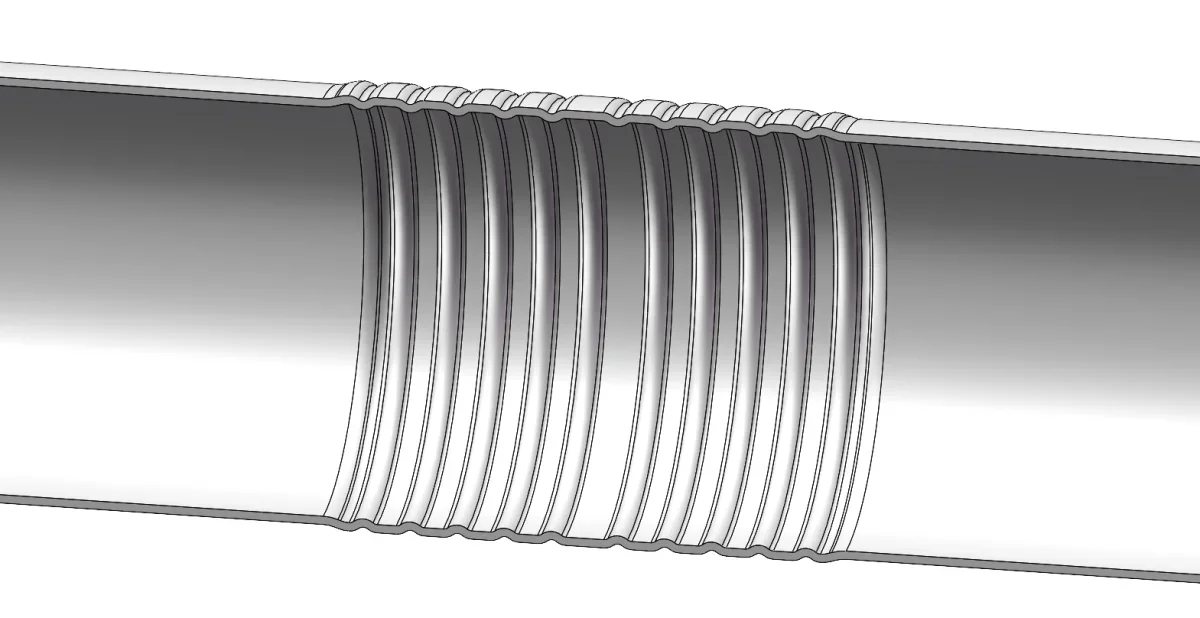
I thought I could use a system. fast/those similar to that used in this video doing 2 deformations by turning the tube of some degree to "fill the holes" left by the first deformation.

you would know how to help me with formulas and the calculation of the first hypothesis that provides
pipe ø133x3 l=140 235j to be carried to ø136 l=140 by means of flange/clinched cutter 20° and n°14 die wedges with surface 10x140mm?

I would like to calculate the single deformation effort, the axial force necessary to approach the 2 blue flanges/cunae, finally get the necessary torque to be applied to the screw that will approach the 2 flanges/cuneo.

Help me, explaining with all the steps, as if I was 3 years old, as usual? : 1697554574372.webp1697554620065.webp
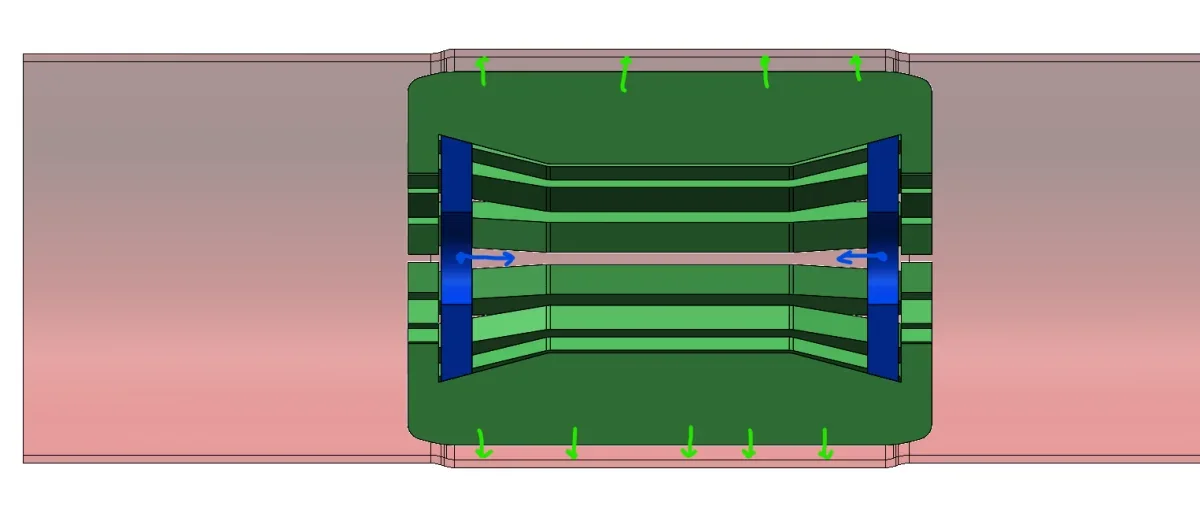
 
give an eye qui (to simplify).
I would make a simulation. the solution is not trivial because it enters the field not linear. you must consider the elasto-plastic behavior of the material. even if in theory it is enough to overcome disnervation (simplification).
 
give an eye qui (to simplify).
I would make a simulation. the solution is not trivial because it enters the field not linear. you must consider the elasto-plastic behavior of the material.
hello and thanks, but I had written "like a 3-year-old" not "I want to take 3 years";)

Of course, you're too professional and I'm too crude.

I keep this as good:
even if in theory it is enough to overcome disnervation (simplification).
that leads me to, grossly, having to stay between 236n/mm2 and not approaching 360n/mm21697561919648.webp. Uhmm if the calculator doesn't fool me we have
14 wedges x 10mm x 140mm x 240n/mm2 = 471 ton = change immediately road ..

maybe changing mechanism? working on a surface 10x10mm x 14pz= ... even so, even finding the way, I always find myself with 34ton ...

No, I don't think that makes sense what I've just done, the ridding just doesn't take into account the thickness, it can't be right... but then? Sob...
 
looking at the design you notice a disproportion between the blue disk and the wedges.
It is clear that it takes tons to dilate.

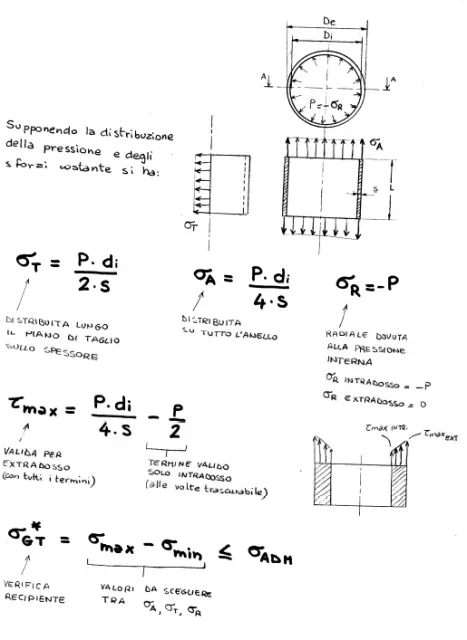
First of all, I would try to calculate the force that I need to overcome the yield of a pressure cylinder shirt. 1697569250536.webpThese are the formulas for cylinder shirts.
from here you can understand that pressure you have to achieve.

once determined it is necessary to find the mechanism to generate pressure.
 
simplified to the maximum you can use the mariot formula to obtain the pressure to press.
 
looking at the design you notice a disproportion between the blue disk and the wedges.
It is clear that it takes tons to dilate.

First of all, I would try to calculate the force that I need to overcome the yield of a pressure cylinder shirt.View attachment 69382These are the formulas for cylinder shirts.
from here you can understand that pressure you have to achieve.

once determined it is necessary to find the mechanism to generate pressure.
hello and thank you, I see the formula but I can't understand how to apply them...
"of" I know him, even "de" and "s" but it seems not to serve
"p" is pressure? in practice is what I look for .. I believe ...

Can you replace my values on your formulas? so I get clearer:)
Thank you.
 
hello and thank you, I see the formula but I can't understand how to apply them...
"of" I know him, even "de" and "s" but it seems not to serve
"p" is pressure? in practice is what I look for .. I believe ...

Can you replace my values on your formulas? so I get clearer:)
Thank you.
the formulas of dixan are not enough.... need also some science.
begins to put formulas in excels and polls p.
then use the last formula by imposing admissible sigma as at least yielding.
 
the formulas of dixan are not enough.... need also some science.
begins to put formulas in excels and polls p.
then use the last formula by imposing admissible sigma as at least yielding.
It is not a matter of dixan, if I were learned I would not ask ... di
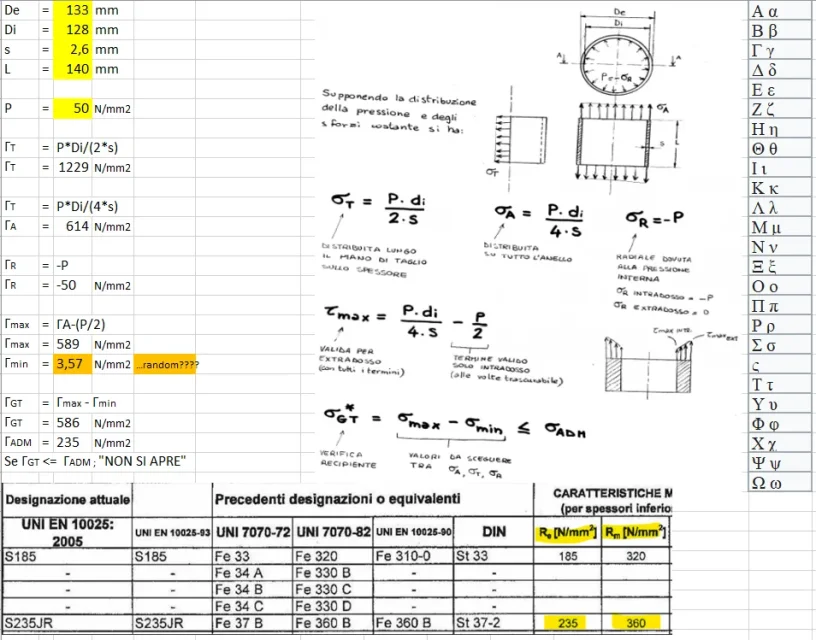
excel asks me if tao min can be calculated, can you tell me how?1697651891279.webp
 
in theory tau do not enter the account.
. Then I fear that I have understood nothing of your help,
does the result not come from the comparison of the tao?
If you can make an effort and meet me I would appreciate it
(maybe the Greek letters we can throw them and use our alphabet)1697652860884.webp
 
in the formula of the above criterion are indicated sigma, i.e. normal tensions (sigma).
the axial sigma, the tangential sigma and the radial one and take the max difference between these 3.

It is then reinforced with the admissible sigma, which in your case, to what I understand, is the yielding sigma.

the tau are the tangential tensions which, in the above criterion, do not fall.
 
in the formula of the above criterion are indicated sigma, i.e. normal tensions (sigma).
the axial sigma, the tangential sigma and the radial one and take the max difference between these 3.

It is then reinforced with the admissible sigma, which in your case, to what I understand, is the yielding sigma.

the tau are the tangential tensions which, in the above criterion, do not fall.
Hi, I think I understand:)

but I'm afraid I'm wrong, it would prove that with 19n/mm2 I'm exceeding the yield of 235n/mm2 material...

What's wrong? :( Do you correct me the task?

excel files verifica tubo - download - 4shared - yayeh33008 1697698011309.webp
 
Good morning

therefore considering the development of the area are 58,466 mm^2 for which we would like to multiply for 235 n/mm^2 a force of 13,739.510 n.... right?
 
therefore considering the development of the area are 58,466 mm^2 for which we would like to multiply for 235 n/mm^2 a force of 13,739.510 n.... right?
I would say no, in that case you would not use any of those formulas, besides you would not take into account the thickness and this does not make sense...
applying the formulas (except my errors) would suffice 19n/mm x surface not to verify the container, so to dilate it ... but also so I don't think we have much sense if the yield is 235n/mm2 ... so I expect the correction of the task from @meccanicamg and anyone else wanting to cite in the resolution & explaining:)
 
My was a provocation, as I see it the way you want to do this, I don't say it's impossible, but it definitely takes a very high force. a couple of questions but should this work be done on existing pipes or what? but do you have to design a machine that does this kind of processing? must be done absolutely like that? other information you can have thanks
 
Mine was a provocation, as I see it, it takes a very high force. is it made on existing pipes? must be done absolutely like that?
provocation? for who?
yes undoubtedly serves strength, I have predicted 14 wedges, can work in pairs bringing the effort to only 2 wedges per time x10mmx140mm.
should be made on existing tubes in what sense? It should be done on new pipes, it is necessary to obtain in any way (excluding removal or welding processing) a "circular homogeneous soil" of 1,5mm on the radius, length 140mm, at the center of a 430mm long tube in all.

among the various alternatives I am also evaluating such a stuff 1697719810481.webpany idea is the welcome, but certainly does not prescind from a draft of initial alcohol to understand whether humanly or not faceable. would be an internal, experimental machine. at the moment we use thicker tube which is then turned: a waste.
 
quickly made a calculation and known that you continue to use tau instead of sigma.
View attachment 69409
Please, let the megapascals stay, just make confusion
I say well if I interpret your calculation by saying: with 19n/mm2 the flat tube? Is that so?

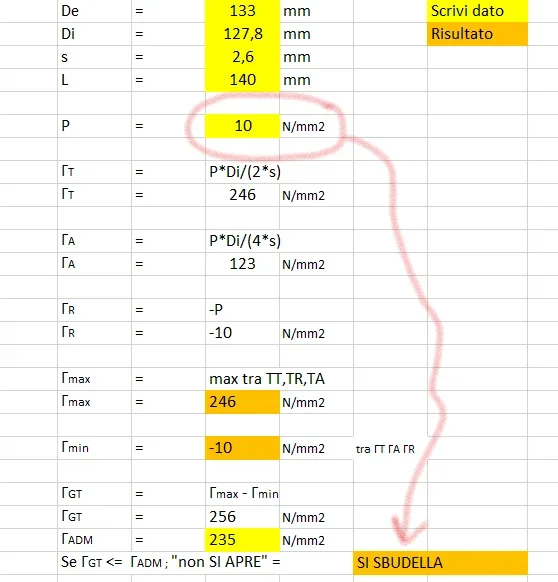
I updated the formula, so tmax doesn't need anything here, do I throw it?1697720271176.webp1697720419106.webp...even with 10n/mm2 deforms? ? ?1697720489014.webpCan you help me?
 
provocation? for who?
yes undoubtedly serves strength, I have predicted 14 wedges, can work in pairs bringing the effort to only 2 wedges per time x10mmx140mm.
should be made on existing tubes in what sense? It should be done on new pipes, it is necessary to obtain in any way (excluding removal or welding processing) a "circular homogeneous soil" of 1,5mm on the radius, length 140mm, at the center of a 430mm long tube in all.

among the various alternatives I am also evaluating such a stuff View attachment 69410any idea is the welcome, but certainly does not prescind from a draft of initial alcohol to understand whether humanly or not faceable. would be an internal, experimental machine. at the moment we use thicker tube which is then turned: a waste.
to think of performing such processing by means of rolling, if the tube is not too long, a roller is inserted inside the tube that has the male protuberances, and on the outside there is a counter roller that has the female gorges.
Note: operation already made but on lower thicknesses and diameter of tube larger.. .
 

Forum statistics

Threads
44,997
Messages
339,767
Members
4
Latest member
ibt

Members online

No members online now.
Back
Top