• This forum is the machine-generated translation of www.cad3d.it/forum1 - the Italian design community. Several terms are not translated correctly.

trolley design with transmission chain

  • Thread starter Thread starter Siriegia
  • Start date Start date

Siriegia

Guest
Hello.
for new application I am designing a positioning system to which I ask two positions with centesimal repeatability. the machine includes two inclined independent trolleys of 45°. the race is of some ten mm, the movement is very slow and happens a few times per hour, for change of equipment.
excluded for reasons that I am not explaining to you, to move the load, the hydraulic solution, I thought of a flexible transmission.
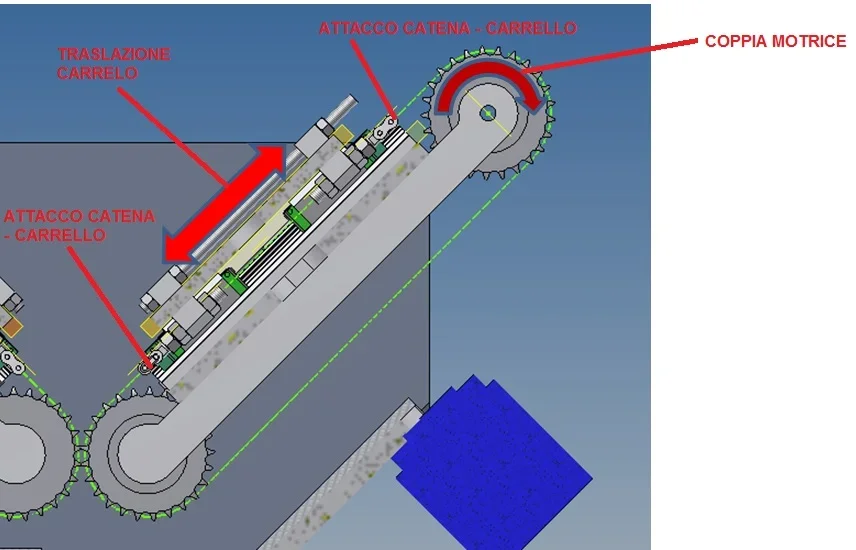
I thought of using for each cart 3 linear guides of which 1 with integrated linear encoder, and 2 iso chains 606 10b1 rollers to handle it. the 2 chains are directly connected to the cart and are moved by a transmission shaft controlled by a brushless servomotor .
to tension the chain I predicted a screw shooting device.

I'm asking you:
*With this solution you can achieve the accuracy 7 repeatability required?
*Are roller chains suitable for precision applications?
Immagine_1.webp
Immagine_3.webpImmagine_2.webp
 
for such precision I would opt for a recirculation screw of spheres, or in any case to a screw-magnet mechanism.
 
Hello.
for new application I am designing a positioning system to which I ask two positions with centesimal repeatability. the machine includes two inclined independent trolleys of 45°. the race is of some ten mm, the movement is very slow and happens a few times per hour, for change of equipment.
excluded for reasons that I am not explaining to you, to move the load, the hydraulic solution, I thought of a flexible transmission.
I thought of using for each cart 3 linear guides of which 1 with integrated linear encoder, and 2 iso chains 606 10b1 rollers to handle it. the 2 chains are directly connected to the cart and are moved by a transmission shaft controlled by a brushless servomotor .
to tension the chain I predicted a screw shooting device.

I'm asking you:
*With this solution you can achieve the accuracy 7 repeatability required?
*Are roller chains suitable for precision applications?
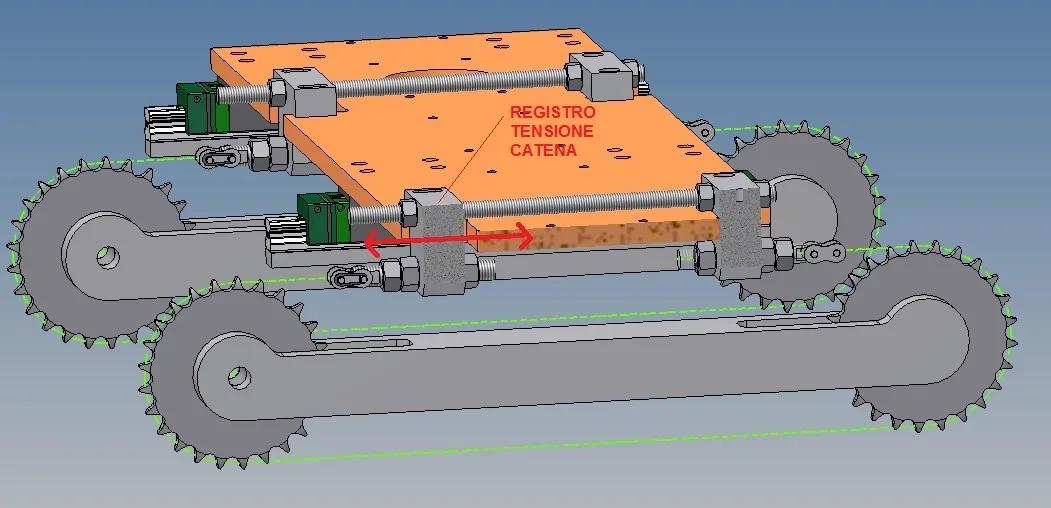
View attachment 69021
View attachment 69023View attachment 69022
Good evening.
if you have thought of this solution there will be a reason you know, but it is not possible to put a linear actuator with screws of balls or screw jack, in between the two guides instead of the central one (three guides are not good) I would avoid all those pieces and recordings rather a movement with rack. for the position check in the actuator already is previewed for the pencil solution or rack a linear transducer .
 
If possible, I would also opt for a system with ball screws controlled by brushless and encoder controlled, if absolute, you don't even have to do zeroing operations when you start the machine.
I would rule out the chain as it wears over time, and if you want precision, it's not the most suitable system.
 
If possible I would put only two linear guides, with 3 risks of hypervinculating the system, unless you have a very high load that obliges you to use 3.
 
With chains he doesn't go anywhere. only the polygonal effect implies a not ability of regular motion.
if just a synchronous belt with teeth.
If you can lift everything and put a ball recirculation screw with a gearbox or pencil.
two linear guides with ball recirculation parties.
 
Boh... for me, if the linear transducer is placed on the linear guide of the tilted cart (and is not an encoder on one of the gears), for me you can also use the chain.
the linear transducer will give the signal to stop always at the same point, taking care of the possible wear of the chain; it will be the motor to have to perform a fraction of turn more or less than when the mechanism was new.
Am I wrong?
 
Last edited:
Boh... for me, if the linear transducer is placed on the linear guide of the tilted cart (and is not an encoder on one of the gears), for me you can also use the chain.
the linear transducer will give the signal to stop always at the same point, taking care of the possible wear of the chain; it will be the motor to have to perform a fraction of turn more or less than when the mechanism was new.
Am I wrong?
No, no, no, no, no, no, no, no, no, no, no, no, no, no, no, no, no, no, no, no.
 
No, no, no, no, no, no, no, no, no, no, no, no, no, no, no, no, no, no, no, no.
According to me, only one chain for trolleys (I don't understand why there are 2...), so the problem of the different wears would not exist (although I believe that the linear guides bind the movement and if one chain was longer than the other, the cart would cut off).
because you don't want to use a canonical ball recirculation screw, maybe it's just because our friend never used it and has more confidence with chains and gears.
 
the problem of the chain, among other things, is that you have a slower regularity than a screw mechanism.
 
the problem of the chain, among other things, is that you have a slower regularity than a screw mechanism.
and even if it were, what does it matter? the wagon goes slow and the friend only cares about precision.
 
Boh... for me, if the linear transducer is placed on the linear guide of the tilted cart (and is not an encoder on one of the gears), for me you can also use the chain.
the linear transducer will give the signal to stop always at the same point, taking care of the possible wear of the chain; it will be the motor to have to perform a fraction of turn more or less than when the mechanism was new.
Am I wrong?
with the line where you say it works just like that, even if you use a 4 teeth pinion. But will the closed back ring be able to guarantee the stop of a non-hard axis in the desired positioning tolerance? This is the problem.
 
with the line where you say it works just like that, even if you use a 4 teeth pinion. But will the closed back ring be able to guarantee the stop of a non-hard axis in the desired positioning tolerance? This is the problem.
the post author had written that the line would be placed on the guide, I did not change the initial configuration. regarding your question, given the low speed and adopting a slowing ramp, for me there are no positioning problems.
 

Forum statistics

Threads
44,997
Messages
339,767
Members
4
Latest member
ibt

Members online

No members online now.
ciao
Back
Top