
You are using an out of date browser. It may not display this or other websites correctly.
You should upgrade or use an alternative browser.
You should upgrade or use an alternative browser.
meccanicamg
Guest
Bye. If you're a future engineer, I don't start well.I have no idea how to start this project. ..you're gonna smoke me.
You haven't read, but with the rules and you haven't even introduced yourself.
on the forum was treated long and wide, kicks, books and sites where to find formulas and ways as well as reasoning to do.
I don't understand why you get to do the project of year without knowing the subject.
but did you attend classes?
If you put down a scha, a more detailed list of how you want to proceed....you can also do an analysis together.
reading the text, the track is clear: with encumbrance box and interaxes imposed, depending on the group there are the characteristics of power/turns/report to be used to dimension the reducer.
they will have taught you lewiss, hertz...or some norms to size and verify the gears.
divide the total relationship in the two stages and verify that it is feasible.
sized the gear train you need to make the first round with the trees and reactions to the bearings. subsequently check and select bearings.
I recommend you make reasonings on paper sheets but to put everything in excel so you can change the parameters without remaking the accounts tens of times unnecessarily.
having everything in excel I would say that you can make sizing and complete verification in a morning and the drawings to the cad with complete table set in 3 days. Realizing that you have no idea where to go, you'll need at least 80 hours if you don't miss it.
Last edited:
meccanicamg
Guest
forgive the errors automatic concealer... I was very frantic and I didn't reread.Bye. if you are a future engineer beginning Good.
you have not read Manco the regulation and you haven't even introduced yourself.
on the forum was treated long and wide, Home, books and sites where to find formulas and ways as well as reasoning to do.
I don't understand why you get to do the project of year without knowing the subject.
but did you attend classes?
If you put one down schema, a more detailed list of how you want to proceed....you can also do an analysis together.
reading the text, the track is clear: with encumbrance box and interaxes imposed, depending on the group there are the characteristics of power/turns/report to be used to dimension the reducer.
they will have taught you lewiss, hertz...or some norms to size and verify the gears.
divide the total relationship in the two stages and verify that it is feasible.
sized the gear train you need to make the first round with the trees and reactions to the bearings. subsequently check and select bearings.
I recommend you make reasonings on paper sheets but to put everything in excel so you can change the parameters without remaking the accounts tens of times unnecessarily.
having everything in excel I would say that you can make sizing and complete verification in a morning and the drawings to the cad with complete table set in 3 days. Realizing that you have no idea where to go, you'll need at least 80 hours if you don't miss it.
Did you take a look at similar posts?
Stan9411
Guest
has never returned to the forum since he wrote the question ...
meccanicamg
Guest
You can see that he has no interest and found another way to get his exercise done.has never returned to the forum since he wrote the question ...
sin because you could make a good development.
TETRASTORE
Guest
If the student will still give signs of life I will also be able to give him some useful indications, since the pl series I designed and designed it in 1992-93.
Pietroloc
Guest
Sorry I did it myself and I didn't open the forum anymore I managed to proceed. thanks the same I apologized not thinking the forum was so active and for this I did not reopen it until today. for the next time light regulation and I will follow the rules. Good day
Pietroloc
Guest
I still apologized anyway I also had the idea of using excel much faster thanks.Bye. If you're a future engineer, I don't start well.
You haven't read, but with the rules and you haven't even introduced yourself.
on the forum was treated long and wide, kicks, books and sites where to find formulas and ways as well as reasoning to do.
I don't understand why you get to do the project of year without knowing the subject.
but did you attend classes?
If you put down a scha, a more detailed list of how you want to proceed....you can also do an analysis together.
reading the text, the track is clear: with encumbrance box and interaxes imposed, depending on the group there are the characteristics of power/turns/report to be used to dimension the reducer.
they will have taught you lewiss, hertz...or some norms to size and verify the gears.
divide the total relationship in the two stages and verify that it is feasible.
sized the gear train you need to make the first round with the trees and reactions to the bearings. subsequently check and select bearings.
I recommend you make reasonings on paper sheets but to put everything in excel so you can change the parameters without remaking the accounts tens of times unnecessarily.
having everything in excel I would say that you can make sizing and complete verification in a morning and the drawings to the cad with complete table set in 3 days. Realizing that you have no idea where to go, you'll need at least 80 hours if you don't miss it.
biz
Guest
I was three years old. :The pl series I designed and designed in 1992-93
biz
Guest
Brilliant idea.I had the idea of using excel.
Excuse me, I no longer pollute this discussion. I couldn't resist.
meccanicamg
Guest
and..... seen that you managed to provide, is not the case of sharing so the next ones have to learn something?Sorry I did it myself and I didn't open the forum anymore I managed to proceed. thanks the same I apologized not thinking the forum was so active and for this I did not reopen it until today. for the next time light regulation and I will follow the rules. Good day
meccanicamg
Guest
are there any news about the development of the task?
I carefully observed the track of the task and noticed that there are errors in the track:
- in the text it is indicated that the reducer is a site size pl63 but the drawing of encumbrance reported in the track is of the size pl 80 - the performance indicated in the track table is related to the size pl 63
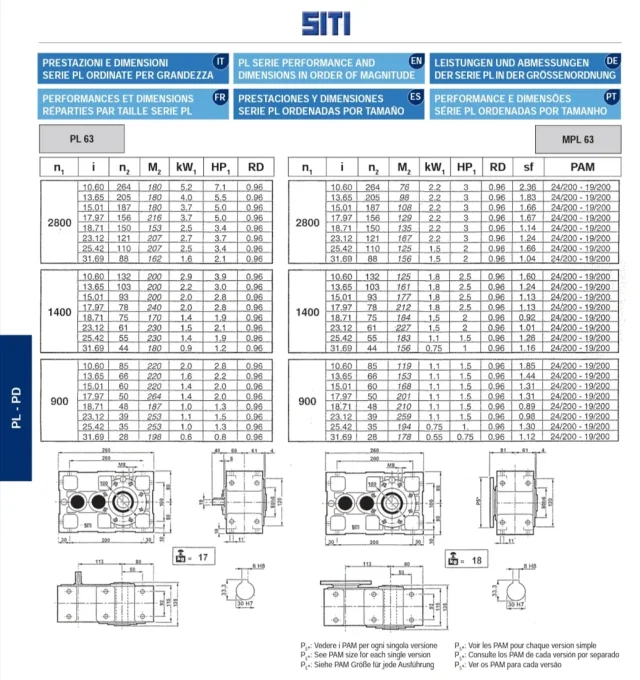 Therefore, we will obtain non-comparable gear values with the real project if we use the data contained in the text proposed by the teacher. with all certainty we will have that gears can be made of materials with mechanical characteristics less than those used in the series reducer.
- in the text is indicated with "i" a value that is called "transmission ratio" but is the incorrect definition because it is the "reduction ratio". the transmission ratio is exactly the reciprocal i.e. u=1/i.
Unfortunately when I was young I did not appreciate the gears and above all I always had little precise and unclear teachers even in the superiors and these errors they did. over the years to follow I was passionate about professional needs and I realized that I had to make clarity even in the terminologies, otherwise the formulas found on manuals or standards produce numbers without proper physical consistency.
Has no student noticed these errors or discrepancies? Has anyone downloaded the manufacturer's catalogue?
I downloaded the catalog because I expected to find a single stage reducer, but of the same size, to be able to determine from the drawing the whole of the last stage. Usually at the same size, on the single stage there is listed the only interasse and on the two stages there is quotated the total intersection...so it is known how much it is even if the builders continue not to put it as ready to use.
I carefully observed the track of the task and noticed that there are errors in the track:
- in the text it is indicated that the reducer is a site size pl63 but the drawing of encumbrance reported in the track is of the size pl 80
- the performance indicated in the track table is related to the size pl 63Therefore, we will obtain non-comparable gear values with the real project if we use the data contained in the text proposed by the teacher. with all certainty we will have that gears can be made of materials with mechanical characteristics less than those used in the series reducer.- in the text is indicated with "i" a value that is called "transmission ratio" but is the incorrect definition because it is the "reduction ratio". the transmission ratio is exactly the reciprocal i.e. u=1/i.
Unfortunately when I was young I did not appreciate the gears and above all I always had little precise and unclear teachers even in the superiors and these errors they did. over the years to follow I was passionate about professional needs and I realized that I had to make clarity even in the terminologies, otherwise the formulas found on manuals or standards produce numbers without proper physical consistency.
Has no student noticed these errors or discrepancies? Has anyone downloaded the manufacturer's catalogue?
I downloaded the catalog because I expected to find a single stage reducer, but of the same size, to be able to determine from the drawing the whole of the last stage. Usually at the same size, on the single stage there is listed the only interasse and on the two stages there is quotated the total intersection...so it is known how much it is even if the builders continue not to put it as ready to use.
meccanicamg
Guest
according to the principle of minimum volume of niemann you get a reducer more or less so composed: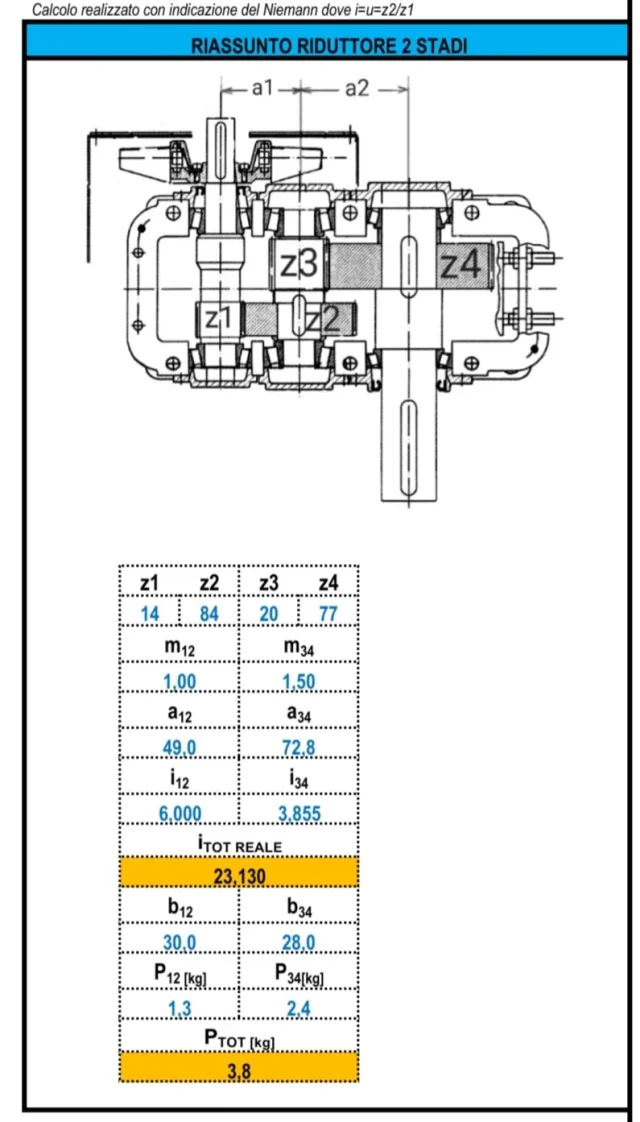 from here you can start to analyze propeller, additional weights of trees, bearings, casings, lids etc. you can increase the entirex up to that proposed by the catalog to improve the wear life of the first pair of gears.
from here you can start to analyze propeller, additional weights of trees, bearings, casings, lids etc. you can increase the entirex up to that proposed by the catalog to improve the wear life of the first pair of gears.TETRASTORE
Guest
Good point!- in the text it is indicated that the reducer is a site size pl63 but the drawing of encumbrance reported in the track is of the size pl 80
I assume that the teacher, having assigned different data to the various groups of students, has exchanged the drawings; probably another group will find pl80 data with pl63 drawings.
the choice of dimensions (interaxes, trees, gears, bearings, etc.) of this series of gears has been carried out taking as the basis the series of normal numbers in geometric progression r10; considering that the size of the gearbox (63) indicates the entirety of the final gear couple, you can easily trace to the intersection of the first reduction.I downloaded the catalog because I expected to find a single stage reducer, but of the same size, to be able to determine from the drawing the whole of the last stage. Usually at the same size, on the single stage there is listed the only interasse and on the two stages there is quotated the total intersection...so it is known how much it is even if the builders continue not to put it as ready to use.
unless explicitly stated that the reducer will be connected to the machine by joint, in the calculation of the bearings of the output shaft it is necessary to consider an external load determined by the tangential force generated by a pinion or other organs.
In this regard, all manufacturers indicate to the catalog the radial and axial load admissible and some, like the one mentioned in the exercise, also reports its polar diagram.
Also for the input shaft, unless it is in the motor version, you will have to calculate the bearings considering the possibility of a shot exercised by a transmission by means of belts and pulleys.