
• This forum is the machine-generated translation of www.cad3d.it/forum1 - the Italian design community. Several terms are not translated correctly.

uso di simulation

  • Thread starter Thread starter Tantocattivo
  • Start date Start date

Tantocattivo

Guest
Hello everyone,
while not being of the emstiere (I am a geometra), I wanted to make a test to see if in the attached file using 4 screws m12 and applying 300 kg on a single rod the screws hold. Do you think it's worth taking the road or is it even better to start? Keep in mind that I don't need a university calculation, I just need to be able to say whether it holds or not, or we're at the limit and we need a precise calculation.

Hello and thank you
 

Attachments

  • Desktop.rar
    Desktop.rar
    85.7 KB · Views: 9
  • Immagine.webp
    Immagine.webp
    68.9 KB · Views: 55
Hello everyone,
while not being of the emstiere (I am a geometra), I wanted to make a test to see if in the attached file using 4 screws m12 and applying 300 kg on a single rod the screws hold. Do you think it's worth taking the road or is it even better to start? Keep in mind that I don't need a university calculation, I just need to be able to say whether it holds or not, or we're at the limit and we need a precise calculation.

Hello and thank you
No, these are the typical cases where the fem hardly provides reliable results, at least I think (it's not that he's very experienced).

the screws you should check them by hand, also because in the calculation of the screws is very important the precarious that hardly applies in the fem drops.
 
I had been invoked by the fact that in solidworks simulation there is the type of connection with the screw and nut, but maybe it does not serve this. and then by hand I don't know where to start, I thought it was enough to put the forces in play, to indicate the type of lives and to launch the simulation.

Hi.
 
It is necessary to evaluate the load and length of the arm. so to the eye I would concentrate on the welding and thickness of the plate rather than on the screws. 4xm12 carry a truck... to say it as my boss says.
 
It is necessary to evaluate the load and length of the arm. so to the eye I would concentrate on the welding and thickness of the plate rather than on the screws. 4xm12 carry a truck... to say it as my boss says.
In fact, I wanted to make a calculation not to hear these things anymore and maybe to base them on a number.
but the effort is axial?
Yes, I posted the image and file solidworks 2010.
 
the image I see but the direction of application of the effort not.
I didn't put the forces, I thought I'd put the flat part of your auction as fixed and the other part of the auction loaded with 300 kg. making the effort for bolts is axial. You mean this or I don't understand?
 
I didn't put the forces, I thought I'd put the flat part of your auction as fixed and the other part of the auction loaded with 300 kg.
but are these 300 kg directed parallel to the tubular? Orthogonal? a little inclined? That's what you don't understand.

I remain always of the idea that with a minimum of calculations the solution is found, without disturbing the fem for something like that.
 
No, these are the typical cases where the fem hardly provides reliable results, at least I think (it's not that he's very experienced).

the screws you should check them by hand, also because in the calculation of the screws is very important the precarious that hardly applies in the fem drops.
I think in these cases the fem can be a great tool, especially to evaluate the distribution of the load on the various bolts both in the case of a cut and traction link.

and finally check the bolt by comparing, in this case, the values of the axial forces of the individual bolts with the ultimate tensile strength (maybe according to the Eurocodes or ntc 2008)
 
but are these 300 kg directed parallel to the tubular? Orthogonal? a little inclined? That's what you don't understand.

I remain always of the idea that with a minimum of calculations the solution is found, without disturbing the fem for something like that.
the 300 kg are perpendicular to the plane that is at the end of the tubular and are distributed throughout the plane evenly.
 
I remain always of the idea that with a minimum of calculations the solution is found, without disturbing the fem for something like that.
in this case it is really superfluous the use of the fem, but in the case of complex junctions it is certainly help.
 
in this case it is really superfluous the use of the fem, but in the case of complex junctions it is certainly help.
I honestly can't do it by hand, I was impressed by how solidwrks simulation easily makes other calculations, so seeing that there is a part talking about joints with screws, I told myself you want to see that I can audit bolts easily.
 
a curiosity: how to apply the preload on the vines? with a thermal delta-t?
I usually do not apply the preload in the screws, because otherwise the contact between the flanges should be shaped.

it could be questionable as a solution but it is also the most used since the calculation and pre processing times are reduced, and in addition it is to the advantage of safety.
 
the 300 kg are perpendicular to the plane that is at the end of the tubular and are distributed throughout the plane evenly.
just uniformly I wouldn't say since the load is applied at the end of the bar which has much less section than the surface of the plate. will be more concentrated in the center plate where the bar starts.. unless you consider the complex bar/plate a whole "infinitely rigid", untrue to me.
In this case it is very simple, divide the axial force for the number of bolts and compare this value with the yielding or bolt breaking resistance
right,
I would proceed so, "by degrees."
once checked bolts (and quiet that 4 m12 the truck also hold it with the trailer:biggrin:, as they say All the garments..) I would pass to the plate, thickness and extension in relation to the fixing points (always regarding my previous consideration), and recroaching if you want to do the end (inflected the plate the load on the screws will no longer be simply axial and also the holes resent). and therefore to its zone of union with the bar, that if welded they will be done appropriately so as not to stress the joint pure traction (to welds does not like): perforated plate with bar threaded from the inside and in bar, preparation/chianing of the hole so as to effectively weld on the inner face.

but speaking of "soli" 300 kg with a good "proporization" (even without fem) you will not have problems, unless you do the plates in 1mm sheet:biggrin:. But then bolts are the last of the problems.

greetings
Mar
 
just uniformly I wouldn't say since the load is applied at the end of the bar which has much less section than the surface of the plate. will be more concentrated in the center plate where the bar starts.. unless you consider the complex bar/plate a whole "infinitely rigid", untrue to me.
...
greetings
Mar
maybe you read badly, I said that the 300 kg are applied to the plane (not plate) that there is at the end of the tubular and are applied uniformly always on this plane. The speech should not be so much about this example, as I wanted a solution to be applied, if it were easy, even in other situations. regarding the fact of doing it by hand, I do not think it is easy to determine which forces are acting on the bolt or on a series of bolts in various parts of the design. for this I wanted to use solidworks.

Hi.
 
maybe you read badly, I said that the 300 kg are applied to the plane (not plate) that there is at the end of the tubular and are applied uniformly always on this plane. The speech should not be so much about this example, as I wanted a solution to be applied, if it were easy, even in other situations. regarding the fact of doing it by hand, I do not think it is easy to determine which forces are acting on the bolt or on a series of bolts in various parts of the design. for this I wanted to use solidworks.
Hi.
Yes, I'm sure I got it wrong.
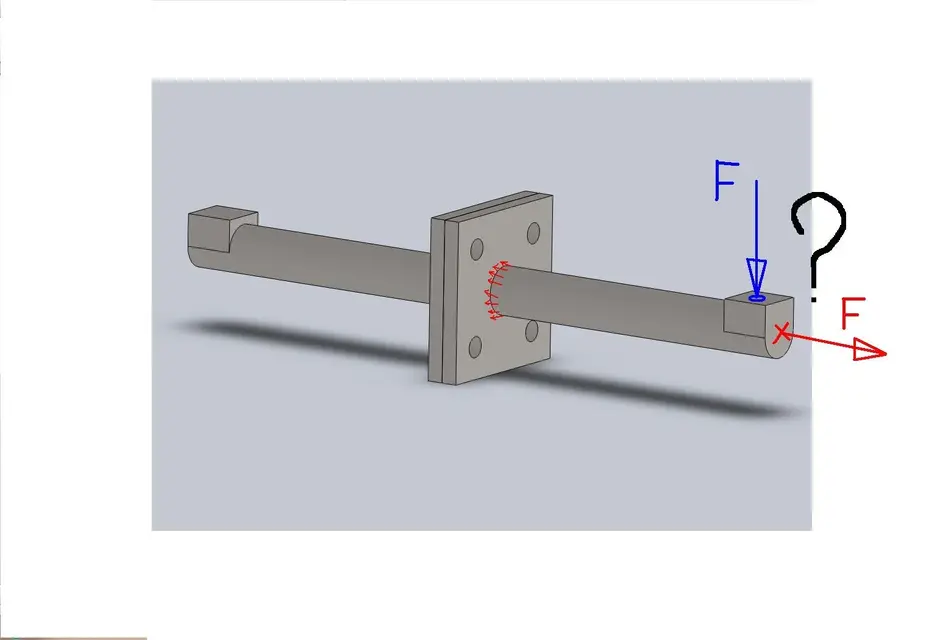
but it seemed to me that you had meant that the load was applied "on the tip" to the rods (key, on the flat face) in axial direction and that therefore all the complex was prompted to pure traction (with the variables of the case in the junction zone between the bolted plates); as I show you in the image (the axial red force I mean):Immagine1.webp (Perdona but I have not yet active swx 2010 and I only see your image)

and from what I hear it seems to me that we all understood that (?).
If so, it is clear that force is applied <on the floor (not plate) which is at the end of the tubular> but the reactions will be found in the boards bolted from the "small" area of union with the bar.

then I was doubtful that the 300kg insisted on the other horizontal "plant" in normal direction, the blue arrow I put. in this case the speech changes, there is no more traction but bending (with "diramations" various always between the boards bolted).. but this only you can tell us by explaining a little better: red arrow or blue arrow?? (or what else did you assume? )

Unfortunately (or fortunately?:biggrin:) if you do not have a minimum of knowledge/experience in order to make these checks "hand" (but also to eye) any fem helps little (in fact, it can do harm). the parameters you have to enter into the program, points of application/reaction of forces etc., consider shape variables, security factors etc. etc. all flour of your sack; If you don't know where to put your hand, stay still at the blocks (or worse you mess up).
the program simply "follows your orders" (we say that it does the accounts for you and displays the results).

greetings
Mar
 
Unfortunately (or fortunately?:biggrin:) if you do not have a minimum of knowledge/experience in order to make these checks "hand" (but also to eye) any fem helps little (in fact, it can do harm). the parameters you have to enter into the program, points of application/reaction of forces etc., consider shape variables, security factors etc. etc. all flour of your sack; If you don't know where to put your hand, stay still at the blocks (or worse you mess up).
the program simply "follows your orders" (we say that it does the accounts for you and displays the results).
I fully agree,
First of all, you have to know how to make the accounts by hand, because it allows you to verify the plausibility of the fem results.
and then you should know what is behind the software. . .
The speech should not be so much about this example, as I wanted a solution to be applied, if it were easy, even in other situations. regarding the fact of doing it by hand, I do not think it is easy to determine which forces are acting on the bolt or on a series of bolts in various parts of the design. for this I wanted to use solidworks.
Maybe start by running the system simulation that you schematized and post the results of axial force related to the beam elements of bolts, so maybe we can assess the correctness of the analysis setting.

then maybe you can create a more complex model and see how it is possible to simulate cut or friction bolts with solidworks.
 

Forum statistics

Threads
44,997
Messages
339,767
Members
4
Latest member
ibt

Members online

No members online now.
Back
Top