
• This forum is the machine-generated translation of www.cad3d.it/forum1 - the Italian design community. Several terms are not translated correctly.

verified grid

  • Thread starter Thread starter AngeloB
  • Start date Start date

AngeloB

Guest
Hello, everyone.

I have to understand if a metal grille is able to withstand a concentrated load (a crane).
by grid I mean a metal structure composed of longitudinal and transverse beams, covered by a sheet.
I solve the calculation with the fem, but I would like to compare my results with someone.
who is available?

Hi.
 
Hello, everyone.

I have to understand if a metal grille is able to withstand a concentrated load (a crane).
by grid I mean a metal structure composed of longitudinal and transverse beams, covered by a sheet.
I solve the calculation with the fem, but I would like to compare my results with someone.
who is available?

Hi.
If you are not a manufacturer of grids, you give you brand and model and see on catalog how the lower supports with lights and everything have been sized. if you are looking for the forum we spoke a few months ago of a foundation with grilled, attached catalogs containing methods of sizing according to norm and limits of use depending on the category.

the grilled under fem behaves like a series of main beams in the other direction there is no structural resistance if you use those with the welded plates and square wires.
 
If you are not a manufacturer of grids, you give you brand and model and see on catalog how the lower supports with lights and everything have been sized. if you are looking for the forum we spoke a few months ago of a foundation with grilled, attached catalogs containing methods of sizing according to norm and limits of use depending on the category.

the grilled under fem behaves like a series of main beams in the other direction there is no structural resistance if you use those with the welded plates and square wires.
I think that as a grid means a structure composed of longitudinal and transversal ferries (balances) covered by a sheet or, the classic structure of a bridge of a ship.
 
this is the example fem
ok for the beam system considered to be stuck to the ends and for the applied load distributed. of this I am sure because not long ago I had to make a structure very similar to yours with a load given by 1.6 m of water.
but all the calculation I have in the office and until Monday.. .
 
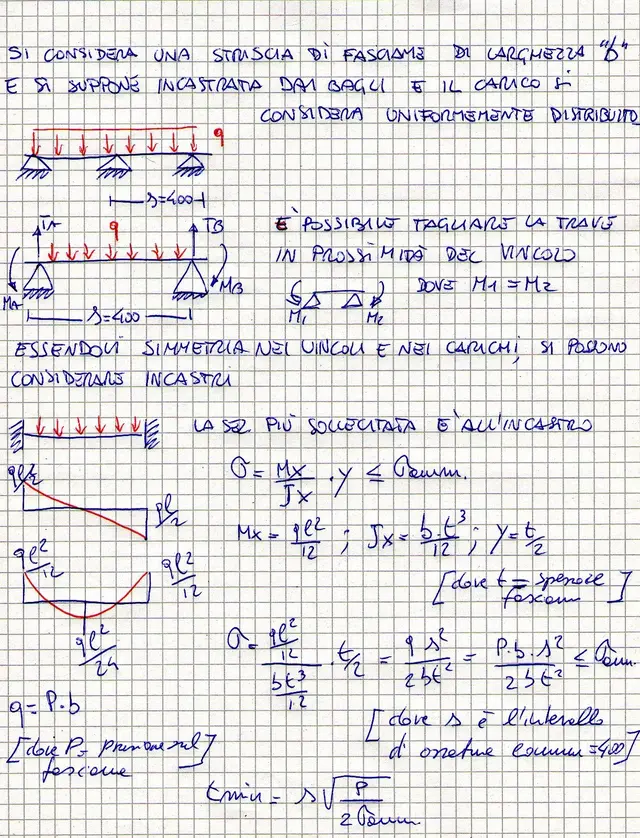
the only trace of analytical calculation that I have drawn and in this annex.
I still have to study it and I don't know if I'm capable of exploiting it on excel.
However, the problem remains to find the "validation" of such a calculation.
 

Attachments

Okay, let's hope we didn't write belinate but by memory I would say that the thickness of the bandage is calculated so.
 

Attachments

  • 3.webp
    3.webp
    619.7 KB · Views: 75
the only trace of analytical calculation that I have drawn and in this annex.
I still have to study it and I don't know if I'm capable of exploiting it on excel.
However, the problem remains to find the "validation" of such a calculation.
Hey, what else do you have of marsich?
We need to get in touch... :finger:
 
but the sheet gets a distributed load .... But how do you realize it? Can you put water on it?
If you put a crane for me, you don't have a load distributed on the sheet but on the beams. the sheet contributes yes, but shortly.
or am I saying a belinate? ? ?
 
but the sheet gets a distributed load .... But how do you realize it? Can you put water on it?
If you put a crane for me, you don't have a load distributed on the sheet but on the beams. the sheet contributes yes, but shortly.
or am I saying a belinate? ? ?
when sizing the bridge of a ship, initially you consider the loads as uniformly distributed.
you get the maximum size of the bridge (but also applies to the fasciame).
then if equipment is installed on it, think for example if you have to install a small cannon, you go to the "local" dimensioning. If I had to do the whole blanket sized with the local criterion, I'd just be armored. :biggrin:
 
Hello everyone

exatem, I applied your procedure on a sheet rectangle thickness 4, width b=1000 mm, light s=400 mm, p=25 kn/mt2=0.25 n/mm2

thickness bandet t 4.00 mm
width of the strip b 1'000.00 mm
light between bagli s 400.00 mm
pressure on the pkn band 25.00 kn/mt2
pressure on pn band 0.025 n/mm2


bending voltage sigmaf 125.00 mpa

with the fem the result is similar.

I have nothing but marsich, I took the dispensation at the university of genova, but I saw that it is also on the internet.

If you made such a calculation, send me the drawing with the needles, I try to solve it in my own way and then compare the results.
 
on the attached structure, are charged 1.6 m of water. the size is 8000x5000 and the thickness of the strip is 7mm. the common currents are bulbs 80x6 while the reinforced ones are 140x6 with 100x6 plague.
look if you are verified then we compare the data.
Bye.
 

Attachments

  • 10112.webp
    10112.webp
    63.8 KB · Views: 33
I'm also preparing you a calculation scheme for a gum clump we put on a wooden hull.
It would take days with more hours!
 
Excuse me if I intervene in the discussion that I find very interesting.
I ask as angelib, you tried to read about the regulations of the rina for yacht charter to the part of if not erro there is written how to dimensional a bridge.
 
I modeled surfaces in inventor 2011, the fem is the latest version of algor, now called autodesk simulation

I used plate elements

the model has something that doesn't go, I still have to figure out what, but infitting the mesch very much in the end the warnings disappeared.
the max shift is about 19 mm, it seems to me a correct value.
on tensions are less secure.

with regard to the 7 mm bridge, in some points the tensions combine
with analytical calculation, but I also have very high peaks.

I trust more than the result obtained on the central current 5 m long, has the very stressed wing, around 270 mpa.

Overall the bridge seems to me at the limit, I would say that with 16 kn/m2 the bridge does not collapse but seriously risk having visible permanent deformations.

What do you think?
I would like to try again to shape better, and exploiting symmetry, inflate mesh without thickening the model.

I took a look at the Rules of Procedure, but I found nothing useful. I'll look better.

greetings
 

Attachments

I modeled surfaces in inventor 2011, the fem is the latest version of algor, now called autodesk simulation
I used plate elements
the model has something that doesn't go, I still have to figure out what, but infitting the mesch very much in the end the warnings disappeared.
the max shift is about 19 mm, it seems to me a correct value.
on tensions are less secure.
with regard to the 7 mm bridge, in some points the tensions combine
with analytical calculation, but I also have very high peaks.
I trust more than the result obtained on the central current 5 m long, has the very stressed wing, around 270 mpa.
Overall the bridge seems to me at the limit, I would say that with 16 kn/m2 the bridge does not collapse but seriously risk having visible permanent deformations.
What do you think?
I would like to try again to shape better, and exploiting symmetry, inflate mesh without thickening the model.
I took a look at the Rules of Procedure, but I found nothing useful. I'll look better.

greetings
Hello, angelb.
I also tried to verify the structure and the data are in accordance with yours. both as stress and displacement values (16mm against your 19).
my maximum stress reaches 514mpa even if in the wing it actually reaches values around 270.
 

Forum statistics

Threads
44,997
Messages
339,767
Members
4
Latest member
ibt

Members online

No members online now.
Back
Top