
• This forum is the machine-generated translation of www.cad3d.it/forum1 - the Italian design community. Several terms are not translated correctly.

problem sets and subsets

  • Thread starter Thread starter Tantocattivo
  • Start date Start date
You said well, I've got a big mess in my head, but I'm going home now and tomorrow I give myself full time to this. where can I find material to erudite me?
It's a bit that I don't look for different tutorials or guides from online help.
if you do a nice graphic pattern, on paper, type feature manager, of a main set, which contains parts and subaxes that in turn contain parts and possibly other subaxes you can plan a simple series of tests on elementary parts (holes and nothing more) to understand how you can propagate external relations.
begin with an ax1 set that contains a part1, on this build a subassieme ass2. enter subassieme modification of ass2 and insert a part2 that models leaning to part1 geometry. then open ax2 and from there insert a part2b component that models on part2 etc. etc. so you will see when you can make changes and when not. For example by opening ax2 and entering part2 change will tell you that you can't, in the modificationsm leaning on the part 2b geometry...
In short, you have to make a nice chart where you understand how the main denn'assieme components are nested and then represent the transfer of allowed and prohibited relationships.
I don't dare reread because it will probably seem complicated to me too, but I assure you that the process is easier to do with paper and pencil than to describe.
You will also see that depending on the chain changes you want to make risks of creating circular references (back satan...) or in any case a chain of unnecessarily long references that could be abreviated by moving a component or leaning on a sketch of layout.
If you want to make topdown push modeling, you must have the logic of external references, of those who command what, when and why, you know it to menadite otherwise you create monsters so unmanageable that when you return from the weekend you will not even touch us again.
ideal would be to do a chord on topdown modeling, dedicated to your types of machines and made by a good one.
I have no idea how much time you're losing with these little cases, which still remain unresolved in the aid you're doing, even if you hand it to Mr. solidworks in person, but I think you've abundantly exceeded the cost of a good course of two or three days; If you have not passed it now, have faith: either come out alone and quickly, or that cost you will soon overcome it and will remain on the groppone the aid of an unmanageable bus.


Hi.
 
umh, then I did the following: I created 6 cubes, I created 3 asses where I joined the cubes 1-2, 3-4, 5-6. I created a four-component that encloses all together and I tried to make various evidence of holes and geometries related and everything works. Now I try to create a new part in a set and I remake the drilling tests, let's see it comes out!

Hi.
 
umh, then I did the following: I created 6 cubes, I created 3 asses where I joined the cubes 1-2, 3-4, 5-6. I created a four-component that encloses all together and I tried to make various evidence of holes and geometries related and everything works. Now I try to create a new part in a set and I remake the drilling tests, let's see it comes out!

Hi.
It'll be okay. ..that kind of problem is not so easy to get out in test assemblies. with this test you understand the logical pattern of links between fathers and children.
a tip: also do a test using the functions of assembly (extruded cutting with propagation to the parts) to evaluate how the individual parts react to further modifications outside the context of assembly.
 
It'll be okay. ..that kind of problem is not so easy to get out in test assemblies
if you understand what the message means:

"this part has some functionsdefined in the context together_xxx. it is possible to change the part, but not to create external references to the components of the current axiemethen can reproduce that type of situation with a simple set+subassieme in five minutes and then design so as not to put in those conditions.
as I have written it is enough to make a pattern on paper of a set nested and then verify in which direction can create estarni references and in which not.


Hi.
 
umh, then I did the following: I created 6 cubes, I created 3 asses where I joined the cubes 1-2, 3-4, 5-6. I created a four-component that encloses all together and I tried to make various evidence of holes and geometries related and everything works.
I had described you a different type of assembly, built in a very precise order. try to do it again and you will see that if you try to make the change as I described you are reported that it is impossible.
 
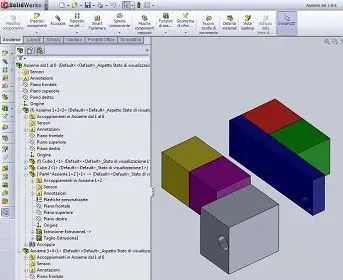
refer to the image I have attached, look at the evidence I've done.
we are looking at the screen capture of a set with inside:
together 1+2: red cube and green cube and blue part (created in the axieme) extruded to the upper surface of the green cube
together 3+4: yellow cube and purple cube
grey part created in the axieme that we are looking at.

just clikko with the right on the blue part and I change part appears to me the writing: "This part has some functions defined in the context of another set etc. etc.". So if I want to bring back the hole of the gray part in the blue part I can't do it. then I thought instead of doing backwards and doing in the blue part to bring it back to the gray part and it works. Now I have to go, maybe tomorrow I'll do more evidence.

hello and thanks to all those who have placed
 

Attachments

  • Forum1.webp
    Forum1.webp
    17.6 KB · Views: 22
if you understand what the message means:

"this part has some functionsdefined in the context together_xxx. it is possible to change the part, but not to create external references to the components of the current axiemethen can reproduce that type of situation with a simple set+subassieme in five minutes and then design so as not to put in those conditions.
as I have written it is enough to make a pattern on paper of a set nested and then verify in which direction can create estarni references and in which not.


Hi.
I humbly apologize....:redface:
I did exactly what you described and gave me that mistake.
I had never designed so unhealthy and this error had only come out in very complex parts after changes made in different times. we have always managed to place things through different artifices.
in general I do not find a good practice to create assemblies within other assemblies, even for the impossibility to mate parts of a subaxieme to parts of the assieme father.
so the problem lies precisely in the concept of together and in its use...right?
 
I humbly apologize....:redface:
I did exactly what you described and gave me that mistake.
I had never designed so unhealthy and this error had only come out in very complex parts after changes made in different times. we have always managed to place things through different artifices.
in general I do not find a good practice to create assemblies within other assemblies, even for the impossibility to mate parts of a subaxieme to parts of the assieme father.
so the problem lies precisely in the concept of together and in its use...right?
Well, I can't draw with solidworks and I've never designed with parametric cads, but I think it's normal what happened to me. You're gonna have to put in your drawing some of the guys that made your partner, right? And maybe you tell him where to drill and not him.
 
refer to the image I have attached, look at the evidence I've done.
make a screenshot of natural size, if you reduce it you do not read the feature manager and you understand little.
if you attach files is even better. I don't think those cubes are industrial secrets.
 
here are the files, but please do not give them to all:smile:
the files are in sw2010 however I attached a high resolution screen.

Hi.
 

Attachments

Well, I can't draw with solidworks and I've never designed with parametric cads, but I think it's normal what happened to me.
In fact, it is normal for you to report that you cannot make those changes.
You're gonna have to put in your drawing some of the guys that made your partner, right? And maybe you tell him where to drill and not him.
inside the main axieme "a" changes to the axieme "b" added in that way by your colleague (which then you will be running. . :smile: ) then create a layout sketch in the "b" axieme where you project the geometry of the holes that are inside the parts in "a".
Exit the change of the axieme
from the feature manager click on the "b" axieme and "open together" icon
at this point you are working on the "b" axieme, out of "a" and you can use the projected geometry on the layout sketch to change the "b" parts as you wish.
However, we are doing quite academic discussions because without a concrete example it becomes difficult to establish how it is better to proceed.
Surely the sub-assistances do not serve because someone can work on his own, they must have their own logic within the main axieme; how dependent on its geometry you can only know it.
 
Well, I can't draw with solidworks and I've never designed with parametric cads, but I think it's normal what happened to me. You're gonna have to put in your drawing some of the guys that made your partner, right? And maybe you tell him where to drill and not him.
My not wanted to be a personal criticism, I probably only had much luck at first:wink: Moreover we are only in three to use the software.. .
I happen to put together several axioms and sub-axioms but I never had this problem. I would say that the problem arises when subassiemi are born inside other assemblies and not when imported and paired. cmq are of the idea that your problem can solve it with the functions of together, i.e. create drilling directly in the final axieme and propaghi to the parts. In this way the "father" of all is the last and only. sometimes I happen to do so: two big assemblies to be coupled through bolts; the puncture created it once only in the final axieme.
 
My not wanted to be a personal criticism, I probably only had much luck at first:wink: Moreover we are only in three to use the software.. .
I happen to put together several axioms and sub-axioms but I never had this problem. I would say that the problem arises when subassiemi are born inside other assemblies and not when imported and paired. cmq are of the idea that your problem can solve it with the functions of together, i.e. create drilling directly in the final axieme and propaghi to the parts. In this way the "father" of all is the last and only. sometimes I happen to do so: two big assemblies to be coupled through bolts; the puncture created it once only in the final axieme.
already you advised me to do so and actually partially solve, even if the fact of not finding the holes in the part gives me a little discomfort. cmq we say that I solved by projecting instead the holes i.e. on the wing part blue. I made a high-resolution screen that is in the zip file, I did it on purpose expecting version problems.

Hello and thank you
 
already you advised me to do so and actually partially solve, even if the fact of not finding the holes in the part gives me a little discomfort.
look well at the function dialog box, don't you? :rolleyes:
put the flag on "prob the function to the parts". . .
cmq we say that I solved by projecting instead the holes i.e. on the wing part blue. I made a high-resolution screen that is in the zip file, I did it on purpose expecting version problems.
Did you try with the sketch in the ass how I wrote you?
 
look well at the function dialog box, don't you? :rolleyes:
put the flag on "prob the function to the parts". . .


Did you try with the sketch in the ass how I wrote you?
Yes, yes, I tried and it works. Now I see what propagates to the parts. You hear something, but you told me to fuss the hypothetical colleague who added in that way the "b" set, why how would he fit it?
 
it works well to make holes in the axieme, but what inconvenience does it have? one, that I have seen, is that if I open the part you do not understand from where the hole comes, therefore in the long can give problems, for the rest I do not know! vabbè but you can not have the full barrel and the drunk wife!!! ! !
 
You hear something, but you told me to fuss the hypothetical colleague who added in that way the "b" set, why how would he fit it?
You know I can't know coem is structured your set. Surely if the need was to have external references of a base part (seat frame?) to a component of another set (plan?) had to create the sotoassieme in the context, and inside the subaxieme in modification create the part "seat frame". at this point he had the subaxieme with the basic geometry, always connected to the main axieme, on which to model the entire seat.
You have to post specific examples where you don't seem to be trying to do what you need.
as you see (sketch of layout, feature of assemblies etc.) to get to the same result in different ways. You have to know which one is the best.

Hi.
 
it works well to make holes in the axieme, but what inconvenience does it have? one, which I saw, is that if I open the part you don't understand where the hole comes from, so in the long run it can give problems, for the rest I don't know! vabbè but you can not have the full bang and the drunk wife!!! ! !
That's why you can rename the functions. .
for example a given hole created in a set and propagated
you can call it "xyz common hole" so it will be easily identifiable.
Anyway, by clicking with ts dx on the function and selecting
lists external references, tells you everything you need.
 
it works well to make holes in the axieme, but what inconvenience does it have? one, that I have seen, is that if I open the part you do not understand from where the hole comes, therefore in the long can give problems, for the rest I do not know! vabbè but you can not have the full barrel and the drunk wife!!! ! !
the other inconvenience is that that puncture you can change it only from the axieme in which it was created, moreover it seems to me that you can delete it only from them (while you can suspend the function also within the part).
the functions of together can be useful, but should be used carefully. create a very tight bond between the part and the aid, so reuse that part elsewhere could become complicated.
 

Forum statistics

Threads
44,997
Messages
339,767
Members
4
Latest member
ibt

Members online

No members online now.
Back
Top