Exatem
Guest
This is a technical forum but I, too often, take me from my second passion that is the history of the two world wars.
Fortunately many friends/colleges bear this mania and suffer without complaining the Filipinos with which I storm the forum itself.
but sometimes history gives me the cue to face the same in a more technical aspect and therefore, inherent to cad3d.
For this reason, I open this section in which to analyze the most significant means. Today to begin with, I want to talk to you about a means that has assumed a role of symbol of this historical context.
the giant from the feet of clayin 1937 Guderian described the operational principles and tactics that characterized German thought on how to employ armoured formations in a future war. the first goal of the mission of the heavy wagon, within this concept, was to attack and destroy the anti-tank cannons of the enemy defensive line. the next goal was to destroy the enemy artillery but guderian, had correctly predicted that the penetration of the defensive lines would force the enemy to throw its reserves into a counter-attack. about the importance of defeating this counterattack, Guderian underlined that the armoured forces had to be able to defeat it, penalty of failure.
German doctrine of that time was essentially offensive.
Therefore the mission of the tiger was first to destroy the tanks of the enemy. understanding of this way of thinking is essential to understand why tiger was developed and used in a certain way.
heavy tanks had to serve as support for infantry and artillery but the main purpose of the heavy tank was to penetrate the enemy's defenses, thus allowing the average tanks to exploit its advantages.
For this reason already since 1938 the Germans realized that the pzkpfw iv should be replaced by a more modern wagon.
the tiger marked a radical change in the criteria of setting up the German tanks since until then the mobility and speed of the armor was privileged.
this because the lightning war imposed speed as a key to victory and germany had decided to play “on attack”.
but the trend and extension of the conflict forced to change attitude against a well-gold enemy and the Germans soon realized that they needed heavily armored and armed tanks.
several firms proposed prototypes but none of them entered production.
in 1941 henschel received an order for a wagon whose requirements were a maximum speed of 40 km/h, a good armor, a powerful armor and a total weight within the 36 t. henschel presented the ve3601 but the development was interrupted in favor of the vk 4501, a 46 t tank armed with the very effective 88 mm gun that we will talk about later. the new prototype had to be ready for April 20, 1942, birthday of hitler therefore, to respect the times, the henschel drew ideas from vk3601 and another prototype called vk3001 and from the union of the two, was born the vk4501(h). Meanwhile the porsche also worked on the specification and elaborated projects and prototypes including vk4501(p).
the two companies presented their prototypes simultaneously in time for the presentation to be held on the birthday of the führer. After the evaluations of the examining committee, the henschel model was chosen and the production began in August 42. the porsche turret was considered excellent and was mounted as it was on the winning prototype of the henschel. here is therefore born a squared wagon and made of welded armours at right angle with an unusual round tower. the new wagon was called pzkpfw vi tiger ausf and (sdkfz 181).
from August 42 to the same month of 44, 1350 will be produced.
the commission however, in order to premunite in case of failure of the model henschel, he ordered a lot of 90 chariots also to the porsche that will be completed as trucks, the panzerjager ferdinand (sdkfz 184) so called in honor of the designer ferdinand porsche. of the tiger were produced three versions: in addition to the standard one, the command-car (befehlspanzer) without armor but equipped with a winch and, the assault wagon (sturmtiger) with a superstructure equipped with 38cm rockets replicated in 10, maximum 18 specimens.
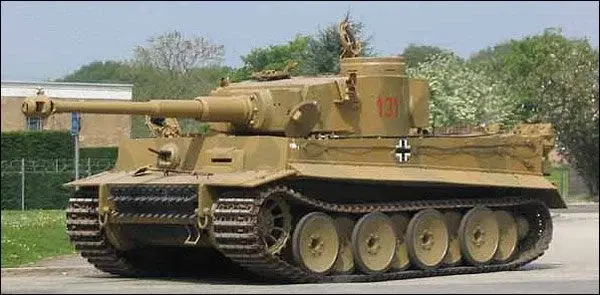
the tiger was long, including the cannon 8.24 meters, while the hull alone measured 6.2 m. the width was 3.75 and the height of 2.86. It weighed 55.000 kg and thanks to the Maybach engine hl 230 p45 to 12 cylinders from 700 hp fueled, reached 38 km/h. the autonomy was 100 km, the maximum gradient was 60%, the step of 0.79 m and could cross a trench of 1.8 m while the maximum guadabile depth was 1.2 m. the crew was 5 men.
for the time it was an exceptional product for armor power and armor, but it was too complicated and difficult to produce.
the führer, although strongly advised, wanted to send 19 new tigers still of africa presets to test them against the enemy (the tiger was first met by the British in Tunisia and from then on appeared in all German fronts).
the wagons terrified the allies revealing themselves invulnerable frontally to the anti-tank pieces thanks to 120 mm of armour (the manual of use of the Sherman American wagons, which were the "mass" of allied wagons, provided that to put out combat a tiger wagon it was necessary to employ four shermans with the prospect of losing three). the Nazi propagandistic apparatus created in a short time a myth of invincibility well superior to the real qualities and possibilities of the medium, mito opportunely diffused between the Allied forces that enclosed in it the true force of the tiger i. already from the first contacts occurred in Africa, American officers indicated in their relations that the bullet fired from the 88 German against the front of the sherman tower, penetrating, us. Allied tank crews were well aware of the tiger's danger and a real psychosis among allied tankers, so much so that every sighted German wagon was identified as tiger requiring "typhoon" and "thunderbolt" fighters to eliminate it.
In fact, the cannon that armed most of the Allied tanks was a 75/37 that was absolutely ineffective against the frontal and lateral armor of the tiger (not to mention that of the turret). during the battle of adjoining one of these mighty wagons, it was attacked by a battery of 4 American anti-tank pieces that marked all their hits on the turret and against the front of the hull. the tiger shrunk his turret and destroy them one after another as if nothing were. even the famous bazooka were little more than "paper balls with spit" (paraphrasing a phrase of the film "Save the soldier ryan) towards them.
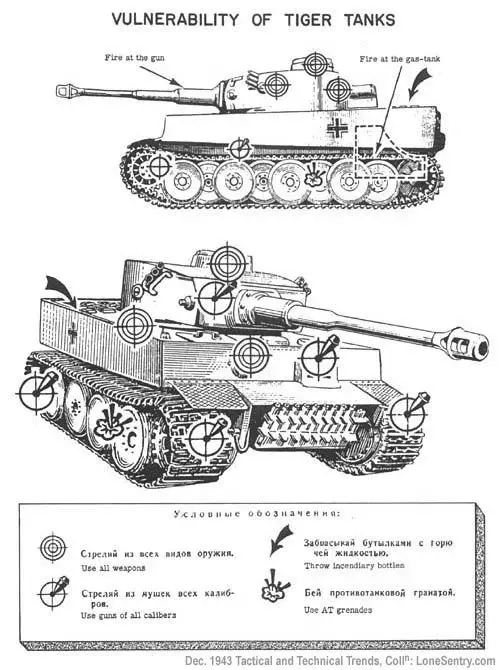
the only chance was to hit a close distance in the back by putting off the engine.
only towards the end of 1944 were fitted with 76/52 and 76/55 guns on the shermans (giving origin to the sherman "firefly") and the cromwells, so as to create conditions to be able to deal with the averages and short distances of engagement the German tiger and panthers (at long distances the 88 of the tiger did it, always and anyway, as master).
Fortunately many friends/colleges bear this mania and suffer without complaining the Filipinos with which I storm the forum itself.
but sometimes history gives me the cue to face the same in a more technical aspect and therefore, inherent to cad3d.
For this reason, I open this section in which to analyze the most significant means. Today to begin with, I want to talk to you about a means that has assumed a role of symbol of this historical context.
the giant from the feet of clayin 1937 Guderian described the operational principles and tactics that characterized German thought on how to employ armoured formations in a future war. the first goal of the mission of the heavy wagon, within this concept, was to attack and destroy the anti-tank cannons of the enemy defensive line. the next goal was to destroy the enemy artillery but guderian, had correctly predicted that the penetration of the defensive lines would force the enemy to throw its reserves into a counter-attack. about the importance of defeating this counterattack, Guderian underlined that the armoured forces had to be able to defeat it, penalty of failure.
German doctrine of that time was essentially offensive.
Therefore the mission of the tiger was first to destroy the tanks of the enemy. understanding of this way of thinking is essential to understand why tiger was developed and used in a certain way.
heavy tanks had to serve as support for infantry and artillery but the main purpose of the heavy tank was to penetrate the enemy's defenses, thus allowing the average tanks to exploit its advantages.
For this reason already since 1938 the Germans realized that the pzkpfw iv should be replaced by a more modern wagon.
the tiger marked a radical change in the criteria of setting up the German tanks since until then the mobility and speed of the armor was privileged.
this because the lightning war imposed speed as a key to victory and germany had decided to play “on attack”.
but the trend and extension of the conflict forced to change attitude against a well-gold enemy and the Germans soon realized that they needed heavily armored and armed tanks.
several firms proposed prototypes but none of them entered production.
in 1941 henschel received an order for a wagon whose requirements were a maximum speed of 40 km/h, a good armor, a powerful armor and a total weight within the 36 t. henschel presented the ve3601 but the development was interrupted in favor of the vk 4501, a 46 t tank armed with the very effective 88 mm gun that we will talk about later. the new prototype had to be ready for April 20, 1942, birthday of hitler therefore, to respect the times, the henschel drew ideas from vk3601 and another prototype called vk3001 and from the union of the two, was born the vk4501(h). Meanwhile the porsche also worked on the specification and elaborated projects and prototypes including vk4501(p).
the two companies presented their prototypes simultaneously in time for the presentation to be held on the birthday of the führer. After the evaluations of the examining committee, the henschel model was chosen and the production began in August 42. the porsche turret was considered excellent and was mounted as it was on the winning prototype of the henschel. here is therefore born a squared wagon and made of welded armours at right angle with an unusual round tower. the new wagon was called pzkpfw vi tiger ausf and (sdkfz 181).
from August 42 to the same month of 44, 1350 will be produced.
the commission however, in order to premunite in case of failure of the model henschel, he ordered a lot of 90 chariots also to the porsche that will be completed as trucks, the panzerjager ferdinand (sdkfz 184) so called in honor of the designer ferdinand porsche. of the tiger were produced three versions: in addition to the standard one, the command-car (befehlspanzer) without armor but equipped with a winch and, the assault wagon (sturmtiger) with a superstructure equipped with 38cm rockets replicated in 10, maximum 18 specimens.
the tiger was long, including the cannon 8.24 meters, while the hull alone measured 6.2 m. the width was 3.75 and the height of 2.86. It weighed 55.000 kg and thanks to the Maybach engine hl 230 p45 to 12 cylinders from 700 hp fueled, reached 38 km/h. the autonomy was 100 km, the maximum gradient was 60%, the step of 0.79 m and could cross a trench of 1.8 m while the maximum guadabile depth was 1.2 m. the crew was 5 men.
for the time it was an exceptional product for armor power and armor, but it was too complicated and difficult to produce.
the führer, although strongly advised, wanted to send 19 new tigers still of africa presets to test them against the enemy (the tiger was first met by the British in Tunisia and from then on appeared in all German fronts).
the wagons terrified the allies revealing themselves invulnerable frontally to the anti-tank pieces thanks to 120 mm of armour (the manual of use of the Sherman American wagons, which were the "mass" of allied wagons, provided that to put out combat a tiger wagon it was necessary to employ four shermans with the prospect of losing three). the Nazi propagandistic apparatus created in a short time a myth of invincibility well superior to the real qualities and possibilities of the medium, mito opportunely diffused between the Allied forces that enclosed in it the true force of the tiger i. already from the first contacts occurred in Africa, American officers indicated in their relations that the bullet fired from the 88 German against the front of the sherman tower, penetrating, us. Allied tank crews were well aware of the tiger's danger and a real psychosis among allied tankers, so much so that every sighted German wagon was identified as tiger requiring "typhoon" and "thunderbolt" fighters to eliminate it.
In fact, the cannon that armed most of the Allied tanks was a 75/37 that was absolutely ineffective against the frontal and lateral armor of the tiger (not to mention that of the turret). during the battle of adjoining one of these mighty wagons, it was attacked by a battery of 4 American anti-tank pieces that marked all their hits on the turret and against the front of the hull. the tiger shrunk his turret and destroy them one after another as if nothing were. even the famous bazooka were little more than "paper balls with spit" (paraphrasing a phrase of the film "Save the soldier ryan) towards them.
the only chance was to hit a close distance in the back by putting off the engine.
only towards the end of 1944 were fitted with 76/52 and 76/55 guns on the shermans (giving origin to the sherman "firefly") and the cromwells, so as to create conditions to be able to deal with the averages and short distances of engagement the German tiger and panthers (at long distances the 88 of the tiger did it, always and anyway, as master).
Last edited: