• This forum is the machine-generated translation of www.cad3d.it/forum1 - the Italian design community. Several terms are not translated correctly.

the technique and history

  • Thread starter Thread starter Exatem
  • Start date Start date

Exatem

Guest
This is a technical forum but I, too often, take me from my second passion that is the history of the two world wars.
Fortunately many friends/colleges bear this mania and suffer without complaining the Filipinos with which I storm the forum itself.
but sometimes history gives me the cue to face the same in a more technical aspect and therefore, inherent to cad3d.
For this reason, I open this section in which to analyze the most significant means. Today to begin with, I want to talk to you about a means that has assumed a role of symbol of this historical context.

the giant from the feet of clayin 1937 Guderian described the operational principles and tactics that characterized German thought on how to employ armoured formations in a future war. the first goal of the mission of the heavy wagon, within this concept, was to attack and destroy the anti-tank cannons of the enemy defensive line. the next goal was to destroy the enemy artillery but guderian, had correctly predicted that the penetration of the defensive lines would force the enemy to throw its reserves into a counter-attack. about the importance of defeating this counterattack, Guderian underlined that the armoured forces had to be able to defeat it, penalty of failure.
German doctrine of that time was essentially offensive.
Therefore the mission of the tiger was first to destroy the tanks of the enemy. understanding of this way of thinking is essential to understand why tiger was developed and used in a certain way.
heavy tanks had to serve as support for infantry and artillery but the main purpose of the heavy tank was to penetrate the enemy's defenses, thus allowing the average tanks to exploit its advantages.

For this reason already since 1938 the Germans realized that the pzkpfw iv should be replaced by a more modern wagon.
the tiger marked a radical change in the criteria of setting up the German tanks since until then the mobility and speed of the armor was privileged.
this because the lightning war imposed speed as a key to victory and germany had decided to play “on attack”.
but the trend and extension of the conflict forced to change attitude against a well-gold enemy and the Germans soon realized that they needed heavily armored and armed tanks.
several firms proposed prototypes but none of them entered production.
in 1941 henschel received an order for a wagon whose requirements were a maximum speed of 40 km/h, a good armor, a powerful armor and a total weight within the 36 t. henschel presented the ve3601 but the development was interrupted in favor of the vk 4501, a 46 t tank armed with the very effective 88 mm gun that we will talk about later. the new prototype had to be ready for April 20, 1942, birthday of hitler therefore, to respect the times, the henschel drew ideas from vk3601 and another prototype called vk3001 and from the union of the two, was born the vk4501(h). Meanwhile the porsche also worked on the specification and elaborated projects and prototypes including vk4501(p).
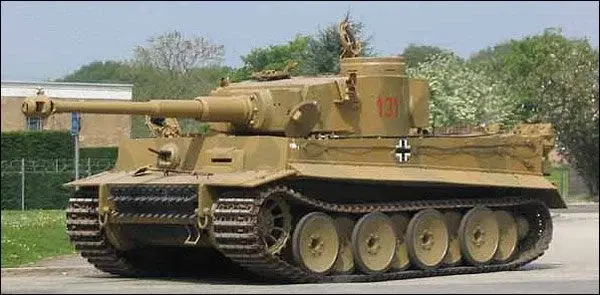
the two companies presented their prototypes simultaneously in time for the presentation to be held on the birthday of the führer. After the evaluations of the examining committee, the henschel model was chosen and the production began in August 42. the porsche turret was considered excellent and was mounted as it was on the winning prototype of the henschel. here is therefore born a squared wagon and made of welded armours at right angle with an unusual round tower. the new wagon was called pzkpfw vi tiger ausf and (sdkfz 181).
from August 42 to the same month of 44, 1350 will be produced.

the commission however, in order to premunite in case of failure of the model henschel, he ordered a lot of 90 chariots also to the porsche that will be completed as trucks, the panzerjager ferdinand (sdkfz 184) so called in honor of the designer ferdinand porsche. of the tiger were produced three versions: in addition to the standard one, the command-car (befehlspanzer) without armor but equipped with a winch and, the assault wagon (sturmtiger) with a superstructure equipped with 38cm rockets replicated in 10, maximum 18 specimens.
the tiger was long, including the cannon 8.24 meters, while the hull alone measured 6.2 m. the width was 3.75 and the height of 2.86. It weighed 55.000 kg and thanks to the Maybach engine hl 230 p45 to 12 cylinders from 700 hp fueled, reached 38 km/h. the autonomy was 100 km, the maximum gradient was 60%, the step of 0.79 m and could cross a trench of 1.8 m while the maximum guadabile depth was 1.2 m. the crew was 5 men.
for the time it was an exceptional product for armor power and armor, but it was too complicated and difficult to produce.
the führer, although strongly advised, wanted to send 19 new tigers still of africa presets to test them against the enemy (the tiger was first met by the British in Tunisia and from then on appeared in all German fronts).
the wagons terrified the allies revealing themselves invulnerable frontally to the anti-tank pieces thanks to 120 mm of armour (the manual of use of the Sherman American wagons, which were the "mass" of allied wagons, provided that to put out combat a tiger wagon it was necessary to employ four shermans with the prospect of losing three). the Nazi propagandistic apparatus created in a short time a myth of invincibility well superior to the real qualities and possibilities of the medium, mito opportunely diffused between the Allied forces that enclosed in it the true force of the tiger i. already from the first contacts occurred in Africa, American officers indicated in their relations that the bullet fired from the 88 German against the front of the sherman tower, penetrating, us. Allied tank crews were well aware of the tiger's danger and a real psychosis among allied tankers, so much so that every sighted German wagon was identified as tiger requiring "typhoon" and "thunderbolt" fighters to eliminate it.
In fact, the cannon that armed most of the Allied tanks was a 75/37 that was absolutely ineffective against the frontal and lateral armor of the tiger (not to mention that of the turret). during the battle of adjoining one of these mighty wagons, it was attacked by a battery of 4 American anti-tank pieces that marked all their hits on the turret and against the front of the hull. the tiger shrunk his turret and destroy them one after another as if nothing were. even the famous bazooka were little more than "paper balls with spit" (paraphrasing a phrase of the film "Save the soldier ryan) towards them.
the only chance was to hit a close distance in the back by putting off the engine.
only towards the end of 1944 were fitted with 76/52 and 76/55 guns on the shermans (giving origin to the sherman "firefly") and the cromwells, so as to create conditions to be able to deal with the averages and short distances of engagement the German tiger and panthers (at long distances the 88 of the tiger did it, always and anyway, as master).
 
Last edited:
the tiger became so a myth and a demon even if at the reckoning, they were used very little.
to understand the superiority of the carriage compared to the opponents is interesting the following: on July 7, 1943, the commander of the ss franz staudegger, 2nd platoon, 13° carri company, 1° division leibstandarte ss adolf hitler, attacked a group of 50 Russian wagons t-34 near psyolknee (battle of kursk).
staudegger consumed the entire ammunition of his wagon by destroying 22 enemy tanks, while the remaining retreated. for this franz staudegger was decorated with the cross of knight of the iron cross.
the most victorious commanders were: kurt knispel with 168 victories, eight carius with 150 wins, johannes bölter with 139 wins, michael wittmann with 138 wins. In short, 4 crews of 5 people (i.e. 20 people in all) destroyed 595 enemy tanks. despite the fact that the tiger was curiously not the favourite of the German tankers, who considered it too “elephantically” and little quick to react to the controls, preferring the most agile panther.
But if the tiger was so powerful, then why did Germania lose the war? the answer is in the numbers: the German industry could not produce tiger in sufficient numbers to make the difference; While building 500 tigers, the Russians produced 58,000 tanks of only type t34, while from the assembly lines of the American industries came out almost 50,000 m4 sherman.
with a ratio of 100 to 1 any technical superiority was destined to succumb.
For a comparison of production capacity, the Russians produced 23,937 t34/76 between 1942 and 1945, while the American pershing wagon was built at a rate of 1,350 tanks during a six-month period.
When production ceased in June 1945, 49,234 Sherman tanks were built, more than all the production of German tanks throughout the war. in the end, it was this difference of production philosophy and production faster than made the difference between defeat and victory. the real failure of the German tanks was to have exceeded the capabilities of the German industry to produce in sufficient numbers.
the tiger remains the most famous wagon among those created by the Germans in the war and for the Westerners became the symbol of German technological supremacy within armoured troops although, to the evidence of the facts, it proved unsuitable for the offensive role for which it was designed, remaining a formidable opponent in defense, since it could destroy every strangled allied by considerable distances thanks to the long range of the 88 mm piece. if used correctly it proved an invincible and indestructible opponent for many enemy tanks until the end of the war. undoubtedly it was a powerful tank, although not too innovative that at practical time proved to be a giant with clay feet. he obtained excellent tactical results even if he was unable to turn the fate of the conflict in favour of the Germans.
the welded hull was characterized by perfectly squared lines to simplify its production, with the armour that reached in the front the thickness of 100 mm while on the sides measured 80 mm and above 26 mm. it was a nickel steel laminate with a brinell hardness of 255-280. the armor represented, together with the armor, the strength of the tiger. was practically invulnerable to most enemy weapons at distances greater than 800 meters

the turret, like the hull, was heavily armored, with 120 mm of steel on the shading and had the characteristic horse iron plant; his branding, obtained through an electromechanical system, was very slow due to the overall weight and represented one of the major defects. the main armament was constituted by the anti-tank gun kwk 36 from 88 mm (long 56 calibers) that was able to pierce any American or British carriage to more than 1500 m of distance, except for the m26 pershing, while with the Soviet heavy wagons of the type js-2 proved ineffective, with possible penetrations on the frontal only within 300 m. in the turret was installed 34 while another mg34 was placed in the right front wall of the hull. the ammunition was 92 shots of 88 mm and 6,850 cartridges for machine guns. the interior of the carriage offered the maximum comfort that a tank could present; the driver used a normal steering wheel instead of the two usual levers in the tanks and the instrumentation was among the most complete and sophisticated of the time.
another advantage was that if a tiger was damaged, the crew often managed to escape capture and return to its unit, helping to create experienced crews.
a tiger cost 250,800 marks of the reich against 103.163 of a panzer iii, 115,962 of a panzer iv ausf g or 117,100 of a panther, all figures net of weapons and radio apparatus. at the end the cost of a tiger reached 300,000 marks.
for its production it needed a working week of 6,000 people.
much has been said about the manoeuvrability of the tiger, which was a "gorgeous monster" or that "was barely moving", but that is not exactly the truth. In fact it was relatively manageable if you consider its weight and size. despite its power, however, the tiger was a fairly "delicate" wagon and was often subject to avaries that forced them to not always easy repairs. among the main defects was the system of suspensions with overlapping wheels and torsion bar, subject to avaries due to mud and stones. this defect proved disastrous especially on the eastern front when the mud froze blocking the medium. was superior to the sherman in muddy soil when it adopted 725 mm wide tracks that reduced the pressure on the ground to 1,05 kg/cm2. and which could be replaced by narrower tracks from 520 mm for transport by rail or road. the replacement of the tracks could take place in about a quarter of an hour. its powerful engine had been developed by the Maybach-motorenbau gmbh who produced engines for all medium and heavy German tanks. the engine of the tiger, the Maybach hl 210 p45, was a 12 v water-cooled petrol engine with a capacity of 21.33 liters and a power of 650 cv at 3.000 turns and was mounted in a closed compartment on the back of the cart.
However, it could not be reliable if used at the maximum power because the transmission, the og maybach 40 12 16 a, with 8 marches ahead and 4 back, despite a system of controls for the driver, had the tendency to faults, especially if there was no proper preventive maintenance. the combat weight was 57 tons and was too much for the transmissions of the time. the recommendation was that the driver did not exceed 2,600 laps per minute, however it required constant maintenance (every 3 hours the wagon was lit for about 20 minutes) and above all a large amount of fuel (the 540 litre tank was enough for only 195 km on the road, much less in rough terrain conditions), that the German army was no longer able to provide in the last stages of the conflict.
 
the first 250 tigers received the Maybach engine hl 210 p45, then in May 1943, the maybach produced the hk 230 p45 with two air filters and improved transmission. the new engine, also a V-12 water cooled gasoline engine, of 23.88 liters, had a power of 700 cv to 3.000 rpm. but the transmission was still weak due to the power generated by the engine, and preventive maintenance continued to be an imperative. this, and the overwhelming allied air power, were the main reason for the destruction of tiger, more than any tank fight against tank, especially on the western front. on the eastern front the main causes of destruction of tiger were transmission problems ( resulting in abandonment and/or destruction of crews), Russian air attacks, and the overwhelming numerical inferiority.
like all German tanks, he used a steering wheel with hydraulic control that allowed a rotation on the spot in 3,44 meters. the tiger was not particularly slow: for the panzer iv the road speed was 40 km/h and 20 off-road. the panzer iii (ausf and n) reached a road speed of 40 km/h and 18 off-road. for the tiger the speed on the road was 38 km/h and 20 off-road.

at the end the only German tank faster than the tiger was the panther, with speed of 46 and 24 km/h.

from July 1943 to some specimens an amagnetic coating was applied, a sort of plaster, called "zimmerit", so that the magnetic mines could not attack the wagons. on the hull of the porsche tiger was realized the "elefant" hunter armed with the pak 43/2 cannon of 88/71 mm, while from the tiger henschel was derived the powerful assault obice sturmtiger, armed with a powerful mortar of 380 mm of naval origin.
the particular technical characteristics of the medium, its high weight and fragility, made sure that the tiger was not distributed normally in the panzer-division preferring to constitute a fifteen tank battalions for the army (heer) and the waffen-ss, with an organic of 45 tiger each.
the tiger was used on the eastern, western and southern front with good success, especially after appropriate tactics were studied for the use of such a complex weapon system. However, it is still difficult today to give a serene judgment on the operational value of the tiger i. with the continuation of the war even the powerful armor gradually became vulnerable to the new and more effective anti-tank weapons opponents; the German tank had been realized in fact before the German engineers and builders learned the lesson of the Russian t-34 in which the protective plates, remarkably inclined, confer a capacity of resistance almost identical to those of the German tanks while equipped with a thicker armor but constituted by vertical plates. then came to the front the 122 mm Soviet d-25 cannon that could penetrate the front of the tiger up to 1,500 m away while the 17 British pounds could do it frontally up to 1,700 meters with the traditional apcbc bullets. due to this the production was gradually reduced until completely ceased in August 1944 after 1,354 specimens had entered online.

We said we'd talk about the famous 88.
kwk 36 l/56 was an adaptation of the famous 8.8 cm flak 36, in turn developed by the model flugzeugabwehrkanone 18 (flak 18).
was universally known as the acht-acht, a contraction of acht-komma-acht zentimeter (8.8 cm = 88 mm), and was used the first time in combat by the condor legion, in spagna, where he gained the reputation of being an excellent anti-aircraft cannon but above all a real killer of tanks. this ability will be confirmed during the francia campaign in 1940, and more in the hands of the afrika korps of rommel in the north of Africa. the origins date back to the First World War when the krupp and the erhardt (later rheinmetall) produced an 8.8 cm counterhearing cannon the flak18 which showed a remarkable precision of shooting and that could engage in the treacherous earth shooting, targets up to 3,000 meters. the next development was the flak36 whose barrel was built in three separate sections which facilitated its replacement.

initially the perforating ammunition was the 8.8 cm panzergranate weighing about 9.5 kg and initial speed of 810 m/s. during 1942 the penetration capacity was improved with the introduction of the projectile pzgr.39 of 10.2 kg of weight and initial speed of 800 m/s. kwk 36 l/56 was a very precise weapon and able to grasp successes against goals at more than 1,000 meters. if it is considered that the armor was impenetrable to normal combat distances (about 800 meters), it is understood why the tiger at its appearance dominated the battlefield

on 21 July 1943, general hermann breith armored, commander of iii.panzer - korps, issued the following directive: "On the basis of experience in recent battles, the following instructions are issued for the cooperation of tiger tanks with other weapons: following its high-performance weapon and strong armor, the tiger should be used mainly against enemy tanks and anti-tank weapons and then only exceptionally - against infantry units. as experience shows, its weapons allow to attack enemy tanks at distances of 2,000 meters and more, with great incidence especially on the morale of the opponent. As a result of the strong armor, you can get in touch with enemy tanks without being seriously damaged by hits. Still, the tiger must try to start engaging enemy tanks at distances of over 1,000 meters."the reputation of the tiger was however due to the respectable relationship of successes (5.74 to 1) obtained from all battalions. production ended in 1944 with great relief on the morale of allies.
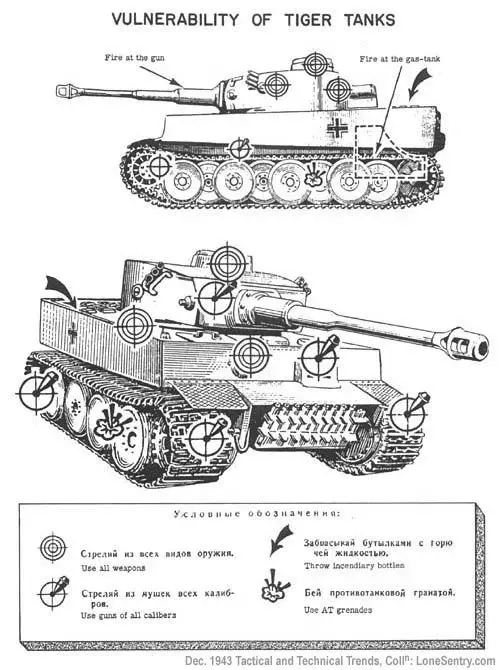
Maybe this is the best epitaph that the "tigers" could have.(the last annex represents an interesting table distributed among Russian soldiers, about the vulnerable points of the tiger)
 

Attachments

  • germany-afrika-PzKpfw-VI-Tiger-Tank -TAM35227.webp
    germany-afrika-PzKpfw-VI-Tiger-Tank -TAM35227.webp
    19.6 KB · Views: 221
  • pzkpfw6_tiger1_fotobn.webp
    pzkpfw6_tiger1_fotobn.webp
    16 KB · Views: 221
  • Tiger1-131-Bovington-2004.webp
    Tiger1-131-Bovington-2004.webp
    40 KB · Views: 225
  • ttt_tiger_vulnerability.webp
    ttt_tiger_vulnerability.webp
    63.4 KB · Views: 51
Last edited:
the tiger became so a myth and a demon even if at the reckoning, they were used very little.
to understand the superiority of the carriage compared to the opponents is interesting the following: on July 7, 1943, the commander of the ss franz staudegger, 2nd platoon, 13° carri company, 1° division leibstandarte ss adolf hitler, attacked a group of 50 Russian wagons t-34 near psyolknee (battle of kursk).
staudegger consumed the entire ammunition of his wagon by destroying 22 enemy tanks, while the remaining retreated. for this franz staudegger was decorated with the cross of knight of the iron cross.
Yes, but... It was a victory of piss, : (it was not true victory, because the salient was not conquered and, after kursk on the eastern front the initiative never returned + in German hands.
Hi.
 
Yes, but... It was a victory of piss, : (it was not true victory, because the salient was not conquered and, after kursk on the eastern front the initiative never returned + in German hands.
Hi.
Of course.
but I do not want to analyze the course of the war (this we are already doing) but rather, to choose a means for its innovative age and try to avoid it under the most technical aspect.
I will exclude air transport from this analysis because the forum already has a luminaire in this matter and I would risk only small ones.
If you have any military means of particular interest, we could try to discuss it.
p.s. known for a long time, that you follow me whatever you write.
Thank you!
 
in the First World War and the period intermezzo with the second, the battles were won by armored means and cannons. the Germans have brought these means and techniques to their maximum development.

However, during World War II, Americans taught the world that things had changed. the decisive instrument had become the air force. and in this no one could beat them.

both German stukas and Japanese zeros were excelled, but they were bombing planes, not hunting. so when they met a series hunting squad like p38 or p51 they didn't even get to the target.

infantry as a means of breaking the lines was passed.
 
p.s. known for a long time, that you follow me whatever you write.
Thank you!
Of course......:redface: I really like the story...... All the story, and you know how to tell.
You're an excellent divulner.
Hi.
 
After the analysis of the tiger wagon, we see today another innovative weapon whose purpose was to defeat a hidden and silent enemy, the submarine.

by now you know my admiration for these machines and for the men who served but this time we will see the story on the opposite side and above all, we will see what technology had to be studied to counter the sharks of the ocean. the insidia represented by the submarines in fact, caused not a few scratches to the allies that had to ingegnate in studying an efficient solution.

Initially, the b.t.g. were used, a sign with which the torpedo bombs are indicated, weapons intended for the anti-submarine hunting and constituted in principle, by a burst charge equipped with an ignition device that, regardless of the principle of operation, has the task of causing the fire of the weapon.
this can happen: or to achieve a certain quota, or by impact, or by influence. b.t.g. are divided by the amount of charge and are included in a range ranging from 30 to 150 kg. As mentioned, the bursting devices can be hydrostatic, watchmaking, shock and flu. At first, the depth bombs were dropped or launched by special hoppers arranged on the stern of the ships.
having negative thrust, the b.t.g. sank with a speed of about 2 m/s therefore, to reach the maximum depth of burst of 300m, they took about 2 minutes and a half.

a submersible dive that sails at 6/7 m/s, but at the same time travels about half a mile. from this it follows that the speed of descent of normal b.t.g., was no longer suitable for the bombardment of modern submarines.
a first innovation was linked to the modified conditions of use of the weapons which, they had to be launched by board simultaneously to constitute the so-called "packages" or "pumps". This presented a second important problem to solve, making weapons not influenced by overpressions caused by the explosion of nearby weapons. a third difficulty was the simultaneous launch from the shipbombs of edge of weapons having speeds of descent among themselves different so that they have the simultaneous burst at different depths.
if the bombs were regulated so they had all the same time of blast and if all had identical speed of descent, the explosions happened on the same floor and had what was called carpet.
if instead the save happened with the simultaneous launch of clusters having different speeds, with identical time of regulation, the burst took place on different planes thus obtaining a package.
this new form of employment had as a consequence the realization of a new armament, the so-called “hedgehog” (the porcupine). .
 
...the depth bombs meet the requirement to blow a charge to a predetermined depth. It is known that in this case the damage of the submarine occurs if it is at a distance equal to or less than the destructive radius of the weapon. This radius varies depending on the relative position between burst center and hull and, increases with increased charge. for this reason the weight of such weapons has always grown to a point beyond which it was no longer convenient to increase the charge.
in fact they would have had greater difficulty in the launch and handling of the bombs themselves in addition to a slowing in the rhythm of fire. to this was added the increased underwater speed of the submarines and the greatest quotas accessible, two factors that strongly reduced the chances of damaging the boat.

These reasons, combined with the evolution of research systems, contributed to the construction of other types of weapons for which high speed drop-down features were required and the possibility of being launched at a large distance with high fire rate or, at clusters, adoption of flu or percussion burst devices.

in the case of percussion burst, the charge can be of lower quantity, that just enough to tear the resistant hull ie, for the period under review and for the characteristics of the submarines of the epoch, about 15 kg.
the charge of the flu bomb will have to be greater than the greater the distance from the hull again, because of the greater size, in low speed of descent to which you will have to ovviare adopting suitable profiles. the external profile therefore takes great importance having to ensure high speeds of descent and stability of trajectory.
in conclusion the b.t.g. will have to be hydrodynamic, high charge and will be launched at large distance with high rate of fire.
to solve the problem of the celerity of fire two solutions were studied.
one provided for the application of a rocket propulsion and the other, the use of a working lancebombe as an obice, able to expel the bomb with a high initial speed.
given the high required fire rate (4-5 seconds), it is understood that it was necessary to design completely different dazzles from those used previously.

This is how the porcupine bomb was born, whose descent speed is 7 m/s () and the overall weight is about 30 kg (but later studies will bring the speed to about 14 m/s and a weight of 160 kg) for which launch, the lancebombe mark 10 and mark 11 (hedghoge).
It is a prodier weapon intended to launch a cluster of 24 bombs at a distance of 180 meters, creating an elliptical rose of 37x42 meters in the case of mark 10 and, circular with a diameter of 60 meters, in the case of mark 11.

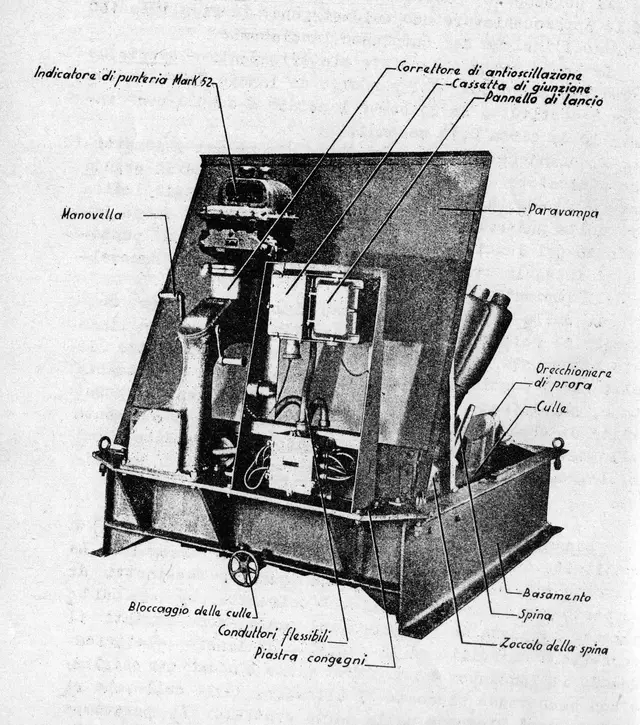
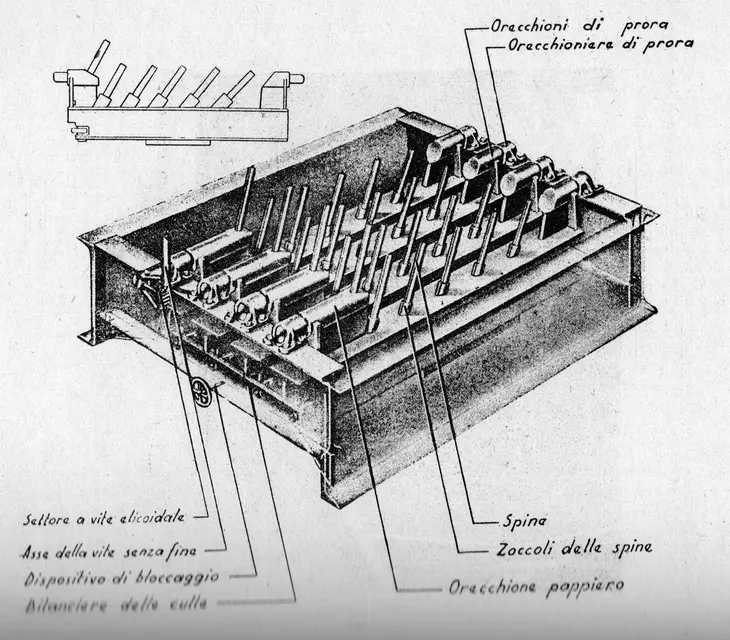
the lancebombe consists of a frame base formed by 4 ferroguides. the shorter beams carry 4 support bearings for the 4 cradles. a stern of the base is a paravamp sheet of protection of the operators on which the roll corrector and the electric square for the launch are mounted. the porcupine is connected to the ecogoniometric equipment and the cradles can be disbanded both to compensate for the roll of the ship, and to allow a limited shred of the weapon. 24 bombs are innestate on as many plugs connected to the cradles, can be rotated compared to a horizontal axis.
bombs are launched in pairs using an electric command with a range of 0.10 seconds per pair.
when the lancebombe is not in operation, it is blocked for keel and with it is also blocked the cradle balancer. the cradles consist of 4 crosses and bring to the ends the earphones that lodge within the bushings, allow to adjust the inclination regarding an axis parallel to the keel. all the poppie ends of the cradles are connected to one of the same barbeques that makes them band simultaneously through the roll concealer. each cradle carries six thorns each of which has different orientation both in elevation and in azimut so as to create in the fall point, the desired rose.
the thorns are hollows and housing the conductor destined to the ignition of the propulsive charge. when the bomb is housed on the plug, the launch capsule rests on percuotitoio which has the only function to ensure the electrical contact of the capsule with the ignition circuit.
the gases of the launch charge, expanding, push on the head of the plug, forcing the bomb to “depart” dropping the casing of the propellant charge.
the roll concealer consists of a kneading, axes and gears. the transmission connects a crank to an endless screw that integrates a solid helical wheel sector to the ear of a cradle (the first left). the 4 cradles are connected by a barbeque that forces them to rotate at the same time.
a pointer indicator is connected to the handle and indicates the breakdown of the total. the pointer receives the data transmitted electrically by the transmitter/ target indicator, indicates the vertical, algebraically sum the detection of the roll and the shingle indicating the deviation to give to the cradles, allows the manual introduction of the shingle indicating the values and, provides a reference vertical through an air bubble level.
the target transmitter/indicator, receives the route from the ship's compass, indicates the target detection and transmits to the pointer the value of the deburring angle. the bombs arrive in the water with a speed of 44 m/s and with an angle of about 58°. the trajectory in air lasts 8 seconds and after 17,5 seconds from the impact with the surface of the sea, are 122 meters deep.

Let's see now the 183 mm bomb. the body of the bomb has a diameter of 183 mm and its weight is 29,5 kg. the weapon is equipped with an impennage intended to ensure the stability of the trajectory. the cylindrical casing of the body consists of a sheet of steel welded to a flat ogiva and a conical stern filled with 13,3 kg of tnt or 15,1 of torpex. on the ogiva is a cap for the application of the winch while the tail is fixed by a threaded glass placed in the poppiero cone. the support sleeve of the lock is threaded externally to apply it to the body of the bomb and, internally to apply the lock. a printed casing is supportive with the head of the sleeve and constitutes the support for sponge and snow. the tail ends with a cylindrical enclosure where the planes can be parallel to the axis of the tube, or tilted to give during the descent a rotation to the bomb that improves the trajectory. the winch is of the shock type and is activated in two stages. removed the safety pin, the locker is partially activated and at the time of launch, a collar pulls a plug allowing the shift of the collar. when the bomb reaches the water, it has full activation of the winch. the propeller placed on the top begins to rotate and so doing, pulls a plug. 4-6 meters is sufficient to make this happen. the operation takes place by both direct and oblique impact against a dipped target.
this type of acciarino is very sensitive to the impact of a strip so as to detonate crawling on the sides of a submarine and whose effect is devastating.

united to the asdic (or peritero, as we called it Italians), it turned out to be an effective anti-submarine weapon and caused numerous losses between the forces of the axis. among its advantages there was also the fact that the weapon exploded only to the contact while the bombs of depth, exploding when reaching the quota, disturbed the sonars to which then took 15 minutes before they could resume their normal work. equally positive was the fact did not need to know beforehand the depth of the target.

at the end of the ii gm, he used to supply numerous hedghodg plants that were installed on antisom units, such as the corvettes of the gull class, the albatros class and the aldebaran class, the torpedoes of the bear class and the spica class and the destroyers of the infant class.
 
Sorry, I forgot to attach the attachments. . .
 

Attachments

  • 1023.webp
    1023.webp
    980.4 KB · Views: 27
  • 1024.webp
    1024.webp
    777.6 KB · Views: 20
  • 1025.webp
    1025.webp
    747.1 KB · Views: 21
  • 1026.webp
    1026.webp
    405.8 KB · Views: 28
  • 1027.webp
    1027.webp
    1.5 MB · Views: 25
If he reads you, Mr. President, I'm sorry. :smile:
Think about it, she got out, I didn't read it.
And now, what do I have to do?
Perhaps only a "full immersion" in the vineyard... could offer itself "voluntary" and, if it survives, it would be forgiven.
:biggrin:
 
this time, instead of talking about a weapon in particular, we will see a whole category of weapons that from their first introduction to the battlefields, have found a wide spread throughout the world, the so-called “flashfires”. These weapons are designed for combat using the so-called “intermediate unit”. are generally equipped with removable charger of great capacity, they have the possibility to select between single shot and raffica.Today there is a wide range of assault rifles such as “compacts”, suitable for urban combat or “bullpup”, with backed charger compared to the trigger, allow to obtain a shorter shot at equal length of the barrel.
We are talking about a “genre” of great diffusion, considering that every year something like 8 million “read” firearms are sold, of which 4.5 in the america alone. these are added to the 875 million already present. in use every year 100,000 people remain killed because of firearms. are impressive data that move huge figures. If we add more or less large, more or less well-known conflicts to this, which bloody the world, we talk about figures of 2.6% of the world pil. is a business that interests us closely as Italy is one of the world’s leading manufacturers and exporters.
Therefore, like it or not, we are talking about one of the products that have the most market and among them, one of the most popular is the aak-47 acronym that identifies the “avtomat lalasnikova obrazca 1947”, more known as “kalashnikov” from the name of its inventor. born in Soviet union but produced in different variants produced in cina, North Korean, Poland, is a sower of death diffused in every corner of the earth.
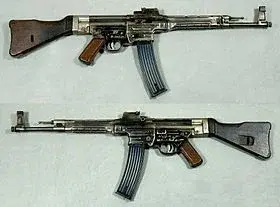
the aak-47 belongs to the category of “assault fires”. The story of this kind of weapons began at the beginning of the 900 when it emerged the need to equip the infantry of a new generation of individual firearms intended to replace the manual-drive rifle. some designers, including Italian rigotti, considered it essential to equip the infant with an effective automatic weapon. the machine guns of the time were excessively heavy in order to replace the rifle and their excessive caliber bullets. louis chauchat proposed a light machine that defined “fucile mitragliatore” but without solving the problem of the portatility of the weapon. the standar calibers of the time were the 8mm Austro-Hungarian, the 7,62 Russian, the 7,92 German, the 7.5 French and the 7,7 British. only the Japanese had descended to 6.5mm and it is exploited this type of ammunition that the Russians managed in 1915 to conceive a weapon (called “fedorov avtomat” designed by the inegner vladimir fyodorv) that, although not yet defined “flash fire”, introduced a good number of features such as the selectivity of fire and the removable charger (particular). other modern features were the short recoil and the shutter closed. the weapon proved efficient and served until the Leningrad battle of the world war. Meanwhile, the Italians did not hesitate to look but approached the problem by following an alternative path trying to make a machine gun that, while using the 9mm, had a higher range. starting from a villar-perosa machine machine (known with the nickname “pernacchia”) the ovp prototypes (in collaboration with trims) and mab-18 were realized. the mab had a follow-up with the mab-18/30 and its successors as the mab-38 of World War II. this family was called improperly “automatic device” but it is actually a matter of guns, rather heavy, that it is not yet possible to consider ancestors of the assault rifle. are the same considerations that can be made about the thompson mod. 1919 that although armed with 9x19 or 9x21 had a maximum range of only 250 meters. However all these weapons allowed us to experiment with all the innovative ideas that will then allow the creation of the real assault rifle. In the following years we will experience rifles that, if they arrived at the production, could be called real assault rifles. the ribeyrolle mod. 1918 for example, was an automatic French production rifle with an experimental ammunition of 8x35 mm. the 400-metre range was considered insufficient. Danes experimented with a light machine called weibel m/1932 which did not in time enter production because of the German occupation of 1940. had the possibility to select the shot and the caliber from 7x44. the same fate touched the modern and ergonomic “pyrkal epk” of Greek design of which 15 prototypes were made but then the factory was invaded by the German and Bulgarian troops and production was interrupted. Armed with caliber 7.92x39 had the characteristics to become the weapon of World War II. Americans instead produced in large number the carbines m1,m2 and m3 oltra light version for parachute m1a1. automatic rifles equipped with possibility of selection of the fire (from the m2 onwards), with .30 caliber. the Germans experienced numerous firearms similar to real assault rifles such as malenenkarabiner (m35) and the fallschirmjägergewehr 42 (fg42) intended for paratroopers but excessively expensive. research continued by experimenting unusual calibers such as 7,92x30 and 7,92x33 kurtz. so in the gm it came to have the machinenpistole mp44; more similar to a rifle than a gun (despite the name) and that it used an intermediate ammunition (less powerful of the rifles but more of the guns). the goal was to create a weapon that combined precision at a single stroke, the range and the high impact power of the classic rifles of the time with the possibility to offer automatic fire at close distance and thus act as an automatic weapon; a complete weapon, able to adapt to field situations.mp44 was the final result of a long sequence of experiments and research conducted by the haenel and walther industries.
the first prototypes were made in 1941 while the first specimens were ready in 42. those produced by haenel were called mkb 42h, while those produced by Walther were marked by the acronym mkb 42w. the two weapons were very similar, both with a 30-round charger, attack for the bayonet and predisposition for myrino zf. the baptism of fire took place on the eastern front when they were parachuted to a group of soldiers encircled by the Russians. While the troops welcomed the new weapon, hitler initially opposed its use, believing it to be too powerful, too expensive. It also made the huge amounts of cartridges available in the warehouses. Despite the opposition of the fhurer, the production continued secretly disguised as a machine gun with the mp43 theme. the weapon was reproposed to hitler but also this time did not authorise mass production which, however, went on equally even if in reduced numbers (pare that only 14,000 were produced). But under the continuous requests from the division commanders to distribute the weapon in sufficient quantities, hitler ordered that an investigation was opened on those who had authorized the production and the results obtained on the front (in particular there was a considerable increase in the volume). the investigation ended with such a positive judgment, that the fhurer changed opinion and authorized the mass production of the rifle renamed "sturmgewehr-44" (stg-44). but by now it was too late and the availability of the weapon remained insufficient.
l’stg-44 was the first assault rifle produced in large quantities and the first to exploit in a non-experimental manner all the features. can be used both as an automatic and semi-automatic weapon, with light ammunition and reduced weight, with a range less than a traditional but small rifle.
the sg-44 became the reference for modern assault rifles and in particular will derive the most famous of all, the “ak-47 kalashnikov”. the Russians, who had been able to experience at their expense the effectiveness of the German weapon, realized the ak-47, an improved version of the German competitor. the Russian exemplar was of a lower technological level; made for milling parts while the Germans already resorted to molding with considerable weight reduction. the ammunition was 7,62x39 while the sg-44 used 7,92x33.

(will pursue a panormic on some assault rifles).
 

Attachments

  • stg44.webp
    stg44.webp
    10.2 KB · Views: 56
  • AK47.webp
    AK47.webp
    143.7 KB · Views: 17

Forum statistics

Threads
44,997
Messages
339,767
Members
4
Latest member
ibt

Members online

No members online now.
Back
Top