• This forum is the machine-generated translation of www.cad3d.it/forum1 - the Italian design community. Several terms are not translated correctly.

helical development

  • Thread starter Thread starter belcarlo
  • Start date Start date

belcarlo

Guest
I'm learning inventor

I need help with this problem:

I should make a descent ramp for a garage plastic with these features:

external radius 60,2 cm
internal radius 17.2 cm
total angle 200 degrees

height to exceed 10.5 cm


but above all (I know that it is not directly about inventor but...maybe someone knows the trick...) how do I project the helid on the countertop plan to cut?

Thank you.

carlo b.
 
for the first part is simple, there is the "helicoid" command that does what you ask, the development instead you don't do it with inventor because inventor doesn't do it, I don't know other solid modelers.. .
 
Hello sends a drawing that you understand well what you have to do.:smile:


Hi.
 
for the first part is simple, there is the "helicoid" command that does what you ask, the development instead you don't do it with inventor because inventor doesn't do it, I don't know other solid modelers.. .
a nose, without proof: follow tarkus, then convert it into sheet metal and create the flat model.

Hi.
 
No, no, no.
even if you convert it into sheet metal is not developed because the processing of a helicoid is a processing of deformation on several directions, then nisba.
inventor, develops only deformation processing on a single axis (folding,calandering. )
I don't know what other modeler can do,
the formula of calculation, I believe that in the baldassini there is
 
Look what inventor opens rhino without problems.
for what concerns precision, on a sheet that will then be overwhelmed, I do not think that there is the problem, if then you have to make a model in plywood, cut with a pond....
 
I had not noticed that you could open a rhino file, thanks to the suggestion.
 
Thank you stefanobruno,

I'm gonna invite you to see the finished project...
...and you will have a surprise.. .

Thanks again
 
a helid develops it here! we make helical scales for tanks, and we make the development with inventor of the dish of which the hails are bolted. with so much length of development of the dish in table. Believe it works!
 
x Could you post an example file? could be useful for everyone so much to understand. also what version of inventor used?
 
a helid develops it here! we make helical scales for tanks, and we make the development with inventor of the dish of which the hails are bolted. with so much length of development of the dish in table. Believe it works!
Maybe we're not talking about the same thing.
I'm talking about a helid like e.g. an element of a core, my "inventor professional 2015" does not develop it, I don't know yours.
the "piattone where the steps are bolted" with which command have you made it?
if you have made it revolution or bending, it develops it!
Otherwise tell us how you do it.
rather, the image you posted does not seem to be made with inventor, as already told you davide75, why not place a simple file with helical+ development?
 
Maybe we're not talking about the same thing.
I'm talking about a helid like e.g. an element of a core, my "inventor professional 2015" does not develop it, I don't know yours.
the "piattone where the steps are bolted" with which command have you made it?
if you have made it revolution or bending, it develops it!
Otherwise tell us how you do it.
rather, the image you posted does not seem to be made with inventor, as already told you davide75, why not place a simple file with helical+ development?
hi to everyone, the file I attached is absolutely done with inventor professional 2015!
I took that photo from a dwf file I got on my phone.
that dish on which the steps are bolted is made with the helical command. then I turned the sheet file and made the development.
I have that plate cut directly to the laser with the holes of the steps.
Monday put directly the dish first helical and then developed.
if I can place the ipt file directly.
hiooo to Monday and thank you all because it is nice to find someone to discuss and discuss these things with!
 
Let's sum it up,
if the direction of the "thickness" dimension is perpendicular to the axis of revolution of the helid, inventor develops.
your "piattone" is similar to a calandrate.
if instead the direction of thickness is parallel to the axis of revolution,nisba.
In the case of an element of cochlea, the development is necessary on a perpendicular plane to the axis of revolution, then direction thickness parallel to the axis, then:nisba. :36_1_28::36_1_28
 
Let's sum it up,
if the direction of the "thickness" dimension is perpendicular to the axis of revolution of the helid, inventor develops.
your "piattone" is similar to a calandrate.
if instead the direction of thickness is parallel to the axis of revolution,nisba.
In the case of an element of cochlea, the development is necessary on a perpendicular plane to the axis of revolution, then direction thickness parallel to the axis, then:nisba. :36_1_28::36_1_28
I assume that the development of the helid can be done by keeping in mind what you said te tarkus.

nisba let me do it is not a constructive answer and suitable for this type of forum, also because I think we have to arrange all with the tools we have in hand.

and if you are able to arrange inventor a hand on the development of a helicoid gives it to you.

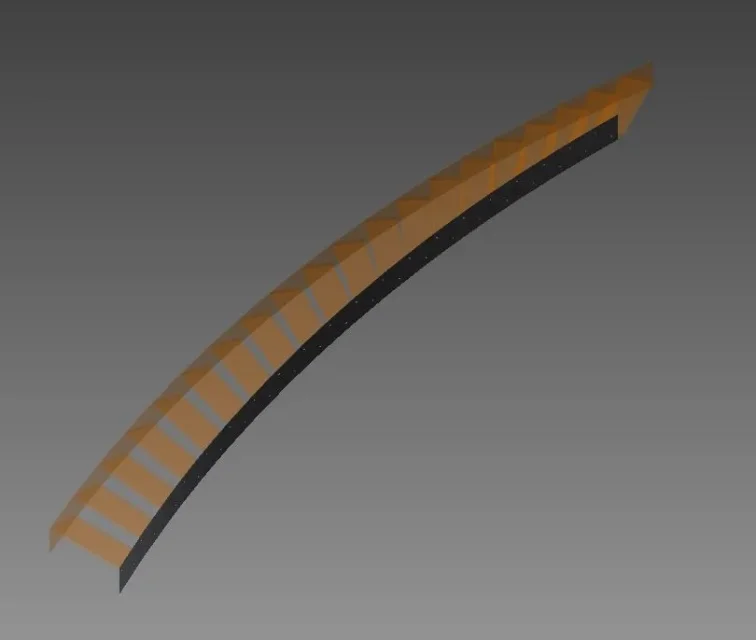
cmq here is my dish. (helicoidal) obtained with inventor from a helical crumpled with the sheet module of inventor pro. 2015
cosciale elicoidale 1.webpcosciale elicoidale 2.webpgreetings to all
 
It is not constructive, but it is realistic and fruit of commitment (though over the years) in responding. However the helicopter in question I think is this (he was talking about a garage ramp):
Elicoide.webpthe other of course is developable, with this it seems to me a little everyone with inventor have problems
 

Forum statistics

Threads
44,997
Messages
339,767
Members
4
Latest member
ibt

Members online

No members online now.
Back
Top