
• This forum is the machine-generated translation of www.cad3d.it/forum1 - the Italian design community. Several terms are not translated correctly.

modeling advice

  • Thread starter Thread starter volaff
  • Start date Start date

volaff

Guest
Good evening to all, I would have a doubt / curiosity.
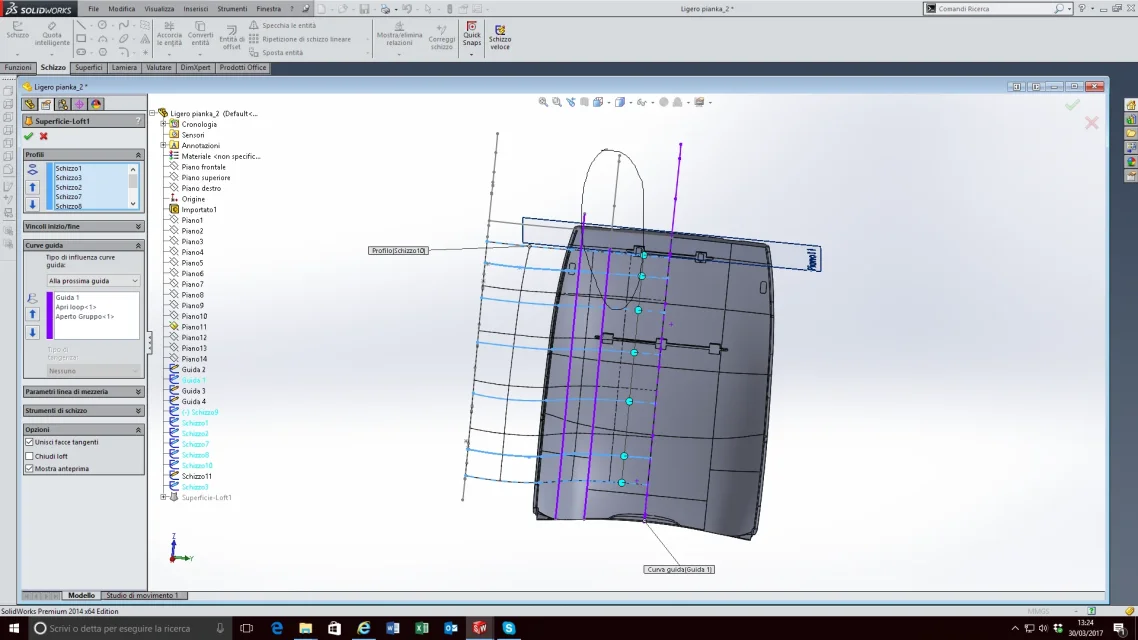
if you had to reproduce from a step that was given you a type armchair shape (figure) to understand what would be the technique you would use to reproduce it in solidworks? work for surfaces? in view of any changes?
of course there are functions like fittings and holes that complicate the thing.

would it be possible to go to change the step directly by adding feature?


thanks to all for any answers.
a tip smears well
 

Attachments

  • Immagine.webp
    Immagine.webp
    123.4 KB · Views: 39
Meanwhile save the file in solid format, then you can intervene on the file. depending on the changes you have to make is not said that it is necessary to rebuild, already so you can move holes make offset of surfaces etc etc.
 
Meanwhile save the file in solid format, then you can intervene on the file. depending on the changes you have to make is not said that it is necessary to rebuild, already so you can move holes make offset of surfaces etc etc.
volaff has already imported that step file in solid (you see in the feature manager the imported function at first), but would like to know how to remake it with solid functions. and would like to know with a spit of practically dimensional image. it seems that for the hands it always has ultra-secret files (this perhaps is the back of the apollo 18) that cannot attach. to the absurdity of the demands there is never limit.

volaff, if by chance that file is made with a program dedicated to design or complex surfaces (catea, rhino...) remaking it with solid is much more than complicated, especially if you are not familiar with surface modeling. Solidwrks is not the software suitable to do this. Who gave it to you to remodel is an idiot
 
thanks to both for the answers.
in summary, beyond the file that I briefly insert (an example) but at the end the pappa is that, it starts from a step and want to change it (maybe you know make me a little tighter here and widest there of tot) and are pains.

I understood that it may be crazy, but I would only like to have a brief opinion on a possible resolution of this problem: if the solution is working with and for sw surfaces is less suitable. Amen.

ps the filè is about 17 mb zipped and do not attach it to me :)
 
but I would have just wanted a council on a possible resolution of this problem
to understand what is the right way to shape such a thing you must absolutely absolutely have the file and be able to manipulate and study it, make attempts and return back and give back others.
have an example file could possibly do not serve anything because in such particular file cases modeling is specific.
I repeat that if someone believes to make a particular design with a cad dedicated to mechanics is an idiot, if he claims to make it to a person who does not have a deep knowledge of the software and, in this case, of modeling with surfaces (which may or may not serve, but it is definitely an approach to do) then it is worse than idiot.
at this point you do a reconstruction of the functions, let the pc work for a week or a month and then manage the created functions
 
I understand perfectly.
Sometimes I'm connected to the phone and sometimes I don't have time to attach.

an example could be this
 

Attachments

I repeat what I said before, it is not a solid thing to do. certainly you can do it; I have no idea how, but I doubt that with lofts, several lofts, do everything; I think you have to work on surfaces.
You know when you do these jobs? when there is lean in the office and tell the owner that since you don't pay for an advanced modeling course, instead of going to vacation you study yourself the program with tutorials, video is steps to be copied.
and let us see this example Immagine.webp
 
I repeat what I said before, it is not a solid thing to do. certainly you can do it; I have no idea how, but I doubt that with lofts, several lofts, do everything; I think you have to work on surfaces.
You know when you do these jobs? when there is lean in the office and tell the owner that since you don't pay for an advanced modeling course, instead of going to vacation you study yourself the program with tutorials, video is steps to be copied.
and let us see this example View attachment 46768
I agree with you, doing such a thing with sw is really a waste of energy without comparisons, most of all when with a suitable modeler you can do it in a tenth of the time and even better....I had so far to work with complex surfaces both in sw and in solidedge and was a nightmare, in the end I had a tree of features that was long more than the queen rolls. .I would not like to say fesserie but I believe that with a software for molds you would certainly get excellent results but remains the fact that they are much more complex to use of ryno modeling software and company.
 
I agree with you, doing such a thing with sw is really a waste of energy without comparisons, most of all when with a suitable modeler you can do it in a tenth of the time and even better....I had so far to work with complex surfaces both in sw and in solidedge and was a nightmare, in the end I had a tree of features that was long more than the queen rolls. .I would not like to say fesserie but I believe that with a software for molds you would certainly get excellent results but remains the fact that they are much more complex to use of ryno modeling software and company.
I disagree.
made the debite distinctions between the scaffolding of the various software (useless and stupid to compare in acritical way catia, nx or omnicad with swx & c.) , chedo that the main difference to model complex surfaces is... to be able to do so, that is to know in depth the techniques of modeling with the surfaces. Perhaps it seems a trivial consideration, but after years I read the forum it does not seem to me at all discounted.
I would say to leave the comparison with rhino, because then with rhino when you have to make changes you can shoot and it is evident that a parametric modeler, as such, makes available a tide of dimensional controls more than then make the changes much faster than granted by a "stupid" model like rhino.

Assuming that seat seems to me like a bad guy who takes away and I think that anyone with a mini of dysfunction with swx can get to it, I recommend volaff to look for some resource on the net on the (general) modeling techniques with the surfaces.
in the specific (swx) try to look on the tube under "advanced surfacing". Here it seems to me that it is not really impossible to model with surfaces in swx. It takes a bit of a handle.. .https://www.youtube.com/watch?v=a0kzgwst6syhttps://www.youtube.com/watch?v=9rpriglduvehttps://www.youtube.com/watch?v=ehufeje0k_chttps://www.youtube.com/watch?v=whsqbfs0jqghttps://www.youtube.com/watch?v=5mbdlv4ze_4
 
I disagree.
made the debite distinctions between the scaffolding of the various software (useless and stupid to compare in acritical way catia, nx or omnicad with swx & c.) , chedo that the main difference to model complex surfaces is... to be able to do so, that is to know in depth the techniques of modeling with the surfaces. Perhaps it seems a trivial consideration, but after years I read the forum it does not seem to me at all discounted.
I would say to leave the comparison with rhino, because then with rhino when you have to make changes you can shoot and it is evident that a parametric modeler, as such, makes available a tide of dimensional controls more than then make the changes much faster than granted by a "stupid" model like rhino.

Assuming that seat seems to me like a bad guy who takes away and I think that anyone with a mini of dysfunction with swx can get to it, I recommend volaff to look for some resource on the net on the (general) modeling techniques with the surfaces.
in the specific (swx) try to look on the tube under "advanced surfacing". Here it seems to me that it is not really impossible to model with surfaces in swx. It takes a bit of a handle.. .https://www.youtube.com/watch?v=a0kzgwst6syhttps://www.youtube.com/watch?v=9rpriglduvehttps://www.youtube.com/watch?v=ehufeje0k_chttps://www.youtube.com/watch?v=whsqbfs0jqghttps://www.youtube.com/watch?v=5mbdlv4ze_4
Thank you very much for reporting!
 
I disagree.
made the debite distinctions between the scaffolding of the various software (useless and stupid to compare in acritical way catia, nx or omnicad with swx & c.) , chedo that the main difference to model complex surfaces is... to be able to do so, that is to know in depth the techniques of modeling with the surfaces.. .
Hello, Marcof, what you say is sacred. Obviously knowing the advanced surface modeling techniques is indispensable but the question is another: the flexibility of features for the generation of surfaces that sw and company do not have. with a bit of time everything can be done but if I have an endless debate to carry out the modeling and also the result that I get is, at the level of parameterization, very unstable means that something does not fit. What I want to say is that if I had to deal with surfaces every day, I would stay away from sw and the like.
 
Hello, Marcof, what you say is sacred. Obviously knowing the advanced surface modeling techniques is indispensable but the question is another: the flexibility of features for the generation of surfaces that sw and company do not have. with a bit of time everything can be done but if I have an endless debate to carry out the modeling and also the result that I get is, at the level of parameterization, very unstable means that something does not fit. What I want to say is that if I had to deal with surfaces every day, I would stay away from sw and the like.
I modeled surfaces with nx from morning to evening for years and it is difficult to understand what you have. I'm finding out by seeing the comments on a thread I started on mechanical cads in comparison. users who do not have certain modes of modeling and have never tried them can not understand.
this to give you advice: side by side with a modeling expert of nx surfaces, caty or other and compared on the methodologies used. you will see that certain concepts such as parameterization and stability are very relative when talking about surfaces. not by chance are called free form :wink:
Hi.
 
I disagree.
made the debite distinctions between the scaffolding of the various software (useless and stupid to compare in acritical way catia, nx or omnicad with swx & c.) , chedo that the main difference to model complex surfaces is... to be able to do so, that is to know in depth the techniques of modeling with the surfaces. Perhaps it seems a trivial consideration, but after years I read the forum it does not seem to me at all discounted.
I would say to leave the comparison with rhino, because then with rhino when you have to make changes you can shoot and it is evident that a parametric modeler, as such, makes available a tide of dimensional controls more than then make the changes much faster than granted by a "stupid" model like rhino.

Assuming that seat seems to me like a bad guy who takes away and I think that anyone with a mini of dysfunction with swx can get to it, I recommend volaff to look for some resource on the net on the (general) modeling techniques with the surfaces.
in the specific (swx) try to look on the tube under "advanced surfacing". Here it seems to me that it is not really impossible to model with surfaces in swx. It takes a bit of a handle.. .https://www.youtube.com/watch?v=a0kzgwst6sy
I agree with you on everything and allow me to highlight three errors in the video you posted and that make me feel that who did it did it only for demo and not to produce the piece:
1) Class a surfaces (concept difficult to explain) never end at a point. are four-sided surfaces of preference. try to make a surface for three sides and you will see that at one point it grows.
2) Never use the blend to make the blend (it looks strange but it is so) and at least variable radius, blend surfaces are made with which curve controls or flow on support curves made with particular techniques.
(3) and this is unforgivable mirror the model: you will never get a continuity between the two surfaces and you will always see the line.

Hi.
 
I agree with you on everything and allow me to highlight three errors in the video you posted and that make me feel that who did it did it only for demo and not to produce the piece

(cut)
I have no doubt that there may be gross errors about what can be found on the tube and I imagine that the videos posted are little more than a game (especially those on the carriages). I did a rocket research, on swx, just to see what was found and why we can realize that to model with the surfaces the surfaces must really know them, regardless of the cad. I for example do not know them and I was more than sure that experts like you could have intervened to raise the level of the discussion much more by identifying all the criticalities that you caught only at first sight. Let's figure out if you had the video model.
Unfortunately here on cad3d we have always noticed the lack of qualified people on the topic "modelling of surfaces" that were available to provide explanations, examples etc as happens in almost all other topics covered here.
he knows a lot about "shop secrets" jealously guarded, and allusion could also stand there, since I think it takes years of work on real and complex models to acquire that mastery and that "buzzo" (as they say from my side) that allow you to plan before and face after the realization of any form.
 
..that experts like you....
thank you but there are more experts than me and with more 'manic'
. that allow you to pianificare prima and face after the realization of any form.
what you affirm is very important, you must try to identify well those that are the true design parameters, whether you work on surfaces or any other project. not to advertise me but look here
http://www.cad3d.it/forum1/threads/50266-multibody-con-nx?p=397215&viewfull=1#post397215the case is trivial beyond the shape that from oval has become square with two clicks, but here the main aspect of the project has been grasped and that there was an oval (important) tank (less important) of thickness tot (important) with a mating tooth (important). based on this ladder I tried to make everything parametric.

even with the surfaces there are more or less important aspects, which are kept strictly under control. if I have some time place some example but one I try to explain it in words: Suppose you have a particular 'ethical' of complex form, 'superficially' speaking, which must be printed. the first thing to do, once you had the idea of how it will come out more or less, is to decide the mold division lines and finish for example. the finish can give me indications on the minimum sform for example. Once I have division and deform or deform, these I hold them strictly under control with sketches but the splines with which I make the surface I take them out of sketches and with only tangency control or curvature on these sketches (or even surfaces). I would never go to do a spline controlled by sketch points like in the movie you mentioned.

As you can see, it's a topic that I'm passionate about, and it's better if I stop it on Sunday like napalm51 instead of taking a bike ride.

Hi.
 
Straquota baskets1959 on everything!!! .... I have been using nx for 12 years, but I also use other parametric cads like inventor, solidworks, solidedge and despite my work as an endothermic engine designer does not lead me to use freeforms every day for some "objects" like the souls of the intake ducts with the swirl pins I have to model completely of surfaces. Sometimes these objects come from reverse engineering of other engines and you do not have time to remodel them but only to remove patches and build others .... to get good curves on which to build new surfaces I usually extraggo from the nearby surfaces the isoparametric curves and then create curves to the outside of the sketch and control in tangence and curvature... and I build the surfaces above the lattice that I created; I have learned to work so from Turin's "carrozziers" ... now in all middle-end cads there are no commands to extract or display the isoparametrics that generate patches of the various surfaces, these are in nx, caia (I have not seen them in creo but I do not know it well...) in programs for design type alias.
I think remaking a model so with solidworks takes a lot of time, and a lot of effort and the final result will not be better.
Better to go on cad with more extensive potential.
 
(cut)

I would never go to do a spline controlled by sketch points like in the movie you mentioned.

(cut)

As you can see, it's a topic that I'm passionate about, and it's better if I stop it on Sunday like napalm51 instead of taking a bike ride.
I was in a hurry before and even now but I wanted to propose an idea to do some didactic on the surfaces revealing some "shop secret" on the general methodologies with which you have to work. it would be interesting that you "disassemble" one of those tutorials (what you think best) showing how that particular should be modeled, explaining why of certain different choices and thus comparing the final results.
It would become a valuable resource, very useful to a lot of users to be able to do it using the basic controls of the surfaces, without pushing into the researches that are of domain only of high-end cads.
If you agree you may indicate which tutorial you would like to correct, I will refer the model to the same swx and provide you with the step for your surface quality ratings.
it would therefore be interesting to repropose a modelling of that object according to "the rules of art" and to try to make it to the best each with the cad that has at disposal, within the limits of the tools that swx (if, inv etc) have available.
 
Thank you all for your concern. !
the discussion has become very interesting!

Good evening!
 
I was in a hurry before and even now but I wanted to propose an idea to do some didactic on the surfaces revealing some "shop secret" on the general methodologies with which you have to work. it would be interesting that you "disassemble" one of those tutorials (what you think best) showing how that particular should be modeled, explaining why of certain different choices and thus comparing the final results.
It would become a valuable resource, very useful to a lot of users to be able to do it using the basic controls of the surfaces, without pushing into the researches that are of domain only of high-end cads.
If you agree you may indicate which tutorial you would like to correct, I will refer the model to the same swx and provide you with the step for your surface quality ratings.
it would therefore be interesting to repropose a modelling of that object according to "the rules of art" and to try to make it to the best each with the cad that has at disposal, within the limits of the tools that swx (if, inv etc) have available.
Thanks for trust, I thought instead of suggesting thishttps://www.youtube.com/watch?v=llvsz5kdiu0&t=1147swhere some modeling and control techniques are well explained.
Hi.
 
Thanks for trust, I thought instead of suggesting thishttps://www.youtube.com/watch?v=llvsz5kdiu0&t=1147swhere some modeling and control techniques are well explained.
Hi.
Thank you for reporting. time ago by curiosity I looked at several, thosendi remembered their existence and for that I wanted some to link here. the fact is that the surfaces are not my job so I can't evaluate the goodness of the various tutorials.
If you happen to find more of "good" and you report them (without necessarily making a review that would always be interesting) I think you would do a good service to all.
the ideal would be to find tutorials that focus mainly on basic rules and possibly advanced ones to model with surfaces, making debit evaluations based on the potential and limits of your cad. Of course if I find an advanced modeling tutorial of surfaces with catia, nx or create hardly commands will be as complete and powerful as in swx. maybe it would be good to find the (just?) well-made tutorials for programs that implement basic surface modeling like solidworks, solidedge and inventor
Maybe you could open a new thread in the most appropriate section.
 

Forum statistics

Threads
44,997
Messages
339,767
Members
4
Latest member
ibt

Members online

No members online now.
Back
Top