• This forum is the machine-generated translation of www.cad3d.it/forum1 - the Italian design community. Several terms are not translated correctly.

cart on tracks

  • Thread starter Thread starter krissbetarr
  • Start date Start date

krissbetarr

Guest
hi guys!I ask for help on the design of an industrial automation cart. I know that this subject has been dealt with several times, but in other topics it seems to me that chaos reigns.

I have to choose engine and gearbox to move a 1000kg cart on four wheels. the questions are:

- the gear motor is to operate two wheels rigidly connected through the same axle. the torque that generates the gear motor is divided into two (between the two wheels) or each wheel receives the same torque generated by the gear motor being rigidly connected? I'm told you're splitting in two, otherwise you wouldn't have to balance the rotation, would you?

- according to the answer to the first question arises second. to calculate the time necessary to move the cart I go to divide the total weight for four (four wheels). after which I have many doubts. the strong torque would be calculated (hand applied mechanical book) mr = mv + tr = fvpr + tr where p would be 2500n (1000kg/4 turned into newton), fv the coefficient of dynamic friction, radius of the wheel, t friction force calculated as p*fs (fs coefficient of static friction) correct?

- then I would like to calculate the maximum torque applicable to each wheel so as not to slip and therefore have maximum acceleration. I would concentrate all the mass of the structure in the wheel and calculate the corresponding moment of inertia for a full disk, using the formula that I attach. Is that correct? Can someone make some light on these blessed dimensions?formula per cad3d.webpthanks to who will help me
 
on the site of the demag there is dip, catalog, formulas and online program to configure everything.
 
If you are doing mechanical engineering, I would say that on books of rational mechanics and above all applied mechanics there are all explanations and exercises carried out on mtu.
However I attach a pattern and some logical formula of the cart system.WP_20180124_21_42_30_Pro.webpThe other posts seemed clear enough to me. you need to know four things about static friction, volving friction, reactions etc.
then clearly it is necessary to think of the real application, dirt on the ground, chips, stones etc....so 0.55-0,75kw 4poli ....no inverter and maximum double torque of the nominal torque.
then if you want you can calculate the transitory, acceleration, inertia etc.
 
If you are doing mechanical engineering, I would say that on books of rational mechanics and above all applied mechanics there are all explanations and exercises carried out on mtu.
However I attach a pattern and some logical formula of the cart system.View attachment 49157The other posts seemed clear enough to me. you need to know four things about static friction, volving friction, reactions etc.
then clearly it is necessary to think of the real application, dirt on the ground, chips, stones etc....so 0.55-0,75kw 4poli ....no inverter and maximum double torque of the nominal torque.
then if you want you can calculate the transitory, acceleration, inertia etc.
Hello! on the paper the speech does not make a grit, but if I try to deepen a little more I arise of doubts. you said that c(resistant)=t*r+ fn*e. would not this actually be the maximum torque to be applied for not having slip? the minimum torque in reality would not be represented only by the resistance to rolling (and also aerodynamics but that is neglected)? I try to investigate the theory well because I need to put it in thesis, because for a maximum sizing it would be as good as you explained. Moreover for the balances the equation would go well, but starting from firm the maximum couple that I can give turns out to be the one above or only c=t*r? for what concerns then the coefficient of friction, how do I establish it? I refer to hertz theory?according to this theory the imprint between a wheel the vulkollan and steel comes to me 0.02mm, can we stand?thank you and apologize if I reopened the discussion
 
you have the formula that I gave you then you have to add the aerodynamic force and the inertia force because you accelerate from stationary. the coefficient of vulkollan can also be double....depends on the hardness. you can try to make calculation with hertz though with the rubber things are a little different.
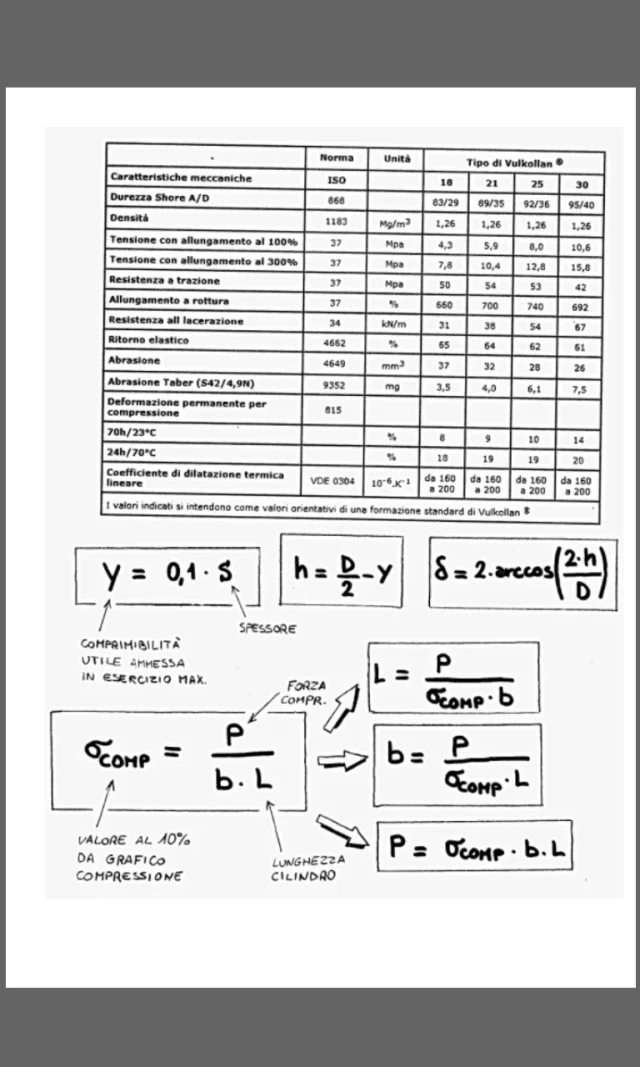
I attach my notes to youwp_ss_20180211_0001.webpwp_ss_20180211_0002.webpas you see the rubberized thickness affects the real deformation of the wheel and you can load the cart as long as the compression sigma falls within the limits. if the load exceeds the wheel tire.

the compression sigma is worth about 10-12mpa.

Other info http://www.unicas.it/media/250785/parte_2_2_2 (1).pdfhttp://www.gerundia.com/files/pdf/auto.pdfhttp://ndtl.org/~luca/dwl/tesi-laurea-collini-2000.pdfand if you are looking for you will also find the dynamic dispenses of the vehicle with all calculated and considered.
 
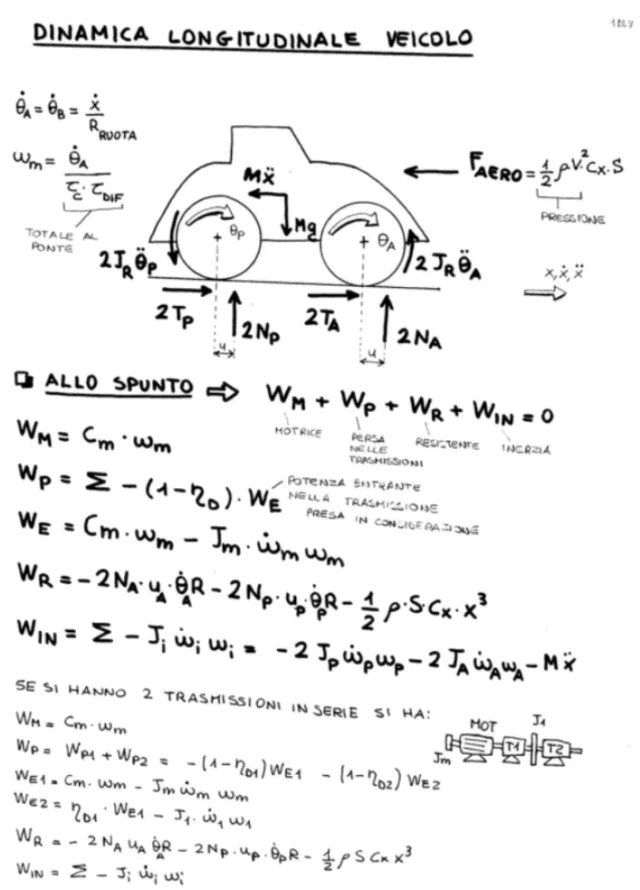
I attach the formulas of the longitudinal dynamics of a transient vehicle. this also applies to your carriage on tracks. Of course, at work, you're not calculating like that, but I'll train you what you need.wp_ss_20180211_0005.webp
 
Hello! on the paper the speech does not make a grit, but if I try to deepen a little more I arise of doubts. you said that c(resistant)=t*r+ fn*e. would not this actually be the maximum torque to be applied for not having slip? the minimum torque in reality would not be represented only by the resistance to rolling (and also aerodynamics but that is neglected)? I try to investigate the theory well because I need to put it in thesis, because for a maximum sizing it would be as good as you explained. Moreover for the balances the equation would go well, but starting from firm the maximum couple that I can give turns out to be the one above or only c=t*r? for what concerns then the coefficient of friction, how do I establish it? I refer to hertz theory?according to this theory the imprint between a wheel the vulkollan and steel comes to me 0.02mm, can we stand?thank you and apologize if I reopened the discussion
c(resistente)=t*r+ fn*e It's the limit couple that if you get over it, you start slipping.

I attach here a summary card for a motorization of a cart like your 1000kg porata.

as you can see, setting the usual formulas in excel you can determine that you can make ramps from 0.8m/s^2 and if you try to make a fur more you get that wheels slip.

being a trolley that transfers things from one side to the other, especially in practice you do not go very specifically to deal with (e.g. you neglect the wheel inertia) and you go basically to evaluate two main aspects:
- torque calculation due to wheel deformation and then passing through fv- calculation of the acceleration torque that is discharged as force that is opposed to the tangential force of adherence t and that goes to sum up or remove the force of thrust fright to clarify all doubts:
- the cart weighs 1000kg
- the wheels in total are 4 therefore each wheel has 1000/4=250kg as vertical force
- the limit torque and the torque due to the turning friction determines it on the single generic wheel (motorized or mad that it is)
- the total torque above calculated serves the system, therefore to the 4 wheels but being that the motions are only 2 connected by single motor, it is has that the total torque of the system is to be divided by the number of moving wheels
- therefore the power dissipated by a wheel must be multiplied by the number of motorized wheels and divided by the number of motorizations that are realized (in this case a motor for 2 wheels...in other cases each motor a wheel)carrello.webp
 
If you are doing mechanical engineering, I would say that on books of rational mechanics and above all applied mechanics there are all explanations and exercises carried out on mtu.
However I attach a pattern and some logical formula of the cart system.View attachment 49157The other posts seemed clear enough to me. you need to know four things about static friction, volving friction, reactions etc.
then clearly it is necessary to think of the real application, dirt on the ground, chips, stones etc....so 0.55-0,75kw 4poli ....no inverter and maximum double torque of the nominal torque.
then if you want you can calculate the transitory, acceleration, inertia etc.
excuse me mechanicalmg but I don't find your formulas clear. Why should the driving power depend on the number of driving wheels? the resistant torque is always generated by all 4 wheels. If the budget of powers is resolved, there will be no dependence on the number of wheeled wheels.
you also reiterate in post 9 but I really don't understand why.
I attach a pattern of how I am used to doing it (I assumed for simplicity that the cart is traveling at constant speed v, so as not to take into account the part concerning static friction)image.webp
 
what I did in the spreadsheet is:
- the strong torque with fv applies to the full number of wheels
- if the driving wheels are 2, the engine must also subsidize fv of the crazy wheels
If it wasn't the 4x4 panda they didn't do it and left the normal one with front traction.
 
studying the vehicle from outside is something, studying it from inside the motorization is a little different.

Imagine having a wagon with 20 crazy wheels and two traction wheels. the two traction wheels work for the 20 crazy wheels and their turned frictions, so the torque to the wheels does not depart equal. The driving wheels can slip if from the couple that exceeds the grip, the crazy wheels do not slip on the straight paths, but only when the internal speed curve and external curve are different and the greater exceeds the grip.
then each wheel has its vertical load and therefore by force you consider the number of wheels
 
the driving power is equal to the resistant power + possibly the lost power in the transmission. instead you are saying that the driving power is 4 times the power resistant to the single wheel if the driving wheels are 4, or 2 times the power resistant to the single wheel if the driving wheels are 2 ..... so if I have two driving wheels I need half power even if the downstream transmission system is identical ? I wouldn't say exactly.
 
the example of the panda falls sharply. It is as if you went to the dealer to buy your beautiful 180 cv road, but you wanted the integral traction instead of the front one and the salesman told you that for the integral traction it takes the 360 horse motor because the wheels are 4 instead of 2.
 
no, the strong torque is that of a wheel multiplied the number of total wheels (number of motions more crazy number)...so says the excel.

the shaft of the motorized axis will be more solicited is bigger than the mad one.
 
the example of the panda falls sharply. It is as if you went to the dealer to buy your beautiful 180 cv road, but you wanted the integral traction instead of the front one and the salesman told you that for the integral traction it takes the 360 horse motor because the wheels are 4 instead of 2.
It's not like that. with integral traction I distribute the torque on 4 wheels that is lower to the single wheel than the torque downloaded on a two drive.
 
the excel I can not consult it in the formulas unfortunately... from the first sheet of notes that you posted read, at the bottom, that if the wheels are 2 then wm = 2cr*omega; if the wheels are 4 then wm = 4cr*omega... .
that’s what I’m challenging ... if the excel considers in any case all wheels then we agree.
 
If you are doing mechanical engineering, I would say that on books of rational mechanics and above all applied mechanics there are all explanations and exercises carried out on mtu.
However I attach a pattern and some logical formula of the cart system.View attachment 49157The other posts seemed clear enough to me. you need to know four things about static friction, volving friction, reactions etc.
then clearly it is necessary to think of the real application, dirt on the ground, chips, stones etc....so 0.55-0,75kw 4poli ....no inverter and maximum double torque of the nominal torque.
then if you want you can calculate the transitory, acceleration, inertia etc.
incorrect courier for the attached image:
the power to the motor must always be multiplied by the number of total wheels, therefore 4, since the couple age was calculated to the individual wheel previously.
 
Is it not that you could post the formulas behind the excel sheet??? I would be grateful....

Hi.
 
Uhhhhhhhhhhhhhhhhhhhhhhhhhhhhhhhhhhhhhhhhhhhhhhhhhhhhhhhhhhhhhhhhhhhhhhhhhhhhhhhhhhhhhhhhhhhhhhhhhhhhhhhhhhhhhhhhhhhhhhhhhhhhhhhhhhhhhhhhhhhhhhhhhhhhhhhhhhhhhhhhhhhhhhhhhhhhhhhhhhhhhhhhhhhhhhhhhhhhhhhhhhhhhhhhhhhhhhhhhhhhhhhhhhhhhhhhhhhhhhhhhhhhhhhhhhhhhhhh ... try to count and see if you get the same
 

Forum statistics

Threads
44,997
Messages
339,767
Members
4
Latest member
ibt

Members online

No members online now.
Back
Top