• This forum is the machine-generated translation of www.cad3d.it/forum1 - the Italian design community. Several terms are not translated correctly.

curve da equazione

  • Thread starter Thread starter MARCOC
  • Start date Start date
if in design the purpose is to define a mechanism in all its parts, these are concrete objects (or tangible)

as operator cam however in many cases for me it is perfectly normal to draw non-concrete objects, as design only the essential strait to drive the tool on the piece. For this reason, sometimes it makes sense to draw self-intersecting curves or other things that in the real world do not have correspondence, and when it happens, I see the "philosophical limit" of solidworks.

but now that I think about it, a sweep cut in the real world would be feasible with an intersecting curve!
 
Surely you can't build a solid with an intersecting curve, I doubt there's a cad that does.
Moreover, that curve represents a path and not an object profile.
with nx the result is what you see in the figure. there is an alert (warning) but the result is a solid self-intersecting (for gates;)
Hi.
c.self_intersecting.webp
 
who knows at the level of geometric logic as the volume of intersection is managed. . .
 
I tried to make a solid self-intersecting with toptron and sent me to that country. Rhino 6 does, but that's not even the problem. . .
 
who knows at the level of geometric logic as the volume of intersection is managed. . .
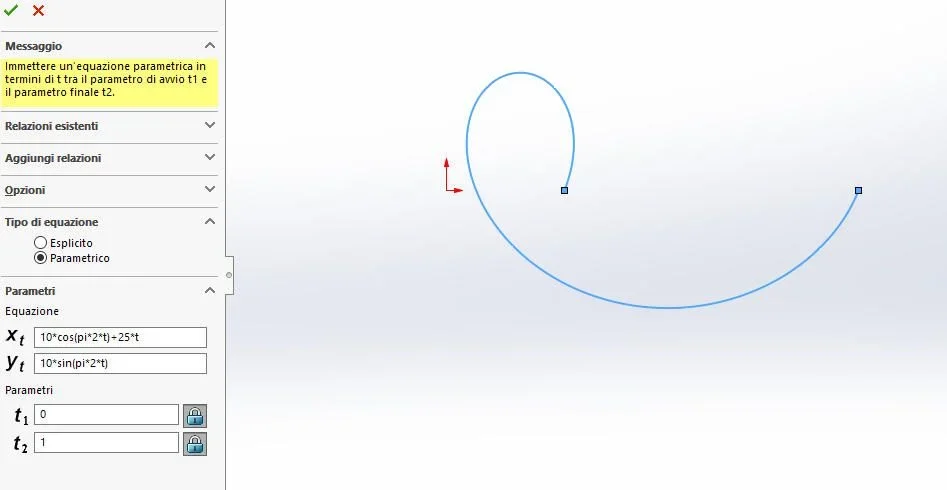
like any union and that is taken only once, if you think you get a solid through the union of three staggered circles (more or less what you see in the figure). I attach image of the icons of the three features 'booleane'.

Hi.
c.boole.webp
 
I was not referring to the Boolean functions, but to the interpretation that the nx geometric engine has of that volume. normally a solid is understood by the representation of the boundaries of a portion of space (boundary representation or b-rep). in a parametric solid modeler, given the automatic management of geometries, it is essential that this representation does not have ambiguity between the internal space and the external space to the solid.
in the case of a solid self-intersecting instead arises the problem that in proximity to the intersection there are points that are at the same time inside and out from the solid.
 
However, leaving aside the theory, the problem is solved in sw creating the single coil and copying it translatingSpira.webpCancello.webp
 
in the case of a solid self-intersecting instead arises the problem that in proximity to the intersection there are points that are at the same time inside and out from the solid.
I think there are points that belong simultaneously to two sets (both closed) and that is why I compare with the Boolean. There is no point in and out of the solid. this happens, points in and out, when you make a tangent hole to a wall (in nx gives the typical message *non manifold solid*).
try to combine the solids you created with the series and you will see that you get the same thing
 
I think there are points that belong simultaneously to two sets (both closed) and that is why I compare with the Boolean. There is no point in and out of the solid. this happens, points in and out, when you make a tangent hole to a wall (in nx gives the typical message *non manifold solid*).
try to combine the solids you created with the series and you will see that you get the same thing
the solids of which I placed the image are already united (see the function "abbina1" at the bottom of the feature tree). but I could do it because I created a solid for every spire.

I would be curious rather than knowing what happens in nx if you try to make a union between the object you got and another solid, like a parallelepiped.
 
the solids of which I placed the image are already united (see the function "abbina1" at the bottom of the feature tree). but I could do it because I created a solid for every spire.
I didn't see her.
I would be curious rather than knowing what happens in nx if you try to make a union between the object you got and another solid, like a parallelepiped.
something very strange happens that I will signal to siemens: if the solid that I go to add is located outside the intersecting zone no problem, otherwise the boolean fails.
These discussions are very interesting.
Hi.
c.
 
if the solid I go to add is located outside the intersecting zone no problem, otherwise the boolean fails.
I honestly expected that. I don't know if my ambiguity hypothesis is completely right, but I imagined that the "output is self-intersecting" was due to the same reasons why other systems deny the creation of geometry, but while others cut the head to the bull, nx seems a little more permissive accompanying the operator as far as it can.
These discussions are very interesting.
sleep d'accordo!
 
good morning to all, taking up the discussion by placing this question, if the starting hypothesis adds the fact that the rolling diameter does not remain constant, how does the trajectory change? ? ?
Do you have any idea? ?
Thank you very much
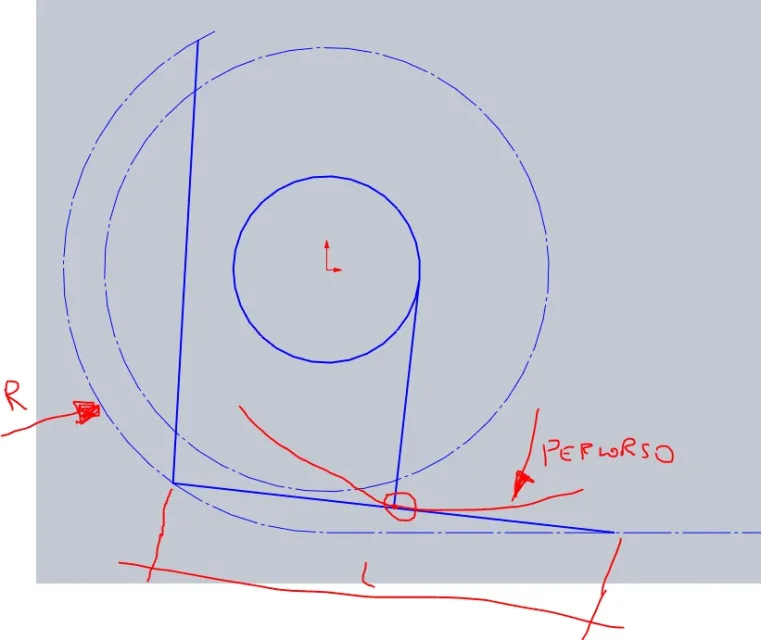
 
good morning to all, taking up the discussion by placing this question, if the starting hypothesis adds the fact that the rolling diameter does not remain constant, how does the trajectory change? ? ?
Do you have any idea? ?
Thank you very much
Hello, Marcoc.

Do you have a way to write an equation that expresses this change in diameter?

I think we can start from a r=r(t) function that expresses the radius according to time.
At this point you will have to remove some algebra and trigonometry and see what happens.
If you have any specific request, maybe I'll put this on.
m
 
hi muzzetto, sorry but I can only answer now,to your question unfortunately I don't know how to answer, but I put an image to make you understand that path I have to get the path that makes the central point of the line1570554267967.webp
 
Marcoc,

if I understood correctly, the wheel with radius r 'rotola' on the plane identified by the horizontal construction line.
continuous lines constitute the solid body (rigid) that performs this movement.
you are interested in calculating the trajectory of a particular point of this solid.
to understand, there are no other constraints in the mechanism.

If you confirm, I try to oil the meninges. .

m
 
exact muzzetto, and exactly so, I was trying to understand that trajectory follows the central point of the line l
 
Hello, Marcoc.

Sorry I'm late, but overwhelmed by work, I forgot.
I tried to get your problem back tonight.
the curve you want to describe is probably a 'mixed cycloid'.
cycloid is the curve described from a point on the circumference of a circle that 'rolls' on a straight.
compared to the three cases I have proposed, it is therefore the case in which v=w*t.
in the cycloid 'not ordinary' shortened, the distance from the center of the circle of the point that interests us is less than the radius of the circle.
find the equation of cycloid, cycloid shortened and elongated here:https://it.wikipedia.org/wiki/cicloideKeep in mind that I used angle speed, so I wrote w*t, i.e.:

angle speed [rad/sec] ♪ Time ♪ [sec] = path angle [rad]on wiki, instead, t is a mathematical variable that corresponds to the rad angle.
If you need me to help you build the excel file, let me know and give me some share.
Good night, m
 

Forum statistics

Threads
44,997
Messages
339,767
Members
4
Latest member
ibt

Members online

No members online now.
Back
Top
