MassiVonWeizen
Guest
and what do you mean by concrete objects?

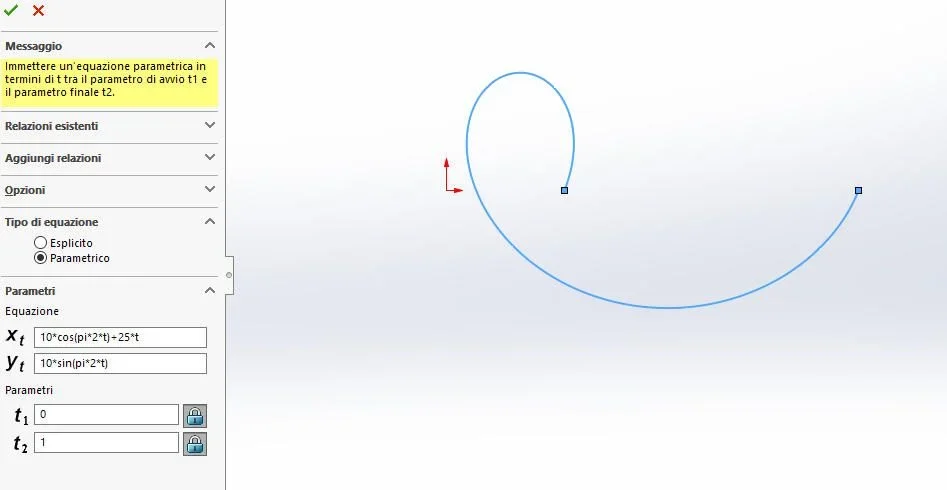
with nx the result is what you see in the figure. there is an alert (warning) but the result is a solid self-intersecting (for gatesSurely you can't build a solid with an intersecting curve, I doubt there's a cad that does.
Moreover, that curve represents a path and not an object profile.


I doubt there's a cad that does..
how to lose a good chance to shut up for dummiesceschi1959 said:there is an alert (warning) but the result is a solid self-intersecting
like any union and that is taken only once, if you think you get a solid through the union of three staggered circles (more or less what you see in the figure). I attach image of the icons of the three features 'booleane'.who knows at the level of geometric logic as the volume of intersection is managed. . .


I think there are points that belong simultaneously to two sets (both closed) and that is why I compare with the Boolean. There is no point in and out of the solid. this happens, points in and out, when you make a tangent hole to a wall (in nx gives the typical message *non manifold solid*).in the case of a solid self-intersecting instead arises the problem that in proximity to the intersection there are points that are at the same time inside and out from the solid.
the solids of which I placed the image are already united (see the function "abbina1" at the bottom of the feature tree). but I could do it because I created a solid for every spire.I think there are points that belong simultaneously to two sets (both closed) and that is why I compare with the Boolean. There is no point in and out of the solid. this happens, points in and out, when you make a tangent hole to a wall (in nx gives the typical message *non manifold solid*).
try to combine the solids you created with the series and you will see that you get the same thing
I didn't see her.the solids of which I placed the image are already united (see the function "abbina1" at the bottom of the feature tree). but I could do it because I created a solid for every spire.
something very strange happens that I will signal to siemens: if the solid that I go to add is located outside the intersecting zone no problem, otherwise the boolean fails.I would be curious rather than knowing what happens in nx if you try to make a union between the object you got and another solid, like a parallelepiped.
I honestly expected that. I don't know if my ambiguity hypothesis is completely right, but I imagined that the "output is self-intersecting" was due to the same reasons why other systems deny the creation of geometry, but while others cut the head to the bull, nx seems a little more permissive accompanying the operator as far as it can.if the solid I go to add is located outside the intersecting zone no problem, otherwise the boolean fails.
sleep d'accordo!These discussions are very interesting.
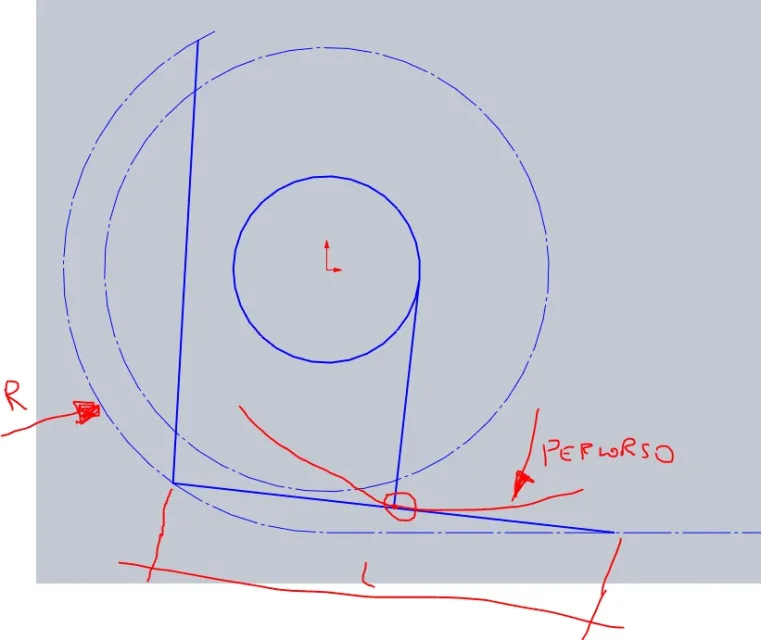
Hello, Marcoc.good morning to all, taking up the discussion by placing this question, if the starting hypothesis adds the fact that the rolling diameter does not remain constant, how does the trajectory change? ? ?
Do you have any idea? ?
Thank you very much