• This forum is the machine-generated translation of www.cad3d.it/forum1 - the Italian design community. Several terms are not translated correctly.

fem benchmark

  • Thread starter Thread starter exxon
  • Start date Start date
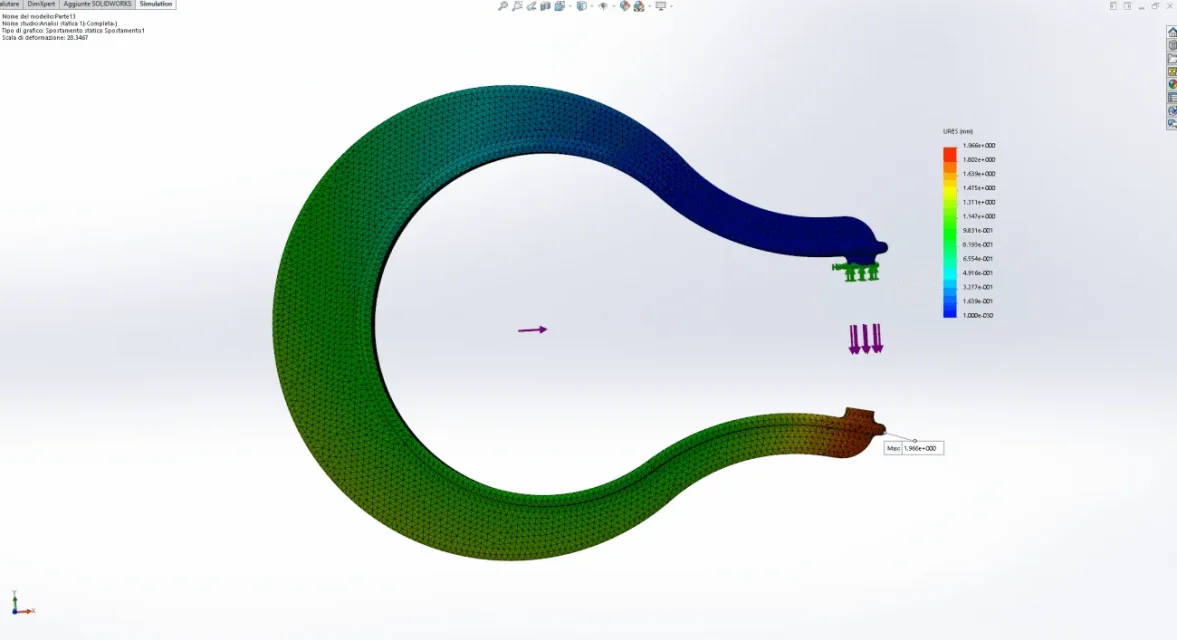
instead with solidworks 1.966mm:

My two fems are in agreement with them, but disagree with others.. Who knows!
1547836816345.webp
 
but did you enter the exxon elastic module in the analysis? ? ?
Young's modulus 168 gpa
poisson's ratio 0.29 ul
shear modulus 65.1 gpa

the elastic module seems very low. If I used the standard steel module, 205gpa, I would get a deformation of 1.6mm compatible with other mails.
greetings
 
but did you enter the exxon elastic module in the analysis? ? ?
Young's modulus 168 gpa
poisson's ratio 0.29 ul
shear modulus 65.1 gpa

the elastic module seems very low. If I used the standard steel module, 205gpa, I would get a deformation of 1.6mm compatible with other mails.
greetings
I like you, 210000 n/mmq and 0.3
 
Last edited:
hello to all, but wouldn't it be correct to do all the same kind of mesh with the same size to check the results and be able to compare it correctly? something does not return to me while remaining the characteristics of the material, the geometry of the solid and the assigned charitable constraints.
 
and also the fem made with se10 placed by telegino, looking in the image seems to have the standard material sj355 that will certainly have an elastic module around 205-210gpa.
so it seems to me that all fem gives exactly the same results if the data of imput are the same
 
and also the fem made with se10 placed by telegino, looking in the image seems to have the standard material sj355 that will certainly have an elastic module around 205-210gpa.
so it seems to me that all fem gives exactly the same results if the data of imput are the same
Yes, but also the mesh counts. My first attempt gave values that were half.
 
I think you said you used linear elements, which for solids are to be avoided. I tried to make some mesh of different size, and I did not find appreciable differences, both with solidworks and with patran/nastran,. Of course if you go down under a certain limit I agree. but I think the big difference made her the formulation of the element
 
and also the fem made with se10 placed by telegino, looking in the image seems to have the standard material sj355 that will certainly have an elastic module around 205-210gpa.
so it seems to me that all fem gives exactly the same results if the data of imput are the same
That's right!
 
and also the fem made with se10 placed by telegino, looking in the image seems to have the standard material sj355 that will certainly have an elastic module around 205-210gpa.
so it seems to me that all fem gives exactly the same results if the data of imput are the same
However the fem of if, if I am not mistaken, is based on nastran, for which the result is exactly the same!
 
I think we went a little drifting. .

goes without saying that using different elastic modules you get different results. the test previews to use the model posted in #1 and the material data placed in #8. all the rest (type of mesh, its size, type of solutor, etc.) are left to the operator: he will decide when the results will be considered realistic.

I repeat, realistic by itself, not as close as possible to the results obtained by others.

If you want.. .
 
I think we went a little drifting. .

goes without saying that using different elastic modules you get different results. the test previews to use the model posted in #1 and the material data placed in #8. all the rest (type of mesh, its size, type of solutor, etc.) are left to the operator: he will decide when the results will be considered realistic.

I repeat, realistic by itself, not as close as possible to the results obtained by others.

If you want.. .
Hello exxon!! for what I remember of fem if I have to compare two different solutors that in theoretical line should converge to the same solution the type of mesh and its size must be chosen equal as possible... Then on the way I can evaluate another type of mesh and with another dimension.... what I mean is that to make a comparison I have to compare apples with apples and pears with pears. Each solutor has ways to proceed from analytical point of view other than with optimizations that affect the accuracy of the final result.
 
I don't see the problem. we are in the elastic linear field. since the shift is less than 2mm. in this field, deformed and elastic module are linearly dependent. in practice the result of the maximum deformation scale according to the elastic module. results are comparable to each other.
then, unless you use unsuitable elements, which with opensource fem can happen, all others give very close results to each other. Just know if the run was done with e=168gpa, as initially required, or with e=205-210gpa, as any sweet steel.
the size of the mesh on the move normally has little influence, unless you make it such a coarse that you alter geometry. There may be a slight difference on the maximum voltage, but I do not think that in the piece there are discontinuities such as to make a particular meshatura.
I have not understood the objective of all this, if to verify that different solutors give the same answer, or else, in any case, knowing the elastic module inserted the results are comparable and similar
 
Your emailsthe purpose is not to compare the algorithms of the various solutors, but the reliability of a final result obtained by several operators with different software (and procedures), assuming that those who perform the calculations are adequately prepared.
@ondaConsidering valid the linear dependence between deformation and elastic module (which seems plausible to me), we can reconsider the various deformations and normalize them to... 200 gpa, just to compare them.

1) 1.7 mm @ 168 gpa = 1.4 mm @ 200 gpa (@exxon)
2) 1.8 mm Waltz 168 gpa => 1.5 mm Ö 200 gpa (@ luca862, escaped the first list... )
3) 1.6 mm @ 210 gpa => 1.7 mm @ 200 gpa (@cacciatorino)
4) 1.6 mm ever 205 gpa => 1.6 mm chim 200 gpa (@, supplier 205 gpa)
5) 2.0 mm Ö 168 gpa => 1.7 mm chim 200 gpa (@onda)
6) 1.4 mm ever 200 gpa => 1.4 mm Ö 200 gpa (@exxon 2 from test for elastic deformation hypothesis)

the extremes are 1.4 and 1.7 mm, the tolerance range is +/- 9.7 %.

a 20 % band is better than I expected, but it also indicates that there is little more than one significant figure in the result of a simulation that all in all is still quite simple.
 
I allow myself to declare with some certainty that the differences are not due to the software used, but to the interpretation and execution by us users.
the way the model is made, the linear hypothesis and above all the comparison between movements (and not between stress) are extremely repeatable conditions, I would say "indulgent".
to say, with simulation 2019 and mesh tetra10 from 6mm I find 1.732 mm
if I use a tetra4 I come down very little, to 1.724.
If I go on a mesh, tetra4 at 12mm, I find 1.652. but that I know no software around would propose by default a mesh so for this piece.
if instead I mistake to take the point (e.g. I do not take exactly the center of the face) the measure can vary from 1.640 to 1.826 in the same plot.
So something doesn't come back. sure you have measured the right moving component and right in the center?
ps: obviously everything to 168 gpa; changing module is like changing force in reverse proportion.
 
Last edited:
interesting.

in my case yes: lower face blocked.
measured distance as vertical component (orthogonal to the lower face) of the upper face center.
 
made with inventor: 1.96mm max displacement (which since interpreter is not between the two circular faces but on the most extreme point of the piece, precisely where the maximum shift takes place).
 

Attachments

  • Risultato.webp
    Risultato.webp
    53.1 KB · Views: 18

Forum statistics

Threads
44,997
Messages
339,767
Members
4
Latest member
ibt

Members online

No members online now.
Back
Top
