Onda
Guest
instead with solidworks 1.966mm:
My two fems are in agreement with them, but disagree with others.. Who knows!
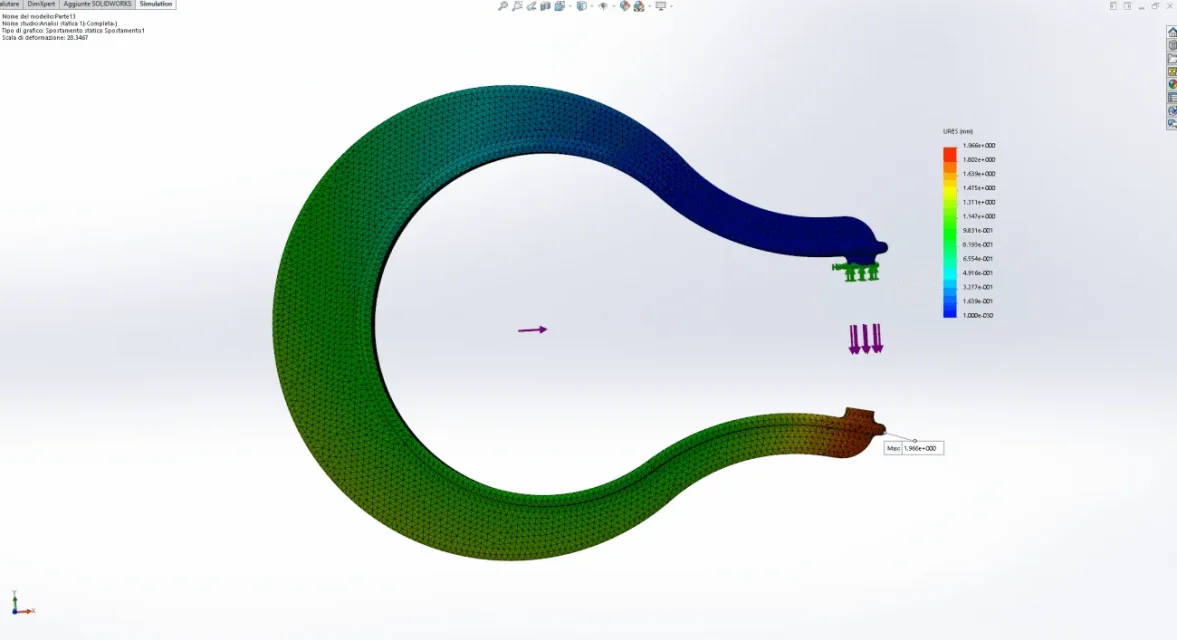
My two fems are in agreement with them, but disagree with others.. Who knows!

I like you, 210000 n/mmq and 0.3but did you enter the exxon elastic module in the analysis? ? ?
Young's modulus 168 gpa
poisson's ratio 0.29 ul
shear modulus 65.1 gpa
the elastic module seems very low. If I used the standard steel module, 205gpa, I would get a deformation of 1.6mm compatible with other mails.
greetings
therefore your result of 1.6mm comes with an elastic module of 210gpa and not of 168gpa. correct?I like you, 210000 n/mmq and 0.3
si esatto.therefore your result of 1.6mm comes with an elastic module of 210gpa and not of 168gpa. correct?
Yes, but also the mesh counts. My first attempt gave values that were half.and also the fem made with se10 placed by telegino, looking in the image seems to have the standard material sj355 that will certainly have an elastic module around 205-210gpa.
so it seems to me that all fem gives exactly the same results if the data of imput are the same
That's right!and also the fem made with se10 placed by telegino, looking in the image seems to have the standard material sj355 that will certainly have an elastic module around 205-210gpa.
so it seems to me that all fem gives exactly the same results if the data of imput are the same
However the fem of if, if I am not mistaken, is based on nastran, for which the result is exactly the same!and also the fem made with se10 placed by telegino, looking in the image seems to have the standard material sj355 that will certainly have an elastic module around 205-210gpa.
so it seems to me that all fem gives exactly the same results if the data of imput are the same
Hello exxon!! for what I remember of fem if I have to compare two different solutors that in theoretical line should converge to the same solution the type of mesh and its size must be chosen equal as possible... Then on the way I can evaluate another type of mesh and with another dimension.... what I mean is that to make a comparison I have to compare apples with apples and pears with pears. Each solutor has ways to proceed from analytical point of view other than with optimizations that affect the accuracy of the final result.I think we went a little drifting. .
goes without saying that using different elastic modules you get different results. the test previews to use the model posted in #1 and the material data placed in #8. all the rest (type of mesh, its size, type of solutor, etc.) are left to the operator: he will decide when the results will be considered realistic.
I repeat, realistic by itself, not as close as possible to the results obtained by others.
If you want.. .

