• This forum is the machine-generated translation of www.cad3d.it/forum1 - the Italian design community. Several terms are not translated correctly.

parallel axle speed reducer

  • Thread starter Thread starter Kekko999
  • Start date Start date

Kekko999

Guest
Good evening to all,
My name is francesco and I am a student of the master's degree in aerospace engineering.
I was assigned as a project for the construction course of machines a parallel axle reducer, basically I was left freedom for the application and therefore no data as a start.
I wanted to ask you how I can approach the project, setting up and implementing advice, unfortunately not having an in-depth section regarding the translators in the course textbook.
I shall draw up a possible solution proposed by the professor and thank you in advance for the attention :
 

Attachments

  • IMG_20180601_150950.webp
    IMG_20180601_150950.webp
    45.6 KB · Views: 236
Last edited:
if you do a search with the special button many examples already faced in these years on the gearboxes with explanations and formulas.
 
the forum is full of parallel axle reducers required by you students, discussed and unleashed.
What are those scarabs?
 
the forum is full of parallel axle reducers required by you students, discussed and unleashed.
What are those scarabs?
from the "scarabocchi" it is seen that two solutions to two stages with parallel axes, different for the exit, the rest is an example of a profile of wheel.. .
 
on the forum we have a tide of parallel and orthogonal gearboxes sized, verified, calculated.
you will also find references to very useful books to have to address the theme of making gears and gearboxes.

if you have a axle reducer parallels I would say that the design of the two conical wheels does not serve anything because that serves for a axle reducer orthogonal.

in the image you posted, on the right we have a traditional parallel axles
riduttore-jpg.25936
and under a coaxial
vista-in-sezione-jpg.40899
....the images are taken from two posts of gearboxes on the forum.

I think you have a lot of material to work on.... then if you need to ask that we give you more information here.

you can take an application and design the reducer or invent and design a reducer that follows data.
 
a new object for students could be the double reducer, which is a gear reducer to parallel or or orthogonal axes, with change or mono ratio, where the output trees are two, counter-rotating.
are gearboxes used to connect machines of various nature where it is necessary that the two outputs roll one opposite to the other, to cut, mix, to pull ribbons etc.Screenshot_20191124_184434.webpThis photo is one of the examples you can find on the net.
 
Since francesco wrote me a mp where he asked me general explanations of everything and that he read the various posts but he found confusion, I will try to explain a little... more bets.
certainly that if francesco asks us specifically it would be better so avoided unnecessary pips.
premessa: only parallel axle reducers, i.e. where rotation axes of each reduction stage are parallel to each other. we will not talk about orthogonal axes, skewers, endless lives and epicycloids (even if they are of the parallel family but are special).

textbooks: - see other posts
- niemann - machine elements volume 1-2-3
- Agma standards and an experimental 8953 and above all iso 6336
generality:- a gearbox is an object composed of gears and is used to reduce the outgoing speed by increasing the torque
- an incoming reducer sees a motor, a wind shovel, a mule spinning.... In short, a source of energy that must be transformed so that the user, downstream of the reducer, does his job. this is necessary because almost always there is no motor that turns a few turns that has a very high couple
- as a user we have a crusher, a pair of tow rollers, a mixer, a transport carpet, a drum of a winch, a...something that does something
- if the incoming power is 100% we will only get out one part of it. the relationship between outgoing and incoming power is called performance. bearings, contact between teeth, seals on trees, viscosity of oil ....everything loses power and turns it into heat
popular beliefs, academics and so on:- first teeth number: if properly dimeionate you can also use gears that do not have a number of first teeth
- number of teeth helical wheels z17: with the profile shift you can get to make 11 teeth without big problems
- reduction ratios with helical wheels up to 5: normally the commercial gearboxes do not push much for issues not to stress the axes and use in order to scale the wheels, but on custom gearboxes it is possible quietly to make reduction ratios i=7....12 in one stage
- with lewiss and hertz we dimensional the gears: the basic theory is so but it is necessary to use the norms otherwise come out of those abominable things...or too weak or too abundant. years of agma experience and then of iso/din has led to greatly improve pure basic theory
- other things have been indicated on the forum in other posts
- sizing is verification: no, dimensioning means using a method, even if it leads to define a first hypothesis. the verification serves to validate the hypothesis of sizing with the limit or admissible parameters of the materials
 
erroneta corrige post previous:Screenshot_20191126_221824.webpbecomes:- standard agma e uni 8862 experimental. . ..

we now take a user that we want to study and with its physical laws we determine that we need x kw a y rpm that we will write to the American rpm.
Here you can choose what you want to study.
premessa: if you use excel we avoid throwing hours and now to make useless iterative calculations.

therefore we look for a motor that meets the requirements of power and turns required, interposing a reducer that has a number of turns consonant.

depending on the application there are the agma tables that define a service factor that multiplies the nominal conditions. see specific posts.

at this point we have:
- input power
- input rotation system
- total reduction ratio
- service factor

Now it is necessary to make a maximum sizing to center the reducer a little.

determine the number of stages: we take the total reduction ratio and compare it with the maximum payable ratio. Let's assume that every stage can without exaggerating i=5.

1 stage = 5
2 stages = 5•5 = 25
3 stages = 5•5•5 = 125
....n stages = 5 highNow we know how many stages of reduction to do (every stage is a pair of gears...so two axes) and we know what are the relationships we want to have. preferably the first stage will have the highest reduction ratio to compact the reducer.

We write the various numbers of teeth with their reduction ratio and the total ratio and change the numbers so that the total ratio meets the theorist with his tolerance.

We keep in mind that the formula of thebacus, rather than modified lewiss, used as reverse formula can be used to have interasses that we want in function of module and number of teeth and therefore you can already have what you want....just use excel and make a table from which to choose.

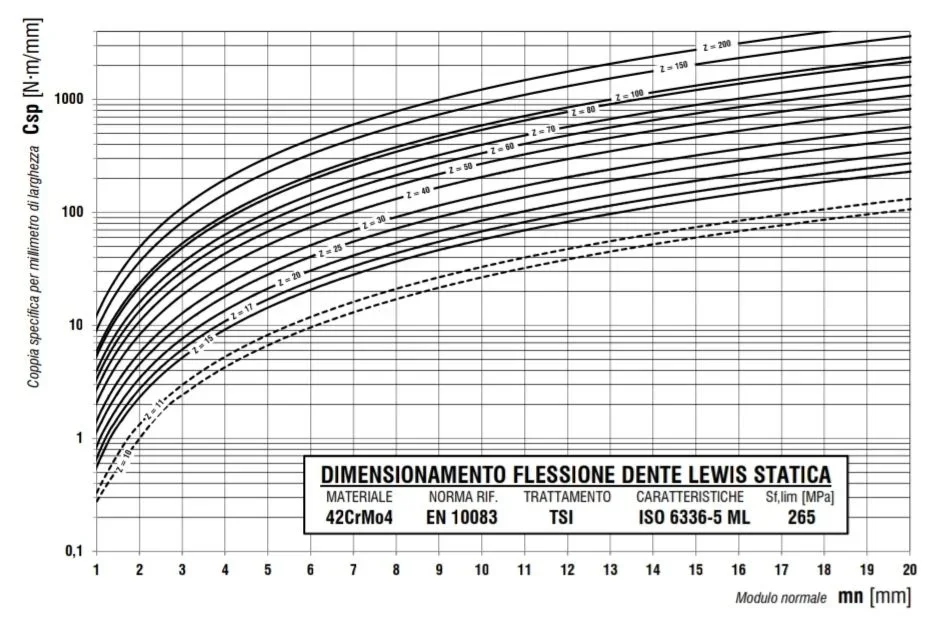
Now we can use standards, abachi (like my specific couple curves vs module depending on material and wheel teeth number).Screenshot_20191126_215857.webp
short explanation of the abbot:to be transmitted in 600nm. module 6 and pinion with z15 I get specific torque of 11nm/mm. having 600/11=55mm about width of band.
the construction of abachi is made using static lewiss and general coefficients according to one of the rules that most prefer and serve to quickly have an idea of gears.
Material:The materials for me, since I made some gears, are:
- remediation steel 42c. rectified with tempering induction surface for normal gears and teeth grinding equal to 39nicrmo3 to be used normally
- cementing steel 17nicu6 cemented and tempered and rectified to be used for more push applications
- remediation steel without other thermal treatments c45 to be used for very poor applications

I highly recommend using iso 6336 for all references to standards of materials, formulas and considerations.

The proportions between the module and the width of the gear band are often used as a parameter for the choice of gears.

the report b/m of usual is between 10 and 15 for general mechanics but assumes the following values:
- between 6 and 10 if molten teeth and non rigid supports
- between 5 and 15 if hardened but not rectified teeth
- between 10 and 20 if rectified teeth and rigid bearings
- between 20 and 40 precision teeth with less than 3000 rpm rotation
- between 40 and 80 sample teeth, high precision and narrow tolerances, rigid supports and rotation less than 3000 rpm
 
using computational regulations the ruptured tooth failure verification (modified lewiss)Screenshot_20191126_224221.webpwhere sf is the voltage on the basis of the tooth that must be less than dfp that is the admissible voltage, and the contact pressure verification (removed hertz)Screenshot_20191126_224205.webpwhere sh is the contact pressure on the tooth side which must be less than shp which is the admissible pressure.

the oversized factor for bending, in the absence of real tests and specific sampling, takes it pairs to 1.4 and for the pressure it assumes it pairs to 1.

done this you get the verification of the pair of gears.

from here we calculate the forces exchanged so as to determine the reactions to the bearings and then make the duration verification itself and put the forces on the trees for a subsequent sizing and verification of the trees. to do this it is advisable to use skf tools and manual transmission mechanical elements (which is free) for quick formulas.Screenshot_20191126_230003.webpFinally there is the carcass to study, oil level, convective thermal dissipation and structural resistance, knowing the performance of the object and the ambient temperature, as well as the intermittent service.Screenshot_20191126_230120.webp
 
As for the layout of the trees, I would say that it depends on the dimensions you have and what you want to get. definitely the coaxial is sacrificed as space unlike the classic multi-stage gearbox with parallel axes that is also particularly suitable for very high performance of transmissible torque.
a horizontal multistage me dissipates heat better than the same shape but vertically placed because the oil manages to move everything.
in some cases where the lubrication is not enough is used to use motor pumps that bring oil to gears and other bearings.Screenshot_20191126_231114.webp
 
francesco, what other doubts or arguments do you want us to treat? Are you missing... or don't you need the information anymore?
 
francesco, what other doubts or arguments do you want us to treat? Are you missing... or don't you need the information anymore?
No absolutely, I didn't disappear... I believe that after your answer I have enough arguments on which to work so we update as soon as I am a bit forward with the project or if I respond to some problems in design and verification! Thanks anyway for the support, I really appreciate it.
 
have you already thought what application of reducer you want to study and design? If you want we can compare it even in the initial phase....you know if time is not much and you want to do so, study it all and everywhere and maybe you have to organize the study team if it is not an individual job....it is good to talk about it.
 
have you already thought what application of reducer you want to study and design? If you want we can compare it even in the initial phase....you know if time is not much and you want to do so, study it all and everywhere and maybe you have to organize the study team if it is not an individual job....it is good to talk about it.
Hi, I'll keep you informed. I have not yet chosen the application because I am busy with other stuff, however I have made a half idea and should choose an application of medium/low power with two stages reduction, perhaps with the use of a pair of helical teeth wheels for the first tree and straight teeth for the second (or a second pair of helical teeth opposed for the symmetry of axial efforts); I am having some indecision on the type of machine downstream of the reducer and on the coaxial arrangement or not... However the project I turn it from me so the times are dictated by myself in short. thanks to the interest and I keep you updated
 
Okay. keep in mind that the straight teeth are noisy, and they peel little cover for the transmission of the bike and therefore in reality they are not used almost never, usually even with pinion and rack if you have robotized axes.
for coaxial you have to see the encumbrances you have.
 
Are there any news? have you chosen and developed? Do you have any doubts?
hi, I will resume developing the project after the winter appeals of January/February, at the moment no news... As soon as I get back in the race, thank you for your interest! to wish you good holidays and good Christmas to all:)
 
hi, I will resume developing the project after the winter appeals of January/February, at the moment no news... As soon as I get back in the race, thank you for your interest! to wish you good holidays and good Christmas to all:)
Okay. Then we'll be up in a few months. Good holidays to you, too.
 
hi, I will resume developing the project after the winter appeals of January/February, at the moment no news... As soon as I get back in the race, thank you for your interest! to wish you good holidays and good Christmas to all:)
Hello kekko.... are there any news?
 
I'm back here.
Then I briefly explain the choices of the project: I decided to create a double parallel axle reducer with cylindrical wheels with helical teeth that must connect an industrial agitator (with power =10kw and vel.angular =145rpm ) with an electric motor (with power= 11kw and vel.angular= 960rpm).
for the trees and wheels of piece I chose as material a 20crnimo2 cemented steel and for the cast wheels a 40crnimo2 steel reclaimed (if the choices are not well are still in time to change material. . ).
I shoot some calculations so we realize whether in principle we are or not:
- total transmission ratio = 0.151 (first stage at 0.266 and second stage at 0.569)
- angle of propeller and pressure chosen equal to 20°
- minimum number of uncut theoretical teeth without approximate interference for excess to 18
- minimum number of teeth for approximate operation for excess to 16
- pass straight teeth to helical teeth brings me back to a number of teeth z1= 15 so z2=57
- change of the total transmission ratio to the first stage = 0.2632 and to the second stage =0,5737
- number of real teeth of wheel and pinion 57 and 15 respectively; number of dense teeth of wheel and pinion 68 and 18 respectively.
- first stage reduction results: input shaft with vel.ang= 100,5309 rad/s and torque moment= 109,4191 n*m; output shaft with vel.ang= 26,4597rad/s and torque moment=415,7265n*m
- now I have to pass to the calculation of the front module according to the theory of lewis and here I have problems because I cannot find the tables of my material for the calculation of the factor of lewis (and therefore of the front module and all the characteristic data of the toothed wheels. @meccanicamg what do you think? Am I proceeding properly? I apologize for the absence but I had to give two exams and now I only miss the project in question for graduation :d
 
Last edited:

Forum statistics

Threads
44,997
Messages
339,767
Members
4
Latest member
ibt

Members online

No members online now.
ciao
Back
Top