• This forum is the machine-generated translation of www.cad3d.it/forum1 - the Italian design community. Several terms are not translated correctly.

parallel axle speed reducer

  • Thread starter Thread starter Kekko999
  • Start date Start date
I managed to interpolate the data of the first stage (beta=15°) regarding zp=17 and zg=64 but I can not attach the excel file because the file format is not accepted... I have two doubts:
1) results are very different from expectations as the lower and higher values of wheel teeth are 55 and 135
2) how do I interpolate the data of the card with beta=10° if the reference values are missing for zp=17?
with the interpolation I have to fix at least one of the two variables (zp or zg), I could succeed with the second stage zp=21 and zp=37
p.s allego il file pdf
the interpolation at times should be done a little by eye, with proportions etc. is not that you change the value abyssally.

for j use the curve I gave you that you need to know z what you're calculating.
 
excel files are zipped to be placed on the forum.
If you use another type of interpolating curve that has r2 almost equal to 1 you can have true values.
In fact changing the law of variation of the trend line in logarithmic or polynomial grade 2 or 3, the results improve sensibly, I will do the same thing also for the value of j so that you can compare it with the chart you provided me, thank you very much!
 
I apologize if I dig you the 3d but since it was about inverters.. . .
Hypothetic route I have to make a inverter, 30 rpm input turns and pair on 300 nm so relatively light stuff. the tax intersection is 260 mm.
Since I've never designed a gearbox I have no idea of prices...
Does it make more sense at an economic level to make a single pair of gears or to reduce the size of the pinions and the case (which I will have to obtain or from the full anodized aluminum, or welded to stainless tig and then processed) make more sense to reduce the size of the gears and put two oziosi in between?
Thank you!
 
I apologize if I dig you the 3d but since it was about inverters.. . .
Hypothetic route I have to make a inverter, 30 rpm input turns and pair on 300 nm so relatively light stuff. the tax intersection is 260 mm.
Since I've never designed a gearbox I have no idea of prices...
Does it make more sense at an economic level to make a single pair of gears or to reduce the size of the pinions and the case (which I will have to obtain or from the full anodized aluminum, or welded to stainless tig and then processed) make more sense to reduce the size of the gears and put two oziosi in between?
Thank you!
post a scheme because I didn't understand what a cinematic chain you want to achieve and what you really want us to valuate.
reduction ratio i=1? Do you just have to reverse the direction of rotation over the entrance? two gears cost less than 4...
Reducers with n full case? I'd say no... unless his 100x100x100mm.
intermittent service and hours of operation per day?
rests on a carpentry? b3...?
 
Last edited:
I asked for a reception with my professor to discuss the design choices I made and to verify that the following is correct, but before answering any of my questions asked me to compile the specific technique of my translator following the list of the figure I attached. . I begin to draw it up and in case I have some doubts I ask questions about it, surely for a student struggling with the construction project of machines I think it is very useful :)
 

Attachments

  • Foto da Francesco.webp
    Foto da Francesco.webp
    221.9 KB · Views: 49
I asked for a reception with my professor to discuss the design choices I made and to verify that the following is correct, but before answering any of my questions asked me to compile the specific technique of my translator following the list of the figure I attached. . I begin to draw it up and in case I have some doubts I ask questions about it, surely for a student struggling with the construction project of machines I think it is very useful :)
What can't you answer? some are clear....type the kw...

Try and then discuss it.
 
invertitore.webpinvertitore.webpI train you a preliminary study, the two counter-rotating trees through joints will be coupled to two mixers therefore the 260 is interasse that I can not touch. In fact the tree to dx will end in the lid and will not be so long. I wanted to know if, at the purely economic level, it makes sense to evaluate how to put
instead of two gears module 5 with 48 teeth put 4 with 24 teeth so that
have smaller dimensions. is it a thing that makes sense to evaluate or is it a madness given by my ignorance?
 
View attachment 57533View attachment 57533I train you a preliminary study, the two counter-rotating trees through joints will be coupled to two mixers therefore the 260 is interasse that I can not touch. In fact the tree to dx will end in the lid and will not be so long. I wanted to know if, at the purely economic level, it makes sense to evaluate how to put
instead of two gears module 5 with 48 teeth put 4 with 24 teeth so that
have smaller dimensions. is it a thing that makes sense to evaluate or is it a madness given by my ignorance?
Okay, perfectly clear.
the intersection you have to make is 260mm and to have the least possible game you need to use less gears possible. Moreover having more gears means more bearings, more trees, more shooting at machine tools, more things you can break.

a sizing I made is the following, where we do not exaggerate with materials. the wheels are in c45 with induction hardened teeth and cast on c45 trees with maximum diameter around 50/60mm. the helical toothing helps to have the uniform motion and to increase the teeth in press....factor of replenishment.

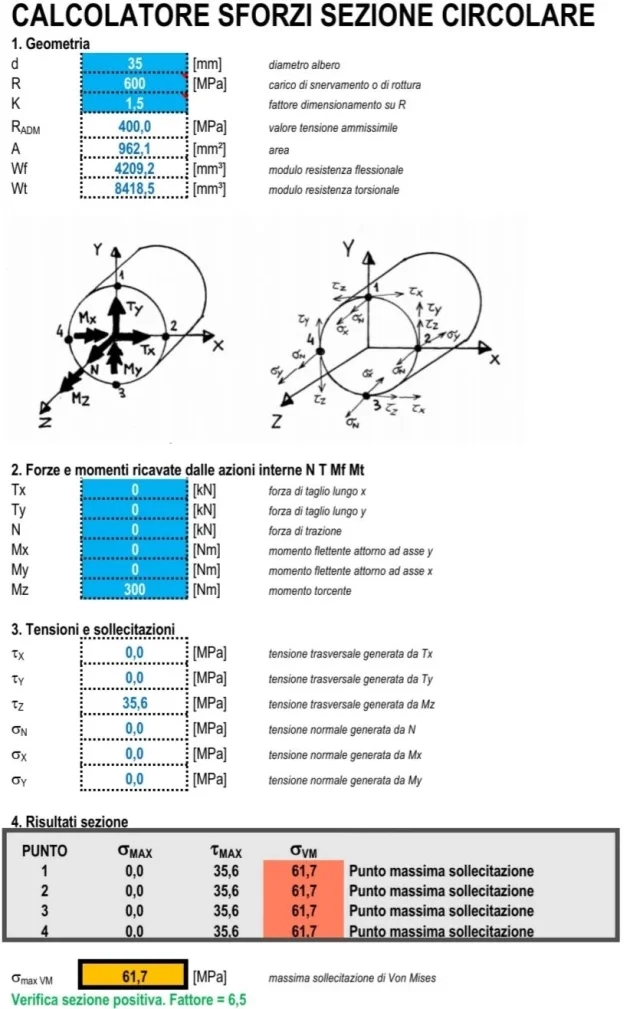
Couple gears with a duration of at least 10000 hours:Screenshot_20200430_181745.webpregarding the thermal verification of the case, I made it in s275jr or similar, operating service s1 i.e. continuous h24 and with overload k=1,25.
surely it is eternal and exchanges well the heat with the outside even at 30°c.Screenshot_20200430_182647.webpAs for the exit trees I would say that if in c45 reclaimed enough useful codons on the 35mm.
Screenshot_20200430_182614.webp
 
View attachment 57533View attachment 57533I train you a preliminary study, the two counter-rotating trees through joints will be coupled to two mixers therefore the 260 is interasse that I can not touch. In fact the tree to dx will end in the lid and will not be so long. I wanted to know if, at the purely economic level, it makes sense to evaluate how to put
instead of two gears module 5 with 48 teeth put 4 with 24 teeth so that
have smaller dimensions. is it a thing that makes sense to evaluate or is it a madness given by my ignorance?
Forgive me for something I miss...n°2 gears from 48z and m5 would give an interasse of 240mm being 48*5.
the 4 gears how would you put them? In sequence or parallel, because I don't understand how you get 260 interasses. . .
other question turns in one way or in two?
 
Forgive me for something I miss...n°2 gears from 48z and m5 would give an interasse of 240mm being 48*5.
the 4 gears how would you put them? In sequence or parallel, because I don't understand how you get 260 interasses. . .
other question turns in one way or in two?
x.........
I don't move out of gear. I don't really do it. is also helical and not straight teeth.
 
Of course I was wrong to indicate the number you teeth?
I really don't care much about precision, but I would have extra work.
I thought instead of doing something special with profile shift a module 5 to be able to think of using some commercial gear, like garotti or khk so as to save and skip the tooth to make before... of course so subsidized. . .
 
x.........
I don't move out of gear. I don't really do it. is also helical and not straight teeth.
I fully agree, but from 240 to 260 the difference to me seems so much.
I think I have understood that I might also put a toothbrush on straight teeth.
so doing you wouldn't have to push axial on the shoulders and put braces that allow you to have a much cheaper fit.
Is the engine a simple asynchronous motor or servo motor?
 
I fully agree, but from 240 to 260 the difference to me seems so much.
I think I have understood that I might also put a toothbrush on straight teeth.
so doing you wouldn't have to push axial on the shoulders and put braces that allow you to have a much cheaper fit.
Is the engine a simple asynchronous motor or servo motor?
- if you're talking about putting braces, that means you want to point out bearings to react axial.
- a 12° angle with that torque creates a very small axial thrust, however well bearable also by ball bearings, although the minimum is to mount bearings to a conical roller crown.
- we can proceed in different ways, however the profile shift serves to:
1) increase tooth flow
2) decrease tooth wear
3) decrease noise production by optimizing the relative speed of tooth flank strophine
4) geometrically adapt any need for interasses without having to fall into school solutions that are often not in line with machine construction
- my wheels if they were straight teeth 3•84=252mm....being helical with angle 12° would be interasse 257,6....so with shift x=+0,4078 I move 1,22mm radial and there is no problem
- instead 48•5=240... if we make beta 12° it is necessary to do x=+1,73 and it means that the tooth becomes not to tip...... it just disappears. Obviously it was a typing error.
 
Okay, perfectly clear.
the intersection you have to make is 260mm and to have the least possible game you need to use less gears possible. Moreover having more gears means more bearings, more trees, more shooting at machine tools, more things you can break.

a sizing I made is the following, where we do not exaggerate with materials. the wheels are in c45 with induction hardened teeth and cast on c45 trees with maximum diameter around 50/60mm. the helical toothing helps to have the uniform motion and to increase the teeth in press....factor of replenishment.

Couple gears with a duration of at least 10000 hours:View attachment 57534regarding the thermal verification of the case, I made it in s275jr or similar, operating service s1 i.e. continuous h24 and with overload k=1,25.
surely it is eternal and exchanges well the heat with the outside even at 30°c.View attachment 57535As for the exit trees I would say that if in c45 reclaimed enough useful codons on the 35mm.
View attachment 57536
just for completeness. . .as it had not yet been explicit that reducer in question was a decoupler and therefore should have its outputs that go to make the agitator, there is to say that in reality 50% of the power comes out from the first tree and 50% comes out from the second tree, overloads apart, while the calculation that I made transfers 100% from the first to the second tree.
 
I asked for a reception with my professor to discuss the design choices I made and to verify that the following is correct, but before answering any of my questions asked me to compile the specific technique of my translator following the list of the figure I attached. . I begin to draw it up and in case I have some doubts I ask questions about it, surely for a student struggling with the construction project of machines I think it is very useful :)
The only argument on the list I have yet to address is the noise speech.
the only thing that can say a priori is that straight teeth whistle while a 10/15° helix is much more smooth and not whistle.
However, it would be interesting to evaluate scientifically.
 
- if you're talking about putting braces, that means you want to point out bearings to react axial.
- a
the 12th with that torque creates a very small axial thrust, however well bearable also by ball bearings, although the minimum is to mount bearings to a conical roller crown.
- we can proceed in different ways, however the profile shift serves to:
1) increase tooth flow
2) decrease tooth wear
3) decrease noise production by optimizing the relative speed of tooth flank strophine
4) geometrically adapt any need for interasses without having to fall into school solutions that are often not in line with machine construction
- my wheels if they were straight teeth 3•84=252mm....being helical with angle 12° would be interasse 257,6....so with shift x=+0,4078 I move 1,22mm radial and there is no problem
- instead 48•5=240... if we make beta 12° it is necessary to do x=+1,73 and it means that the tooth becomes not to tip...... it just disappears. Obviously it was a typing error.[/QUOTE
Qualcosa mi sfugge. Perché 3*84?
Io avrei fatto l'interasse 260 diviso il modulo 5 nel caso dei denti dritti
 
I find 52 teeth for both wheels being ratio equal to 1. am I wrong something?
can also be 51 or 53 teeth.... but with what form?
you can be more precise and indicate:
- form
- tooth number
- helical angle
- interasse
- correction
- width band
- power and turn in
- gear material

as I explained and repeated in several posts above, I made the x profile shift.
You know what that is? often is an unknown for those who do not make gears very often but is what makes all applications "non-banal" go well.

gears are a little peculiar objects and it is necessary to have the necessary shortcomings.

a gear that normally has a primitive diameter defined by module for tooth number, can have a larger or smaller primitive diameter, moving profile while cutting denature. in this way the tooth becomes more smilzo or more tozzo but ingrain.
I simplified the explanation, because it actually changes way of gearing, resistance, wear, noise etc.
 
the module is 5 because it was written by the author of the post.
What is 84*3??
How do you calculate the x shift? Could you explain it to me by courtesy?
 
the module is 5 because it was written by the author of the post.
What is 84*3??
How do you calculate the x shift? Could you explain it to me by courtesy?
then I used module 3, helix angle 12 degrees and teeth number 84.
for gear geometry primitive diameters are given by:
♪[ d=\frac{m•z}{\cos \beta} \]Of course, it comes out a non-fulfilled measure and, however, not the one we want to interfere.
then move the profile by increasing the primitive diameter up to 260mm.
shifting the radially external toothing tool has a positive correction.Screenshot_20200505_163029.webpif to move the radially toothing tool to the inside you have shifted negative profile.Screenshot_20200505_163053.webpthe formulas that govern you can find on the site of khk gear of which we have quoted several times on the forum and I attach the discussion number 7.

summarizing these are:Screenshot_20200505_163541.webp
 

Forum statistics

Threads
44,997
Messages
339,767
Members
4
Latest member
ibt

Members online

No members online now.
ciao
Back
Top