
• This forum is the machine-generated translation of www.cad3d.it/forum1 - the Italian design community. Several terms are not translated correctly.

parallel axle speed reducer

  • Thread starter Thread starter Kekko999
  • Start date Start date
Thank you, but I can't understand how you calculated xm.
I better get the dp 257.6, you take it to 260 how? or better if you impose the dp you will have to change something else. I'm wrong. If you have time to attach a table with the wheel construction dimensions. ? just x understand. Thank you.
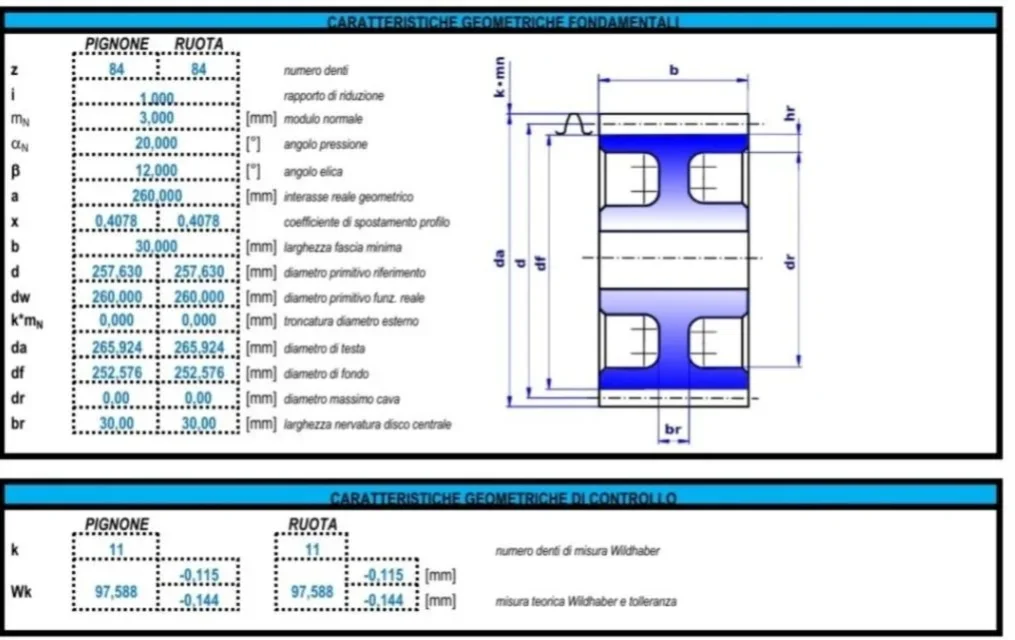
 
Thank you, but I can't understand how you calculated xm.
I better get the dp 257.6, you take it to 260 how? or better if you impose the dp you will have to change something else. I'm wrong. If you have time to attach a table with the wheel construction dimensions. ? just x understand. Thank you.
if you turn back of some posts you will find the full board of main geometric parameters, wildhaber rope quota and resistance parameters.
I'll take her down here.
screenshot_20200430_181745-jpg.57534
in practice the theoretical promitive piameter remains d....while the actual rolling one is the correct one with x....so practically moving the profile increase the primitive diameter to the value 260 mm even if the nominal one would be 257,6mm.
 
so the dimensions to create the wheel are the theoretical ones with d=257, only that you decide that the working cleft is 260 and with the experience you say that the wheels have no problems indeed work better. Right? Sorry, but I'm trying to figure out who builds her what she looks at.
 
so the dimensions to create the wheel are the theoretical ones with d=257, only that you decide that the working cleft is 260 and with the experience you say that the wheels have no problems indeed work better. Right? Sorry, but I'm trying to figure out who builds her what she looks at.
Doing gears, dimensionals, checking them, constructing them however requires a pretty thorough knowledge, especially if you have to make serious gearboxes, with high pairs, shocks, high service factors for heavy conditions.

There are basic theories that regulate geometric construction and among these are the theories of niemann where in his books he gathers explanations about the algorithms of optimization of gears. then explains how and when moving the profile, for a geometric question, or to improve the bending strength of the tooth, increase the specific pressure resistance, tie the creeping speeds and other algorithms that imply a x profile shift factor.

a gear manufacturer must have for the manufacture reported on the drawing these parameters of the pinion on the pinion and wheel design on the wheel design:Screenshot_20200506_200454.webpin addition there is to indicate the helical sense if right or left.
the toother knows that it will simply get out radial with the creator of x•mn mm compared to the reference primitive.
 
just to clarify a notation that makes so many people mess up:
x is the profile shift coefficient and is adimensional.xm is the proportion in mm of the radial shift calculated by multiplying x per mn which is the normal form.

when the toothpick were manual the operators had the ninth in mm.....while with cnc enough x that is a parameter.
 
hello mechanicalmg, reviewing the solution we had discussed and making calculations for wear and tear testing, I reevaluated the solution with the same input and output data with a coaxial reducer with stages at the same reduction ratio.
the results I got are as follows:
number of pinion teeth = 14
Number of teeth wheels = 36
vel. angular middle shaft = 373,33 rpm
tree pair intemedium = 281,37 n*m
for the choice of the initial module I used a first design formula that I found on the shigley and that takes into account the dimensions of encumbrance (which I estimated in 350x150x180 not having given specification), of the number of teeth of the wheels. as a first attempt module I chose m=4 (but so I get the normal module or the tangential one? )
the results were:
pinion diameter = 56mm
wheel diameter = 144mm
first stage speed = 2,815 m/s; first stage power= 3,91kw
primitive velocity second stage = 1.097 m/s; second stage power = 10,09kw
to size the wheels I chose pressure angle = 20°; angle of propeller = 15°; ratio lamda= 15 (b/m)
with this data I have verified the resistance to pitting and the most stressed stage and the results are:
sigmah= 1068,24 mpa with grade of material 2 and values of average hardness that I took from the tables you had posted to me for the materials of the pinion and the wheel < 1162.5 mpa to agma 2101-d04
for bending resistance I consulted the agma tables 908-b89 (which you provided me for different values of the propeller angle) and I chose the table with correction x1=0,25 and x2=-0,25 (if I have x1=x2=0 I have subcut)
sprocket: sigma f= 146 mpa
wheel: sigmaf= 163 mpa
both under the admissible value = 337,5 mpa agma 2101-do4
Since the module is very important at the beginning of the design, do you expect it to switch to a lower module? Thanks :)
 
Another question that leaves me doubt is that I found various formulas for the minimum number of pinion teeth without interference, on the shigley there is a direct formula for helical gears and according to my data from 14, do I recommend to increase the teeth of the pinion? Do you think that having chosen as number 14, I will have to make corrections?
 
hello mechanicalmg, reviewing the solution we had discussed and making calculations for wear and tear testing, I reevaluated the solution with the same input and output data with a coaxial reducer with stages at the same reduction ratio.
the results I got are as follows:
number of pinion teeth = 14
Number of teeth wheels = 36
vel. angular middle shaft = 373,33 rpm
tree pair intemedium = 281,37 n*m
for the choice of the initial module I used a first design formula that I found on the shigley and that takes into account the dimensions of encumbrance (which I estimated in 350x150x180 not having given specification), of the number of teeth of the wheels. as a first attempt module I chose m=4 (but so I get the normal module or the tangential one? )
the results were:
pinion diameter = 56mm
wheel diameter = 144mm
first stage speed = 2,815 m/s; first stage power= 3,91kw
primitive velocity second stage = 1.097 m/s; second stage power = 10,09kw
to size the wheels I chose pressure angle = 20°; angle of propeller = 15°; ratio lamda= 15 (b/m)
with this data I have verified the resistance to pitting and the most stressed stage and the results are:
sigmah= 1068,24 mpa with grade of material 2 and values of average hardness that I took from the tables you had posted to me for the materials of the pinion and the wheel < 1162.5 mpa to agma 2101-d04
for bending resistance I consulted the agma tables 908-b89 (which you provided me for different values of the propeller angle) and I chose the table with correction x1=0,25 and x2=-0,25 (if I have x1=x2=0 I have subcut)
sprocket: sigma f= 146 mpa
wheel: sigmaf= 163 mpa
both under the admissible value = 337,5 mpa agma 2101-do4
Since the module is very important at the beginning of the design, do you expect it to switch to a lower module? Thanks :)
always get the normal form.
There's an inconsistency or I don't understand... i.e. power at every stage.

the input reducer has the first full power input stage and at its output will be less and will be equal to the input of the second stage and then will be even less out of the reducer. to you it passes from 3,9 to 10kw. It's anti-physicist.

using a coaxial instead of a classic parallel axle you have imposed the intersection between the two trees and then you have to work on profile shift.
if the two stages you made them with the same reduction ratio surely the first stage has smaller module than the second.
 
always get the normal form.
There's an inconsistency or I don't understand... i.e. power at every stage.

the input reducer has the first full power input stage and at its output will be less and will be equal to the input of the second stage and then will be even less out of the reducer. to you it passes from 3,9 to 10kw. It's anti-physicist.

using a coaxial instead of a classic parallel axle you have imposed the intersection between the two trees and then you have to work on profile shift.
if the two stages you made them with the same reduction ratio surely the first stage has smaller module than the second.
excuse me are the loads transmitted between the two wheels, in kn
 
regarding the in-depth analysis you always have the data of my post previous previous of a few pages ago, you have that around the interasse 85-90mm I made us stand the two stages....that suitably you can decide to bring to the maximum of the two interassis if you do the coaxial.

regarding z=14 should not present a compromising subcutaneous even if it would need to be corrected about x=+0,25...0,3 to have wear/pressure/flassesment in optimal conditions. I wouldn't leave it wrong.

what you got at the first stage is similar to this (10kw-960rpm k0=1,25):Screenshot_20200513_203846.jpgHowever you have a wear resistance that with sh≈ factor but you have a bending resistance with sf≈8 factor and this obviously shows that the m=4 module is very robust and therefore you could opt for a smaller module or for a less noble material.
 
on the textbook of my course I have the formula that gives me the minimum number of intagible teeth without interference as: zmin=2*(1.25-x)/sen^2(alpha). I therefore deduce that having a z=14 on the pinion should correct with a x greater than 0.25, I think that according to the tables agma 908-d09 I will opt for a correction of +o- 0.5
 
on the textbook of my course I have the formula that gives me the minimum number of intagible teeth without interference as: zmin=2*(1.25-x)/sen^2(alpha). I therefore deduce that having a z=14 on the pinion should correct with a x greater than 0.25, I think that according to the tables agma 908-d09 I will opt for a correction of +o- 0.5
certainly as you said. then you will have to make a profile shift greater than 0.25.
do not exaggerate with +0.5/-0.5 because then you shred the teeth of the led wheel that are thin and not very well. Why instead of using equal correction factor (positive and negative) do not do something that brings the whole to a "clean" value? see the example in place #70 that the intersection is at 104 mm or take it to 105...106.. .

just to give you the idea:

this is the pinion m=4, beta=15°, with 14 teeth and profile shift x= +0.5
The tooth looks great and could be fine.z14_x05.webpthis is the wheel m=4, beta=15°, with 36 teeth and profile shift x= -0.5
as you see the tooth became a toothpick without curvature.z36x-05.webp
 
certainly as you said. then you will have to make a profile shift greater than 0.25.
do not exaggerate with +0.5/-0.5 because then you shred the teeth of the led wheel that are thin and not very well. Why instead of using equal correction factor (positive and negative) do not do something that brings the whole to a "clean" value? see the example in place #70 that the intersection is at 104 mm or take it to 105...106.. .

just to give you the idea:

this is the pinion m=4, beta=15°, with 14 teeth and profile shift x= +0.5
The tooth looks great and could be fine.View attachment 57829this is the wheel m=4, beta=15°, with 36 teeth and profile shift x= -0.5
as you see the tooth became a toothpick without curvature.View attachment 57830
I tried to shape the 2 gears and I'll attach your drawing, my teeth are radiated!
 

Attachments

I tried to shape the 2 gears and I'll attach your drawing, my teeth are radiated!
What do you mean?
If you mean the bottom surely yes....freecad makes a minimum raggettino that does not seem editable because according to him it is cut not with the creator.
but apart from that, just remove the tick to the undercut and do the hand bevels with radius 0.38*mn.
But the wheel with x=-0.5 is mechanically ugly because the teeth are still with an evolving flat....poor tooth base....it keeps less... and wear worse.
 
What do you mean?
If you mean the bottom surely yes....freecad makes a minimum raggettino that does not seem editable because according to him it is cut not with the creator.
but apart from that, just remove the tick to the undercut and do the hand bevels with radius 0.38*mn.
But the wheel with x=-0.5 is mechanically ugly because the teeth are still with an evolving flat....poor tooth base....it keeps less... and wear worse.
I meant radius on the bottom, which is not a radius, because it is achieved by envelope, the creator has the radius because it has a "infinite" diameter. inventor, in the calculation from an approximate model but then there is the function to export the right template by also setting the desired game.
 
Then I will, the coaxial solution has said that it is great for the power in play and therefore I will continue with this, only that it recommended me to pass to a smaller dimensioning module, so I will go to do the calculations with m=3... now I have to write is blessed specific (it keeps me to be done in a certain way and not in a coarse way)
 
Then I will, the coaxial solution has said that it is great for the power in play and therefore I will continue with this, only that it recommended me to pass to a smaller dimensioning module, so I will go to do the calculations with m=3... now I have to write is blessed specific (it keeps me to be done in a certain way and not in a coarse way)
Actually, for the power and the regime in play is all right any form of reducer, even epicycloidal. then one heats more and one less.
I told you that you had to do module 2 at the first stage and module 4 at the second stage....I did not randomly choose them in my tab of a little post ago (I did not put it to make it copy.... but you have to compare it and if you ever ask).
the specific technique is normal that it is "rigorous" but it is not this great thing because the calculations you made it and the only thing dubious is the speech noise.
Anyway, if you want to post, we'll help you out.
 
hi, I am compiling the specific and I have some doubts about these points:
- user interface (I only have the user's specification data but I have no idea what to write, for the engine interface I defined the shaft data with bonfiglioni engine bn 160l tab and then possibly the head connection with the gear shaft); For the record I'm talking about an industrial agitator vmi ranyeri
- the allowed noise, (I have to consult norms or are there reference values? )
- testing and maintenance ( considering the project with operational life
production (according to this number I choose then the realization of the case)
 
for the output interface describe tree, attack, gypsies, bell.... to connect to the chassis of the agitated machine.

the noise needs to be normal but it may also be not under 86bb but then it goes soundproof.... here you have to bang a little... and calculate the noise to a reducer in theory....it is impossible.

testing ... it turns with a known load for x hours and you are appropriate.

for maintenance. ...I change oil every x hours and substitution seals and bearings every x hours.....ingranges duration x hours. should be calculated.
 

Forum statistics

Threads
44,997
Messages
339,767
Members
4
Latest member
ibt

Members online

No members online now.
Back
Top