• This forum is the machine-generated translation of www.cad3d.it/forum1 - the Italian design community. Several terms are not translated correctly.

parallel axle speed reducer

  • Thread starter Thread starter Kekko999
  • Start date Start date
I have actually realized that in the draft there are details to be defined better (spalls, seals, fittings...) now I take a look at the site of theskf and systems everything.
p.s. @massivonweizen on the deferral shaft sprocket there is an obvious drawing error, the shouldering goes beyond the pinion foot radius, I fixed the diameters and checked static and wear
 
I imagined it was just a draft, since there is an obvious eccentricity on the incoming tree;); when you have shaped everything in 3d and the assembly section things will be clearer and you can make detailed comments
 
You're right, I'm pissing. I focused on the bearing and didn't consider the gear.
As for the bearings where I indicated to put a shoulder on the flange to lock the outer ring, does it make sense to put the ring? if yes, is enough considering that the axial shift is prevented from flange?
Thank you.
a ring or a workmanship in the glass....they want us
 
Good evening to all, I tried to correct the mistakes and put the solution there, let me know what you think. I have bound the roller bearing on the inner ring with shoulder and seeger, the outer ring with ring for holes and shielding.schema riduttore.webp
 
At first glance, I point out that the parts must be diversified by alternating the angle between the adjacent components and changing the scale when there are more than 2 adjacent components.
 
Good evening to all, I tried to correct the mistakes and put the solution there, let me know what you think. I have bound the roller bearing on the inner ring with shoulder and seeger, the outer ring with ring for holes and shielding.View attachment 59770
I see a little improbable clamping on the axis where you have the entrance and exit. I wouldn't put the two hoods on it. I usually do the smooth hole in the carpentry and there housing a bearing that can flow axially the outer ring but do not use bearings that disassemble as the roller one you used.
macano seals for rotary trees entrance and exit.
that of the sampling restraints is the problem that worries me less.
you are risking to divide the case into more than two carpenters to mount the pieces.
 
I see a little improbable clamping on the axis where you have the entrance and exit. I wouldn't put the two hoods on it. I usually do the smooth hole in the carpentry and there housing a bearing that can flow axially the outer ring but do not use bearings that disassemble as the roller one you used.
macano seals for rotary trees entrance and exit.
that of the sampling restraints is the problem that worries me less.
you are risking to divide the case into more than two carpenters to mount the pieces.
so if I take pictures on the housing and housing for the fixed roller bearing the outer ring with ring for holes on one side and on the other free?
 
so if I take pictures on the housing and housing for the fixed roller bearing the outer ring with ring for holes on one side and on the other free?
I don't understand.
I usually block axially inner ring and leave free outside.
 
a couple of notes.
the concept of reducing the tree is not to have to flow elements with narrow tolerances for unnecessary traits.
so if the bearing is 50mm wide doesn't make sense to make the shaft diameter 50 for 400mm because you should work to tolerance an unused tract and then you should slide the bearing with time losses.
lower the diameter of 0.5mm and ease the work.
the same speech also applies to groaning.
I only know it now from the last image of mechanicmg, what does that tooth to the left of the roller bearing?
 

Attachments

a couple of notes.
the concept of reducing the tree is not to have to flow elements with narrow tolerances for unnecessary traits.
so if the bearing is 50mm wide doesn't make sense to make the shaft diameter 50 for 400mm because you should work to tolerance an unused tract and then you should slide the bearing with time losses.
lower the diameter of 0.5mm and ease the work.
the same speech also applies to groaning.
I only know it now from the last image of mechanicmg, what does that tooth to the left of the roller bearing?
What do you mean by tooth? to the quarry on the carter for the ring for holes?
 
What do you mean by tooth?
to the one indicated.
in addition to obliging a difficult workmanship to make the bearing housing and the seeger seat does not serve anything and does not allow to mount the seeger
 

Attachments

  • Screenshot_20201028_185155.webp
    Screenshot_20201028_185155.webp
    63.6 KB · Views: 19
to the one indicated.
in addition to obliging a difficult workmanship to make the bearing housing and the seeger seat does not serve anything and does not allow to mount the seeger
must be the same diameter all....the outer one of the bearing.
 
Good evening Checco,
a couple of comments about the last schema published:
it seems to me that the case of the reducer is divided into two halves,
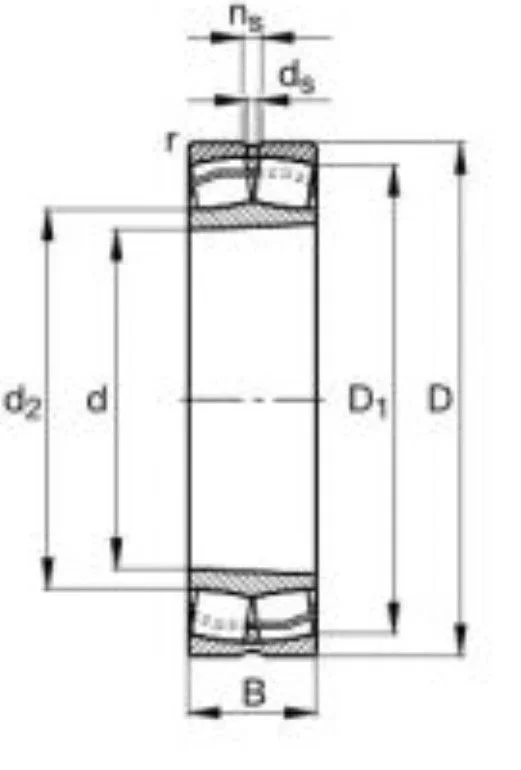
the trees are mounted horizontal axis with fixed point "f" double ball bearing and sliding point "s" roller bearing nu.
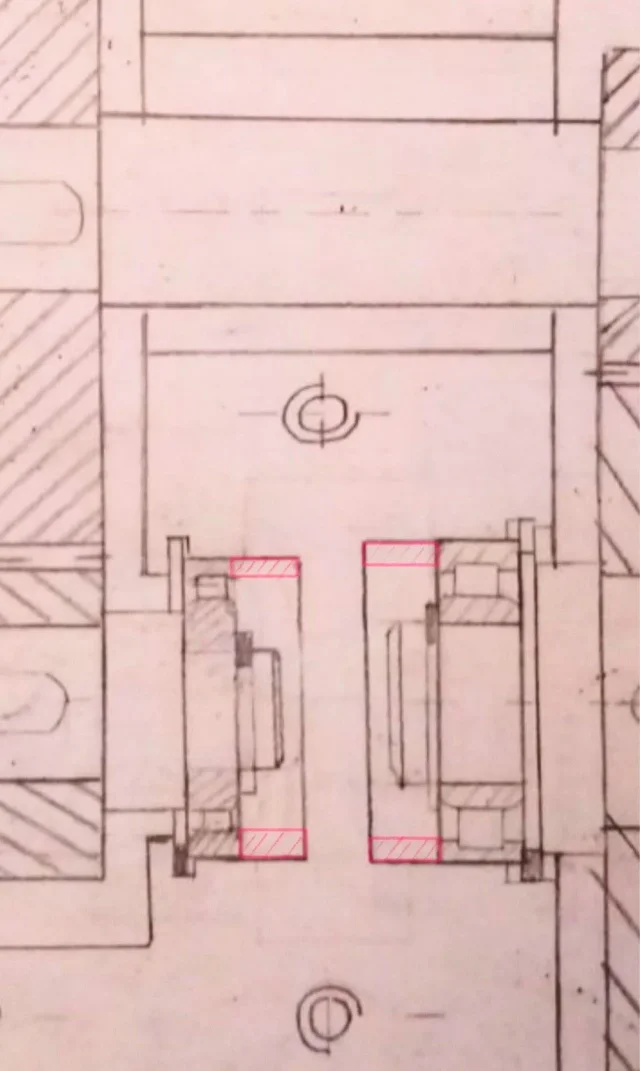
this bearing must have the external track blocked so that the only inner ring moves due to linear expansions, therefore, apart from the difficulty of assembly, the seeger does not serve. just get the two locking bars in the case itself (blue line). if even the mounting tolerance was relatively wide there is no problem, the cents or tenths that will be absorbed by the displacement of the nu bearing.
as it was designed the outer radish can be moved (red arrow) and instead it must be blocked also in that sense.
other annotation, green dart, spacers are short, they have to touch the bearing to pack with the wrench of the wreath.
summarizing: the shaft with wheels and bearings already blocked by the wreath is dropped in the lower half of the case, then position the upper half and tighten the locking caps of the fixed point bearing.
ça ç'est tout,
ah for the rest lack oil seals on the trees and a bare step on the outgoing tree and then I would be curious to see the case developed three-dimensionally.
 

Attachments

  • Immagine 2020-10-28 220124.webp
    Immagine 2020-10-28 220124.webp
    74.3 KB · Views: 23
  • NU.webp
    NU.webp
    8.3 KB · Views: 21
Good evening Checco,
a couple of comments about the last schema published:
it seems to me that the case of the reducer is divided into two halves,
the trees are mounted horizontal axis with fixed point "f" double ball bearing and sliding point "s" roller bearing nu.
this bearing must have the external track blocked so that the only inner ring moves due to linear expansions, therefore, apart from the difficulty of assembly, the seeger does not serve. just get the two locking bars in the case itself (blue line). if even the mounting tolerance was relatively wide there is no problem, the cents or tenths that will be absorbed by the displacement of the nu bearing.
as it was designed the outer radish can be moved (red arrow) and instead it must be blocked also in that sense.
other annotation, green dart, spacers are short, they have to touch the bearing to pack with the wrench of the wreath.
summarizing: the shaft with wheels and bearings already blocked by the wreath is dropped in the lower half of the case, then position the upper half and tighten the locking caps of the fixed point bearing.
ça ç'est tout,
ah for the rest lack oil seals on the trees and a bare step on the outgoing tree and then I would be curious to see the case developed three-dimensionally.
It is true, the seeger can be eliminated and obtained directly the holes with the bars, but for each intervention it is necessary to open the case in two half.
Recently I have realized a reducer that is very similar to your where in the first coaxial stage I have ratio reduction 3 while in the second coaxial stage I have ratio 1 coming out with two counterrotating trees: one on the last and one on the intermediate. this replicated next to an identical anthrop.
the two exit shafts are one above the other vertically, so for me the reducer is rotated 900.Screenshot_20201028_231033.jpgthe case of the reducer is made in one piece only for reasons of economics of work.
everything with adjustable bearings to two crowns of rollers, fixed to the outside crate and furniture to the center crate... so having smooth holes in the central enclosure, as said a few posts ago.Screenshot_20201028_231218_com.android.chrome.jpgthe big gears were dropped from above because I have a window of inspection and assembly, while the pinion and exit trees are inserted by the bearing hole.
I forgot... that the internal bearings (furniture input shaft and shaft output 2) are blocked with bumpers and bolts tightening on the shaft but with the right world-wide sequence.

therefore another note is that the pinions can be obtained from piece with the tree.
 
Last edited:
@kekko999Can you get me a curiosity?
Why do the pencil project when you could use caia by facilitating the assembly of the various components, making the table with few steps etc.?
 
As for the maximum inflexions of the trees, are there limit values to be respected? by kisssoft I have the results and I wanted to compare them if they were reasonable or not...
 
Last edited:

Forum statistics

Threads
44,997
Messages
339,767
Members
4
Latest member
ibt

Members online

No members online now.
ciao
Back
Top