• This forum is the machine-generated translation of www.cad3d.it/forum1 - the Italian design community. Several terms are not translated correctly.

ball/flying valve gear motor

Wow. Fifty meat on fire.

the previous profile shift with z greater than 17 works with external teeth. internal teeth instead suffer from the reverse problem, that is, if too small and without correction find themselves to beat the edges on the pinions and in the grosser cases you can smooth the tooth but it is definitely better to move the profile.

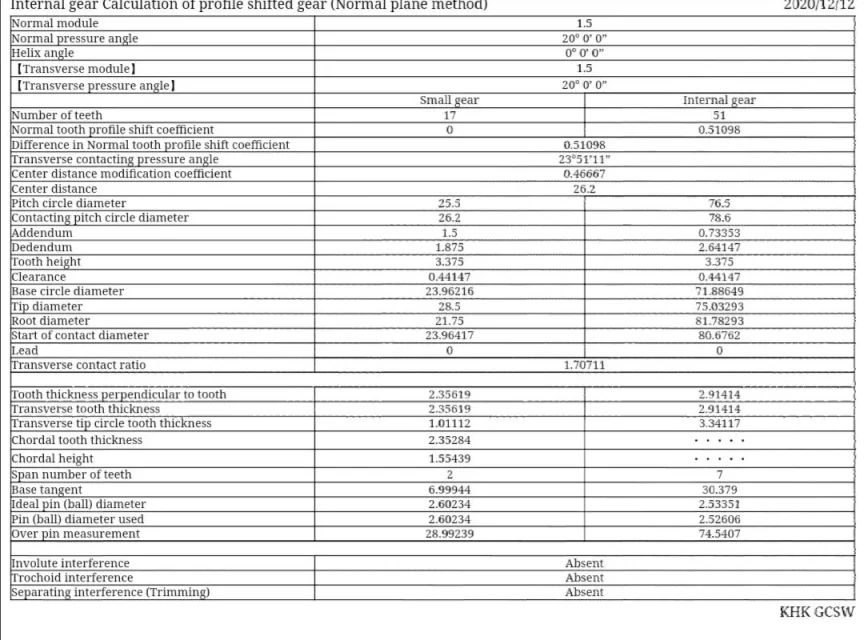
registration on khk gear is free and there is the calculator which is suitable for many types of gears, including internal wheels. it is possible to try to make profile shifts and check the transmissible power its bending that wear.

to understand a little you need to look at some theory and try to apply it. on this forum we love mentioned several times books and resources to consult to understand and calculate.
 
What if I put a central plug? Like this?View attachment 60321
hi, just for completeness and to give you some inspiration, the one often lies (at the conceptual level) in numerous manuals/bibliography
1607790304561.pngthat plug so risks creating localized strengths/usures for disalignment (it is as if I made the system hyperstatic)..so, in poor words, or suffers her or suffers something else :rolleyes:
 
to have no interference on the fourth stage you can do as follows:
- solar 17 teeth x=+0,51.. .
- satellites 17 teeth profile correction x=0
- crown 51 teeth correction profile x = - 0.51.. .
- new interasses 26,2 mm

solar and satellite parameters:Screenshot_20201213_021427.jpgsatellite and internal crown parameters:Screenshot_20201213_020827.jpgattention: the value shifts profile for internal wheels, according to jis rule is of opposite sign compared to din-iso-agma. so if you use any non jis program you need to do x = 0,51098.

this type of ingracing allows you not to have rotation interference.
 
to have no interference on the fourth stage you can do as follows:
- solar 17 teeth x=+0,51.. .
- satellites 17 teeth profile correction x=0
- crown 51 teeth correction profile x = - 0.51.. .
- new interasses 26,2 mm

solar and satellite parameters:View attachment 60344satellite and internal crown parameters:View attachment 60343attention: the value shifts profile for internal wheels, according to jis rule is of opposite sign compared to din-iso-agma. so if you use any non jis program you need to do x = 0,51098.

this type of ingracing allows you not to have rotation interference.
question: why did you correct the solar and not the satellite?
 
question: why did you correct the solar and not the satellite?
There's no reason. there was 50% chance. You should make the transferable pair comparison and see which of the two options is improved.
probably increasing x+ satellites resist more teeth..... is to be evaluated.
 
There's no reason. there was 50% chance. You should make the transferable pair comparison and see which of the two options is improved.
probably increasing x+ satellites resist more teeth..... is to be evaluated.
the doubt came to see page 91 of the pdf I posted yesterday!
 
to have no interference on the fourth stage you can do as follows:
- solar 17 teeth x=+0,51.. .
- satellites 17 teeth profile correction x=0
- crown 51 teeth correction profile x = - 0.51.. .
- new interasses 26,2 mm

solar and satellite parameters:View attachment 60344satellite and internal crown parameters:View attachment 60343attention: the value shifts profile for internal wheels, according to jis rule is of opposite sign compared to din-iso-agma. so if you use any non jis program you need to do x = 0,51098.

this type of ingracing allows you not to have rotation interference.
Dude, now I figured out how the khk calculator works... with your example and reading the manual that provided the good morning I get a lot more things... I begin to see a light at the bottom of this tunnel at last.

One thing, that 0.51 was calculated? because I see that inserting other values are not interference.
that plug so risks creating localized strengths/usures for disalignment (it is as if I made the system hyperstatic)..so, in poor words, or suffers her or suffers something else :rolleyes:
So you think it's better not to put it?
Is it better to do a separate centering for each stage? (to tell us, a small plug, or other, which centers the previous solar with the next door)

regarding the crown of the z51 m1.5, indeed yes, there is little pulp, little more than 4 mm. less in the 6 points where the screws pass. Maybe we should go back to z15-15-45... I wouldn't want to explode.
 
the doubt came to see page 91 of the pdf I posted yesterday!
I don't know what you're talking about, page 91 is this:Screenshot_20201213_140146.jpgah no... you were referring to thisScreenshot_20201213_140358.jpgBut I don't understand why I couldn't do as I did. geometrically ingrain by moving the profile.

often the ralles, called base bearings, have the modification of the inner toothed crown just like this.
 
Dude, now I figured out how the khk calculator works... with your example and reading the manual that provided the good morning I get a lot more things... I begin to see a light at the bottom of this tunnel at last.

One thing, that 0.51 was calculated? because I see that inserting other values are not interference.


So you think it's better not to put it?
Is it better to do a separate centering for each stage? (to tell us, a small plug, or other, which centers the previous solar with the next door)

regarding the crown of the z51 m1.5, indeed yes, there is little pulp, little more than 4 mm. less in the 6 points where the screws pass. Maybe we should go back to z15-15-45... I wouldn't want to explode.
the profile shift coefficient is calculated by the program if you impose a greater inter axis than the theoretical one. increases little by little until the three results of interference in the summary disappear.
 
if you do not want to change interasses I tried to put x=0.45 on the satellite and x=0.45 on the crown and it works!
to not touch the intersection, one will be positive and the other negative....cannot be positive both.
 
I tried to make my own variant. What do you think?

I have seen that you can increase the strength of the tooth well by playing with this coefficient. Plus I gave him 0.1mm backlash on satellites.

link for model 3d: https://a360.co/3nkhxe4
STG04_1.webpSTG04_2.webp
 
as I have explained several times, second norm jis the sign of the shift of profile is of opposite sign regarding the whole text of the world.
In fact, I did the test with my spreadsheet with the formulas of niemann and the cleft remains unchanged only if the co-effents have an opposite sign. I have not understood this thing of the sign: for me the shift is always positive if it is done towards the diameter of head, negative if towards the bottom one. Am I right?
 
In fact, I did the test with my spreadsheet with the formulas of niemann and the cleft remains unchanged only if the co-effents have an opposite sign. I have not understood this thing of the sign: for me the shift is always positive if it is done towards the diameter of head, negative if towards the bottom one. Am I right?
so hai ragione per due ester dentature!
 
In fact, I did the test with my spreadsheet with the formulas of niemann and the cleft remains unchanged only if the co-effents have an opposite sign. I have not understood this thing of the sign: for me the shift is always positive if it is done towards the diameter of head, negative if towards the bottom one. Am I right?
second agma 2001 - iso - din for external and internal wheels:
x>0 if the tool comes out of the material
x<0 if the tool enters the material

according to jis for external wheels:
x>0 if the tool comes out of the material
x<0 if the tool enters the material
according to jis for external wheels:
x<0 if the tool comes out of the material
x>0 if the tool enters the material
this because jis does not consider difference between internal or external wheel but motion is absolute.
 
I tried to make my own variant. What do you think?

I have seen that you can increase the strength of the tooth well by playing with this coefficient. Plus I gave him 0.1mm backlash on satellites.

link for model 3d: https://a360.co/3nkhxe4
View attachment 60355View attachment 60356
personally I would not go beyond x1+x2=1 if I do not want to roll on a flat tooth....in fact +0.5+(-1.5)=-1
a single agma profile shift x = - 1.5 I see it a little so high. controls the duration and bending capacity of the teeth. the internal toothing with x negative makes the tooth bigger at the base...it is because jis uses it positive.... so compare it to the external teeth and therefore can use the graph below...

Keep this pattern in mind:Screenshot_20201214_204444.jpg
 
Last edited:

Forum statistics

Threads
44,997
Messages
339,767
Members
4
Latest member
ibt

Members online

No members online now.
Back
Top