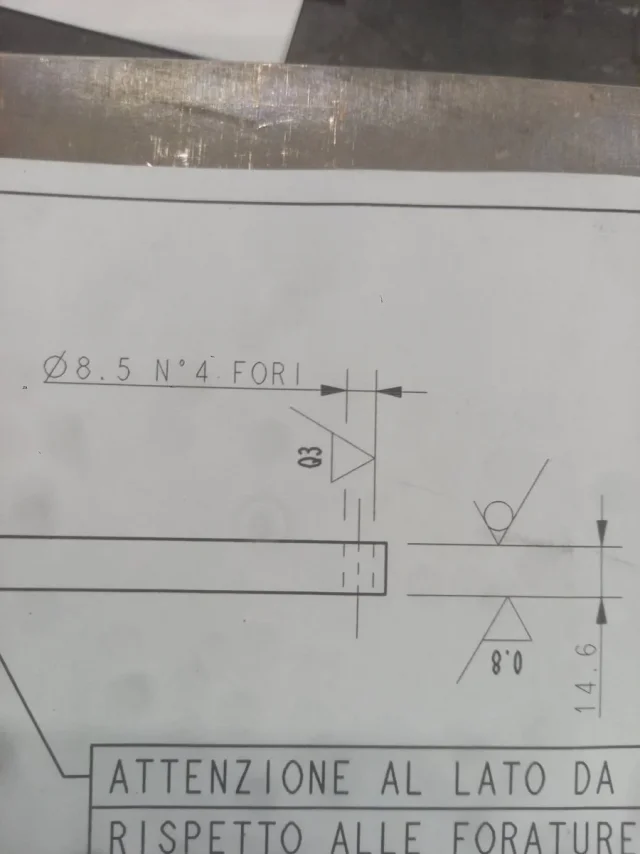
I get out of things on the walls to stucco or on precision classes of linear guides, on roughness I find nothing.in google looking for "tolerance q1" something is found. for now I have no way to deepen
if they refer to an internal standard should be indicated to cartiglio, instead there is nothing.is it not that by chance they refer to some internal standards?
apart from that if q3 < 0.8 μm I would like to know what the hell those 4 holes of ø8.5 free, without tolerance.
I think it might be one of the many cases of "signor poses the fiasco and go for a workshop tour" i
first I prefer to do a research and see if maybe I'm bad because not updated to all regulations, for example.sometimes, if possible, raise the phone and ask directly to whom he drew, or to whom he provided the design, removes any doubt. .
both on the symbol, and on how many whistles he may have drunk. .
You can see that they won't want to get the screw stuck when it flows into the saloon... maybe using partial fillet screws would help, but don't tell them, I recommend.if they refer to an internal standard should be indicated to cartiglio, instead there is nothing.
As for the "posa il fiasco" I have in my hands another fabulous example, roughness 0.4 (lappatura) on asole for a passage of the fixing screws, same roughness on shouldered surfaces that serve only by support, centesimal tolerances on the same sunshades etc.
This more than a fiasco had gone directly into the cask:

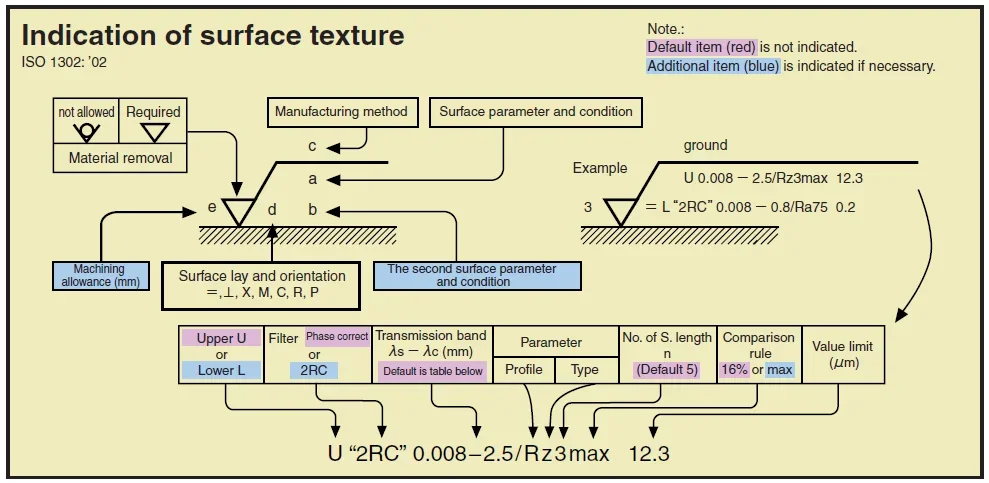
certainly notation is not aligned to the last iso, since roughness should no longer be indicated above the triangle, but under the
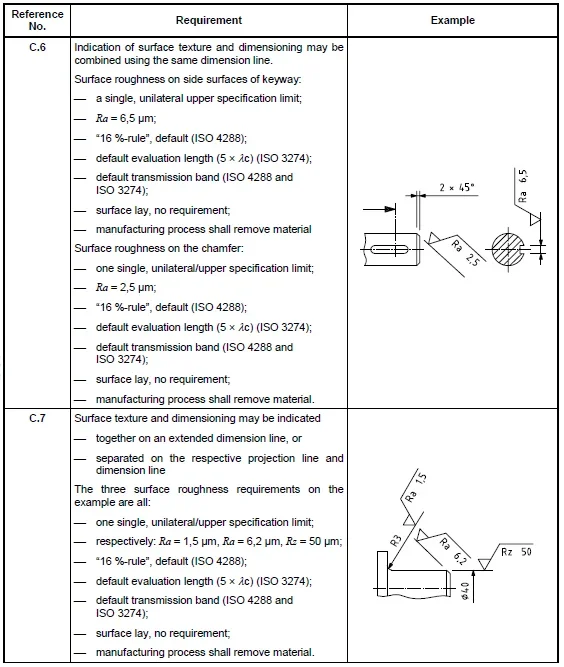
examples taken directly from the iso 1302
thanks for the sbatto loYou can see that they won't want to get the screw stuck when it flows into the saloon... maybe using partial fillet screws would help, but don't tell them, I recommend.
beyond the jokes, I dealt with my dispenses accumulated over the years on roughness and found nothing.
what approaches is the old notation of roughness, but the alphabetic designations do not return.
View attachment 66412
View attachment 66413certainly notation is not aligned to the last iso, since roughness should no longer be indicated above the triangle, but under the
View attachment 66414examples taken directly from the iso 1302
View attachment 66415
I agree, I agree with the notes and what else. but you risk losing the purpose of the design.. .but it does not seem to you that you are exaggerating, I am not contrary to the changes if they bring something useful, at the bottom in mechanics you make the same pieces when you put one, two or three triangles! office complications simple business! Excuse the vent!
I'm self-evident to get a stick on my hands.the iso 1302 of which I have attached the images exist since 2002.
but, just to stay on the subject, I just found out that it was made obsolete right this year :roflmao:
they may have moved 2 commas and changed 2 paragraphs... but go to know without having it in hand
View attachment 66420
where @tecnomodel if the design is after March 2022 it may be that a very zealous designer has transposed the indications of the new norm, and we are on the side of the wrong.perfectly agree on precision mechanics, but I would be curious to know, percentively, in mechanics, how many industries are able to control and measure surface roughness!I'm self-evident to get a stick on my hands.
apparently different things have changed, including graphic designationView attachment 66421where @tecnomodel if the design is after March 2022 it may be that a very zealous designer has transposed the indications of the new norm, and we are on the side of the wrong.
If the design is antecedent, I don't know.
I continue to marry my first hypothesis, referring to a standard of internal designation, although not mentioned in the cartiglio
@ pietro2002 e @drbarde If in principle I could agree with you, in reality I feel to disagree.
I lost track of the times when I tried to explain to those who asked me "but this value of rz roughness, how much does it do in ra? ?"because this is not possible since they are 2 completely disconnected mathematical analysis methods and there is no direct correspondence.
at the end I bowed to reality, and I responded too "a valore tra x ed and"
the reality is that these norms are not avoided in university paths where they continue to recycle dispenses with un obsolete norms for 20+ years, let alone in a path of secondary education of second degree.
Then I can agree that except for precision mechanics on spindle applications have little meaning to many designations, including geometric tolerances, this does not mean that they should be ignored
non è un discorso di fiaschi, semmai di cominciare a googlare non in italiano, ma in inglese, "roughness q3" e troverai tante risposte tra le quali...
q3 quality level 3 if higher demands are made on quality addition to q2, then additional procedures are necessary. jointing and finishing in accordance with quality level 3 includes: > jointing and finishing to q2, plus > wider finishing of the joint and a tight coat of joint compound to the entire plasterboard surface, filling the pores. physical ridges and grooves are not acceptable. even then, under the effect of shallow light, visible marks cannot be totally eliminated. the level and extent of such marks will be considerably lower than in the case of q2. this type of drywall surface is suitable for: > fine structured wall coverings > matt and fine structured paint coatings > top coats (maximum particle size less than 1 mm)
We're talking about mechanics in my case, though.that for ordinary mortals means:
Q3 quality level 3. if higher quality demands are made in addition to q2, additional procedures are required. the joint and finishing according to the quality level 3 include: the joint and finishing to q2, plus a wider finish of the joint and a layer of sealing joint on the entire surface of the plasterboard, filling the pores. physical ridges and grooves are not acceptable. possibly, under the effect of the shallow light, visible signs cannot be completely eliminated. the level and extension of such signs will be considerably lower than the case of q2. this type of surface for plasterboard is suitable for: wall coverings with structure fine matt paints and fine structure finishes (maximum particle less than 1 mm)
a portable rugosimeter costs between 2000 and 3000 € ...perfectly agree on precision mechanics, but I would be curious to know, percentively, in mechanics, how many industries are able to control and measure surface roughness!
We're doing the initial roughing work, a bit of margin of time we still have it.just for curiosity, @tecnomodel, how did you fix it down in the garage?
processing is still to be done, because you plan ahead,
or did the operator fix it in his own way?
Usually, when it happens to me some problem or demand for clarifications from the production, they do not have much time to wait, because they realize the thing at the moment they are doing it. .