
You are using an out of date browser. It may not display this or other websites correctly.
You should upgrade or use an alternative browser.
You should upgrade or use an alternative browser.

meccanicamg
Guest
read the rules you came up with "I read".
good health education and introduce yourself.
any background indication of yours?
did you search the forum?
Surely we have already talked about it.
You could have saved a double discussion and agreed.
good health education and introduce yourself.
any background indication of yours?
did you search the forum?
Surely we have already talked about it.
You could have saved a double discussion and agreed.
meccanicamg
Guest
However, if you work in a company that produces rollers of this kind, you should have a spreadsheet or something like that to size the engines.
everything is explained in the rulmeca catalog that I attach to you.
If you are looking for you will also find other builders who report similar directions.
sapeef seek is fundamental.
then put everyone together and make a nice excel sheet.
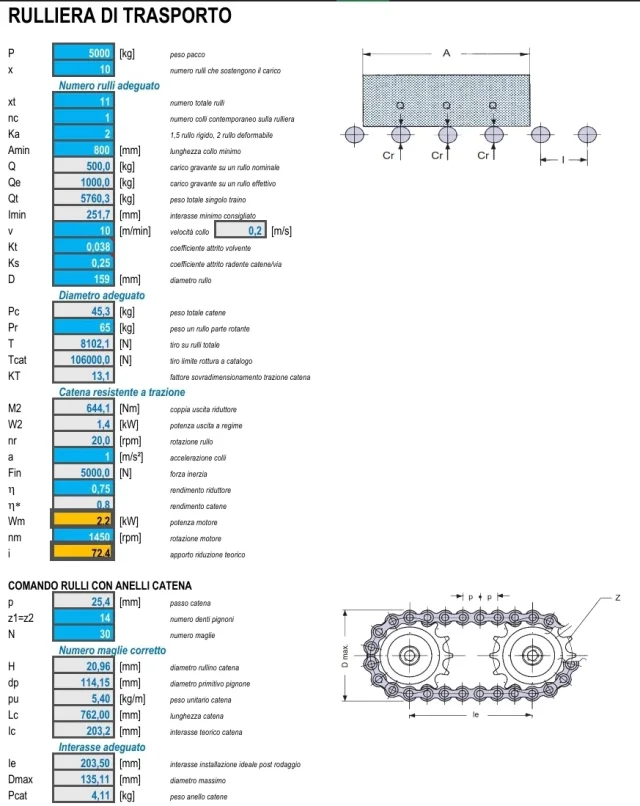 Keep in mind that by finished operation, they are the transients in acceleration/deceleration that make more consumption because at regime it does not need power. if you use direct engines it is difficult to estimate real acceleration.
everything is explained in the rulmeca catalog that I attach to you.
If you are looking for you will also find other builders who report similar directions.
sapeef seek is fundamental.
then put everyone together and make a nice excel sheet.
Keep in mind that by finished operation, they are the transients in acceleration/deceleration that make more consumption because at regime it does not need power. if you use direct engines it is difficult to estimate real acceleration.Attachments
Last edited:
meccanicamg
Guest
I apologize for the words written wrong... the concealer tonight is crazy.
know how
everything
a lot
know how
everything
a lot
nicola00
Guest
In this case I have to deal with a product built by third parties that we are not aware of their design method, and anyway I looked on the forum but I couldn't find anything.I apologize for the words written wrong... the concealer tonight is crazy.
know how
everything
a lot
I now set a couple of data if they can be useful:
1400 rpm of the engine
0,75kw
reduction ratio i=40
sprocket on reducer z=15
sprocket on roller z=12
roller diameter 89mm
weight of a roller 13kg
meccanicamg
Guest
between the fundamental data lacks the type/pass chain. number of rollers, size of the neck....I guess if you see my picture. . .In this case I have to deal with a product built by third parties that we are not aware of their design method, and anyway I looked on the forum but I couldn't find anything.
I now set a couple of data if they can be useful:
1400 rpm of the engine
0,75kw
reduction ratio i=40
sprocket on reducer z=15
sprocket on roller z=12
roller diameter 89mm
weight of a roller 13kg
need some extra data.
nicola00
Guest
chain 5/8 simple 24 steps on the wheel, 27 steps from that conducted.between the fundamental data lacks the type/pass chain. number of rollers, size of the neck....I guess if you see my picture. . .
need some extra data.
number of reels 20.
the size of the package for which it was designed I do not know it, in fact for this I have to understand with the following components how much mass it manages to translate.
not so much so that the rollers can yield, but because maybe the engine doesn't have enough to move it.
meccanicamg
Guest
We start from the fact, that if I understood correctly you have an electric motor 0,75kw-1400rpm connected to an i=40 reducer. I imagine it is in endless screw with a yield of about 70% used at 50hz and service factor fs=1. on the output shaft you have a z15 pinion connected via chain 10b-1 to a series of rollers with pinion z12.
already the fact that you have a simple 10b-1 chain you cannot transmit all that couple generated by the gearmotor.
so looking at the design you placed, it means that from the exit shaft of the gear motor I go out with two pinions that feed two branches.
means that the power is divided two.
but also here I can tell you that the chosen chain is poor because if working full load you have a useful life of no more than 2000 hours.
the roller will travel to a number of turns equal to:[math]nr=\frac{1400rpm}{40}•\frac{15}{12}=43,8rpm[/math]being that the transport diameter is 89mm you will go to an angle speed of about [math]\omega=\frac{2•π•nr}{60}=4,6rad/s[/math]which is equivalent to a linear speed of:[math]v=\omega•0,5•d=0,2m/s[/math]with 1m/s2 accelerations, we can handle about 1000kg spread over 20 reels.
this is an indicative estimate with the parameters I usually use.
Surely if you put yourself to the accounts and considerations for how you use it, with a lot of rulmeca catalog in hand you will get more realistic values.
but what do you mean that the chain on the conduct and the motion is not as long? You mean the two branches that feed the two rollers?
already the fact that you have a simple 10b-1 chain you cannot transmit all that couple generated by the gearmotor.
so looking at the design you placed, it means that from the exit shaft of the gear motor I go out with two pinions that feed two branches.
means that the power is divided two.
but also here I can tell you that the chosen chain is poor because if working full load you have a useful life of no more than 2000 hours.
the roller will travel to a number of turns equal to:[math]nr=\frac{1400rpm}{40}•\frac{15}{12}=43,8rpm[/math]being that the transport diameter is 89mm you will go to an angle speed of about [math]\omega=\frac{2•π•nr}{60}=4,6rad/s[/math]which is equivalent to a linear speed of:[math]v=\omega•0,5•d=0,2m/s[/math]with 1m/s2 accelerations, we can handle about 1000kg spread over 20 reels.
this is an indicative estimate with the parameters I usually use.
Surely if you put yourself to the accounts and considerations for how you use it, with a lot of rulmeca catalog in hand you will get more realistic values.
but what do you mean that the chain on the conduct and the motion is not as long? You mean the two branches that feed the two rollers?
meccanicamg
Guest
I suggest you put your head on it and make your calculations from scratch.
then you can compare with various computers online, as This is even if it does not take into account some factors that could affect the calculation of net power.
dirty and dusty environments significantly decrease yields in a short time.
 What do you propose to us as a calculation?
then you can compare with various computers online, as This is even if it does not take into account some factors that could affect the calculation of net power.
dirty and dusty environments significantly decrease yields in a short time.
What do you propose to us as a calculation?meccanicamg
Guest
other indications can be obtained by questioning copilot plus gpt-4 forcing it to analyze more specific information.
the total transported weight is 1400 kg and the total weight of the rollers is (20rolls•13kg/roll=260 kg). then:
invoice=(1400 kg+260 kg)×0.3=498 n
to calculate the power required for an electric motor that must accelerate a load, we can use the following formulas, considering an acceleration of [imath]1\ m / s ^ 2[/imath], 70% reducer yield and 80% chain rings yield.
the total force necessary to accelerate the load (f_tot) is given by the sum of the force necessary to win the friction (f_ friction) and the force necessary for acceleration (f_ acceleration):[math]f_{tot} = f_{attrito} + f_{acceleration}[/math]dove:
- [imath]f_{attrito[/imath] is the force necessary to win friction, previously calculated as 498 n.
- [imath]f_{ acceleration)[/imath] is the force necessary to accelerate the load, given by [imath]m \times a[/imath], where [imath]m[/imath] is the total mass (load + rollers) and [imath]a[/imath] is acceleration.
the total mass is [imath]1400 \\ g + 260 \\ kg = 1660 \\ kg[/imath], therefore:[math]f_{ acceleration} = 1660 \ kg \times 1 \ m/s^2 = 1660 \ n[/math]therefore, the total force necessary is:[math]f_{tot} = 498 \ n + 1660 \ n = 2158 \ n[/math]the power required for acceleration (p_acceleration) is given by:[math]p_{ acceleration} = f_{tot} \times v[/math]where [imath]v[/imath] is the speed of transport, which is 0.2 m/s. then:[math]p_{ acceleration} = 2158 \ n \times 0.2 \ m/s = 431.6 \ w[/math]this is the mechanical power required by the engine before considering yields. to achieve the actual electric power (p_electric) that the engine must provide, we consider the yields of the reducer and chain rings:[math]p_{electric} = \frac{p_{ acceleration}}{\eta_{riduttore} \times \eta_{catena}}[/math]replacing the found values:[math]p_{elettrica} = \frac{431.6 \ w}{0.7 \times 0.8} \approx 773.57 \ w[/math]this is the electric power that the engine has to provide to speed up the load from the stop to reach the desired speed of transport, taking into account the returns.
As for the torque (t) and rpm (n ) of the roller, we can use the formulas already provided, but taking into account the performance of the reducer in the calculation of the actual torque (t_eff) necessary for the roller:[math]t_{eff} = \frac{t_{riquest}}{\eta_{riduttore}}[/math]dove:
- [imath]t_{richie?[/imath] is the requested pair calculated previously (59.4 nm).
replacing the found values:[math]t_{eff} = \frac{59.4 \ nm}{0.7} \approx 84.86 \ nm[/math]this is the actual torque that the engine must provide to accelerate the load, taking into account the return of the reducer.
the total transported weight is 1400 kg and the total weight of the rollers is (20rolls•13kg/roll=260 kg). then:
invoice=(1400 kg+260 kg)×0.3=498 n
to calculate the power required for an electric motor that must accelerate a load, we can use the following formulas, considering an acceleration of [imath]1\ m / s ^ 2[/imath], 70% reducer yield and 80% chain rings yield.
the total force necessary to accelerate the load (f_tot) is given by the sum of the force necessary to win the friction (f_ friction) and the force necessary for acceleration (f_ acceleration):[math]f_{tot} = f_{attrito} + f_{acceleration}[/math]dove:
- [imath]f_{attrito[/imath] is the force necessary to win friction, previously calculated as 498 n.
- [imath]f_{ acceleration)[/imath] is the force necessary to accelerate the load, given by [imath]m \times a[/imath], where [imath]m[/imath] is the total mass (load + rollers) and [imath]a[/imath] is acceleration.
the total mass is [imath]1400 \\ g + 260 \\ kg = 1660 \\ kg[/imath], therefore:[math]f_{ acceleration} = 1660 \ kg \times 1 \ m/s^2 = 1660 \ n[/math]therefore, the total force necessary is:[math]f_{tot} = 498 \ n + 1660 \ n = 2158 \ n[/math]the power required for acceleration (p_acceleration) is given by:[math]p_{ acceleration} = f_{tot} \times v[/math]where [imath]v[/imath] is the speed of transport, which is 0.2 m/s. then:[math]p_{ acceleration} = 2158 \ n \times 0.2 \ m/s = 431.6 \ w[/math]this is the mechanical power required by the engine before considering yields. to achieve the actual electric power (p_electric) that the engine must provide, we consider the yields of the reducer and chain rings:[math]p_{electric} = \frac{p_{ acceleration}}{\eta_{riduttore} \times \eta_{catena}}[/math]replacing the found values:[math]p_{elettrica} = \frac{431.6 \ w}{0.7 \times 0.8} \approx 773.57 \ w[/math]this is the electric power that the engine has to provide to speed up the load from the stop to reach the desired speed of transport, taking into account the returns.
As for the torque (t) and rpm (n ) of the roller, we can use the formulas already provided, but taking into account the performance of the reducer in the calculation of the actual torque (t_eff) necessary for the roller:[math]t_{eff} = \frac{t_{riquest}}{\eta_{riduttore}}[/math]dove:
- [imath]t_{richie?[/imath] is the requested pair calculated previously (59.4 nm).
replacing the found values:[math]t_{eff} = \frac{59.4 \ nm}{0.7} \approx 84.86 \ nm[/math]this is the actual torque that the engine must provide to accelerate the load, taking into account the return of the reducer.
TETRASTORE
Guest
you can make calculation using this online computer specific for your type of conveyor by changing the maximum load to the result of a power similar to yours. otherwise perform the calculations inversi using the formulas contained in the catalog dugom rollers similar to those present in the catalog attached from @meccanicamg in post #3.
in the calculation you must also evaluate the type and nature of the objects to be transported as they affect the value of the friction coefficient.
in the calculation you must also evaluate the type and nature of the objects to be transported as they affect the value of the friction coefficient.
TETRASTORE
Guest
correct. In this case it may be that the ac motor during the start is subject to a couple in addition to its nominal capacity for a certain duration resulting in increased temperature. if the start is limited there is no problem because, if the operation is continuous, the ventilation of the motor can re-establish the thermal balance, if instead we are in the presence of a service characterized by a high intermittentness, it is necessary to preview of the thermocouples in the winding to safeguard the functionality of the motor in case of excessive overtemperature.if you use direct engines it is difficult to estimate real acceleration.
TETRASTORE
Guest
According to me here should not be considered the weight of the rollers as they are not part of the material to be transported.the total transported weight is 1400 kg and the total weight of the rollers is (20rolls•13kg/roll=260 kg). then:
invoice=(1400 kg+260 kg)×0.3=498 n
here instead I agree because their mass influences the force required in acceleration.the total mass is 1400 kg+260 kg=1660 , therefore:
f acceleration=1660 kg×1 m/s2=1660 nf_{ acceleration} = 1660 \ kg \times 1 \ m/s^2 = 1660 \ nf acceleration=1660 kg×1 m/s2=1660 n
is reasoning correct?
meccanicamg
Guest
In fact, you are right even if you often put it in the stem as an "addition factor". in acceleration does inertia, in static does not affect.According to me here should not be considered the weight of the rollers as they are not part of the material to be transported.
here instead I agree because their mass influences the force required in acceleration.
is reasoning correct?