
• This forum is the machine-generated translation of www.cad3d.it/forum1 - the Italian design community. Several terms are not translated correctly.

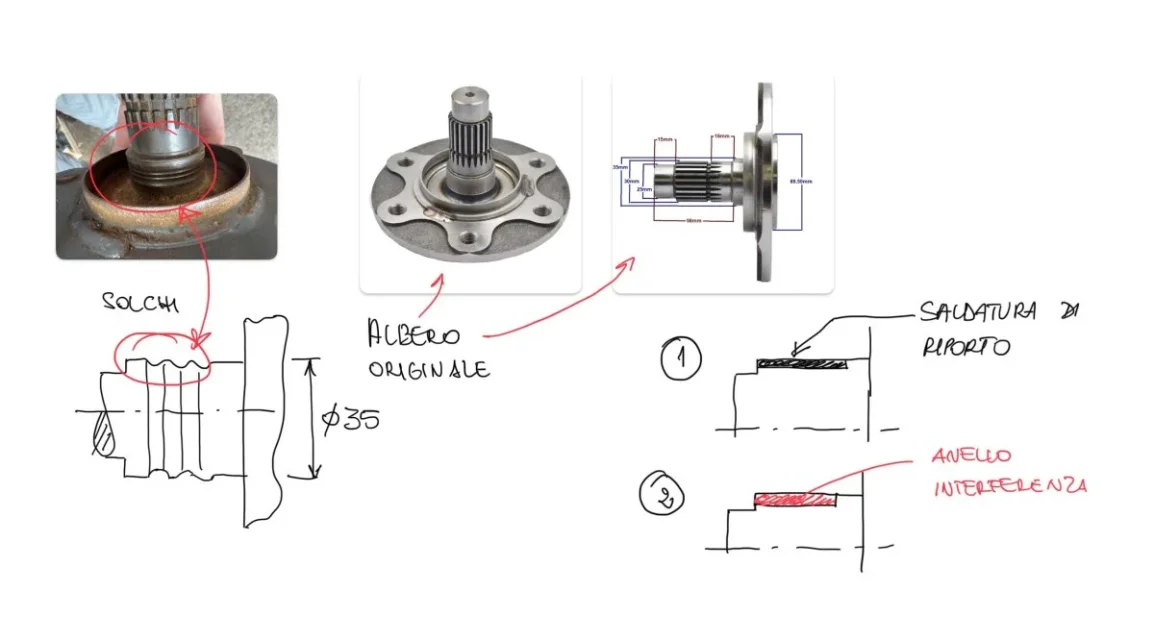
how to repair the grooves on a tree generated by the seals (parail)

  • Thread starter Thread starter gerod
  • Start date Start date

gerod

Guest
my tractor had a front axle problem (it's a 4x4, kubota b1600, a all-mechanical stuff): the hub was lasco because of the bearings and he lined up.
the sliding seat has d=35 mm.
There are two theories:
1. turning of the grooves, carrying with welding and then turning overmetal;
2. turning of the damaged part (I would carry the d35 to d31) and inserting hot (interference) of a turned ring.
the 1 do not like because the tree has little thickness and residual tensions could arise
the 2 would give me a reduction of the diameter and therefore of the resistant section besides the fact that between ring and tree could generate games with loss of oil.
these are the damage (they are important grooves), the original tree and the two patterns.
Thank you.
 

Attachments

  • albero_Kubota.webp
    albero_Kubota.webp
    38.7 KB · Views: 77
I don't know how deep the grooves are, sometimes it can be solved with a thick chromium carry and then rectification.

p.s., are you sure the repair costs you less than the spare?
 
Those are not furrows... they are whirlwinds!
you could turn the tree back, then create a ring to stick on it, but I don't know if it would pass the ring, because the grooves look deep. then the ring would not pass through the tree. Then I would cut in 2 the ring in two semi-circles and then I would climb them to the tree. Obviously the ring should have a small weld edge, so it will easily weld and would not deform.
 
the grooves are from 1 mm thin (it is not little, I know). Besides, he was tilted because the two bearings were gone. Fortunately the gears did not get damaged even if the load weighed on the same.
 
There are concrete steel bushings hardened of the ina and other manufacturers....the hot mountains and you are affixed.
for welding you have to cool it with blanket and sew it... it's a little menaced.
 
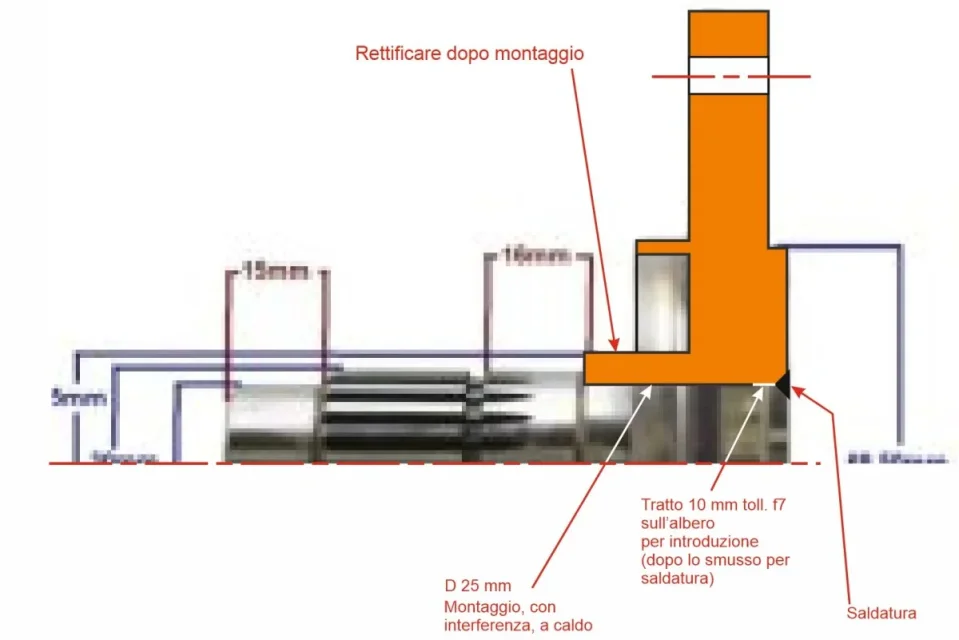
If I had to do so I would take it from a turning machine and I would remove all the flange by bringing the shaft to d25 until the d30 bar, then I would make it build a flange in c40 rectified as I indicated in the attached sketch (with the diameter of 35 mm increased of 0.6 mm for the subsequent grinding) and the hot-mounted on the shaft blocking the two pieces with a welding.
last I would rectify d 35.
 

Attachments

  • Albero scanalato riportato.webp
    Albero scanalato riportato.webp
    34.8 KB · Views: 35
If I had to do so I would take it from a turning machine and I would remove all the flange by bringing the shaft to d25 until the d30 bar, then I would make it build a flange in c40 rectified as I indicated in the attached sketch (with the diameter of 35 mm increased of 0.6 mm for the subsequent grinding) and the hot-mounted on the shaft blocking the two pieces with a welding.
last I would rectify d 35.
excellent solution, paying a lot of attention in welding phase, are hard steels to join, considering well the right welding parameters, preheating temperature, intake material and cooling time.
 
I know it's the best solution but at this point I'd like to buy it new.
There was also the possibility of spraying metal and then turning back, but they tell me it costs a proposition.
thanks anyway to everyone. I'll tell you what.
and anyway, both trees are engraved, even the second that worked correctly and was in oil bath.
Hi.
 
my tractor had a front axle problem (it's a 4x4, kubota b1600, a all-mechanical stuff): the hub was lasco because of the bearings and he lined up.
the sliding seat has d=35 mm.
There are two theories:
1. turning of the grooves, carrying with welding and then turning overmetal;
2. turning of the damaged part (I would carry the d35 to d31) and inserting hot (interference) of a turned ring.
the 1 do not like because the tree has little thickness and residual tensions could arise
the 2 would give me a reduction of the diameter and therefore of the resistant section besides the fact that between ring and tree could generate games with loss of oil.
these are the damage (they are important grooves), the original tree and the two patterns.
Thank you.
I use solution 2 or rings in interference
try to evaluate if on catalog ina there are measures that can be helpful
 
Thank you.
a ring is easy to do!
I still try to see if they have
if you are lucky you find a correct ring for inner diameter, maybe if by outer diameter you find a measure greater than the current you could change seal ring with a suitable for the new diameter
 
the estate is special, made by kubota. He has a shoulder. I thought about it, but now I found it. the ring however will give me the opportunity to replace it if it hurts, not that I will use it so much.....
 
I remember a similar problem that my dad had solved by welding on the damaged area and then returning the tree again to measure.. .
typically for such applications use alloy steels and therefore it is not exactly the most... risk making it crack during cooling. . .
 
I remember a similar problem that my dad had solved by welding on the damaged area and then returning the tree again to measure.. .
typically for such applications use alloy steels and therefore it is not exactly the most... risk making it crack during cooling. . .
Sometimes, to repair the molds, welding carry is done by tig.
 
tig would be ideal but risk creating tensions. I don't know what material it is and then the diameter is small. for greater diameter is normally done. if then the distension makes me eccentric .... frittata made.
 
had not been subjected to distension, welded and cooled in air, it is usually cemented stuff, part the tempering of the surface layer but for the rest it is a tender material. . .
 

Forum statistics

Threads
44,997
Messages
339,767
Members
4
Latest member
ibt

Members online

No members online now.
Back
Top