• This forum is the machine-generated translation of www.cad3d.it/forum1 - the Italian design community. Several terms are not translated correctly.

ø80 drain hole

  • Thread starter Thread starter Sebastiano71
  • Start date Start date

Sebastiano71

Guest
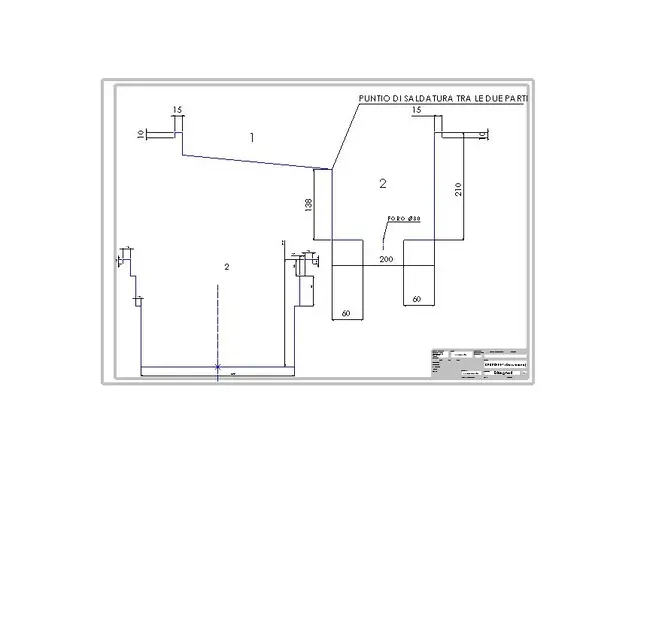
Hello, everyone. I would like to underwent my riddle, that is the construction in a tub sheet. I attached a file in 2d of massiam only to understand what shape it has. as you see for constructive reasons, I numbered the slip with number 1 and the tray with hole n.2, because both of them get with separate sheets and then welded where I put the welding note. I come to the qunque; I tried in several ways it has to make the slip (1), even with a loft, but I did not succeed (me by mistake). If I build it with the usual functions of flanges and edges/angles after I can't close the corners, then the profile remains open. I also can't put the slippery plan.
Who can give me any ideas?
Thank you.
 

Attachments

  • VASCA CON SCARICO.webp
    VASCA CON SCARICO.webp
    11.2 KB · Views: 81
Hello, everyone. I would like to underwent my riddle, that is the construction in a tub sheet. I attached a file in 2d of massiam only to understand what shape it has. as you see for constructive reasons, I numbered the slip with number 1 and the tray with hole n.2, because both of them get with separate sheets and then welded where I put the welding note. I come to the qunque; I tried in several ways it has to make the slip (1), even with a loft, but I did not succeed (me by mistake). If I build it with the usual functions of flanges and edges/angles after I can't close the corners, then the profile remains open. I also can't put the slippery plan.
Who can give me any ideas?
Thank you.
Handle!
but reread what written before pressing sending is not used at anyone's house? you struggle to follow the speech and you do not understand a patch between typing errors and "fantasy" syntax.
ah, if you are not of Italian native speakers better say it in advance, to scans of equivocs and "remproveri" out of place (in case I apologize..):smile:
then from the 2d that I place the form just do not understand (may you put it a little smaller? ... try with a pdf).

Come on, try again. keeping in mind that we're not all in your head.

greetings
Mar
 
I thank you for the attention you received. I've already split it into two parts, part 1 and part 2 that are then put together (saldati) in a set. My problem is that I can't close the edges of the corners to find the development of the sheets. as you can see (hope), the final edge of the whole tub is a "c". when I take a corner edge on the three sides with the special profile, the two corners can not close them (uniting them) and I have an empty space. At present I should cut two pieces of sheet separately to complete (unite the two corners to "c".) example: if I make a base sheet and after I build an angle edge on the three sides (with any profile), automatically closes all edges. Now I can't close them as the base sheet is tilted and use flanges to close the three sides, changing the 2d design.
the version I use and 2010.
Thank you again for your attention.
 

Attachments

perhaps with the pdf that I attached in the second message everything becomes clearer.
Thanks again.
big way maybe I understood
you have to close the bottom side of the "trafila"
not use solidworks
But if you open a plan in that position and activate the sketch
select the tangent or loop
and with the command convert entities create a closed sketch that then
to extrude in h for sheet thickness
I hope you've been helped
 
sincerely on the top of the side that in the closed is missing the edge to "c" that must collect with the "c" of the two side edges.
 
Sincerely, I'm quite difficult to understand. :confused: it will be because where I work we are for simple things simple and rather to put a more fold we try to put 2 in less:tongue:
 
But if you can, if you can, give me the precise measures that I take out the development to the tenth of mm...:cool:

mine was just an interpretation of your description. . .
if you can't develop such a piece you don't understand philosophy
of solidwors.
However, stopping that side with the addition of a folded flange is not the maximum, the folder would have difficulty running that fold, given the height of the edges.
I've already designed similar objects and swabs I've made them weld, decapate and finally satin, in fact I suppose that you realize it in ac.inox, right?

greetings

Michael
 

Attachments

Sincerely, I'm quite difficult to understand. :confused: it will be because where I work we are for simple things simple and rather to put a more fold we try to put 2 in less:tongue:
maybe you don't have the right equipment (breaking sts, swan necks, crease, laser/punching cutting...) to work the sheets, I can assure you that with an extra fold, if done and calculated properly, eliminate
a lot of diamonds caused by the deformation of welds, especially in noble materials such as stainless steel, perhaps with satin finish.
:finger:
 
Finally (maybe:biggrin:) I understand what Sebastiano asks.
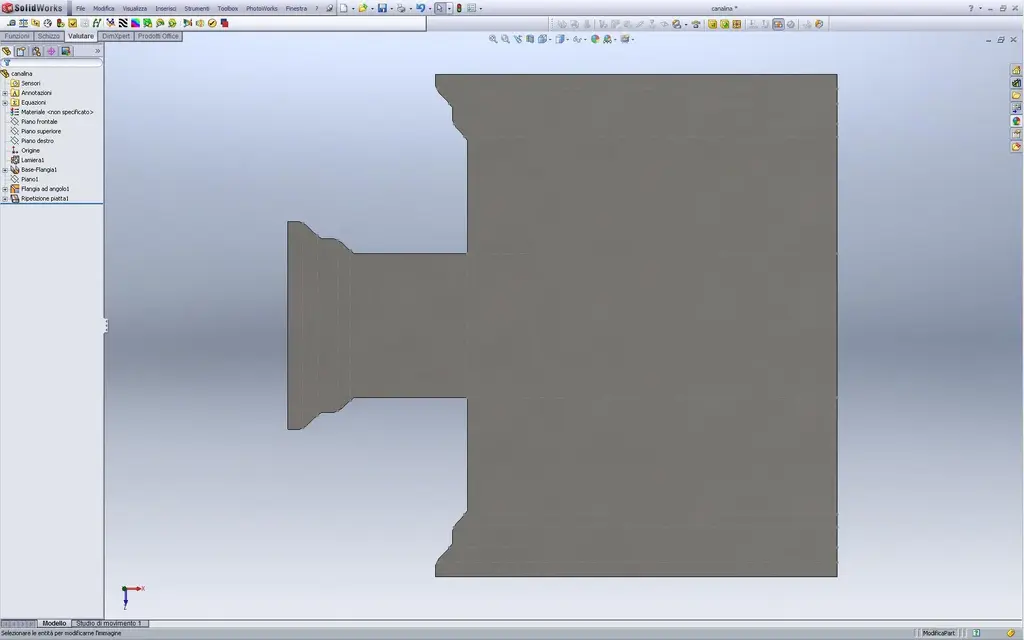
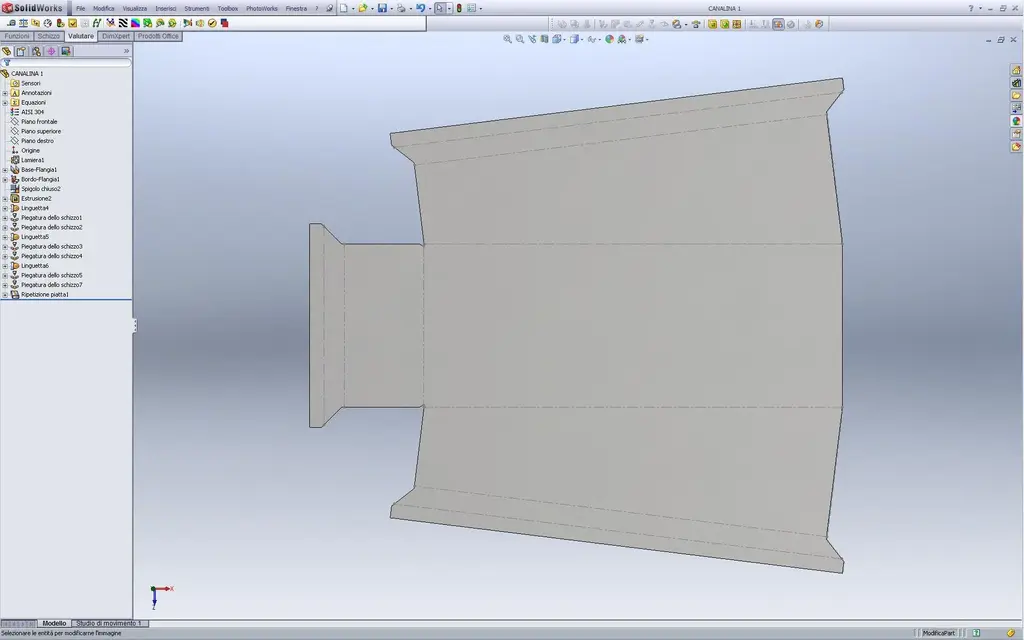
would like the three closed sides and with "double filling" edge all around with 45° junta/cut, so:canalina.webpcanalina Svil.webp. but this is "simple" because from the base plan it is all in a blow with flea tagliad.

its instead has the sloping base plane and the walls all vertical with horizontal edge, about so:CANALINA 1.webpCANALINA 1 Svil.webp. for brevity I made a piego only on the edge.
only that becomes much more laborious (at least for my abilities); Two. flange on board side have modified sketch and folded edges are made by adding tabs and with Sketch bending and consequently unbeaten to trace the appropriate sketches. the corners remain very open, you should further change the sketches.

nothing is impossible but in the end you lose more time to model it than to fold it in the car (I always save the availability of suitable equipment).
In the end I think it's more convenient to build the "schiena" apart and weld it.

greetings
Mar
 
But, if you can, if you can, give me the precise measures that I take out the development to the tenth of mm...

mine was just an interpretation of your description. . .
if you can't develop such a piece you don't understand philosophy
of solidwors.
However, stopping that side with the addition of a folded flange is not the maximum, the folder would have difficulty running that fold, given the height of the edges.
I've already designed similar objects and swabs I've made them weld, decapate and finally satin, in fact I suppose that you realize it in ac.inox, right?

greetings

Michael
Mike,
Try to see if you can get out of something feasible and fast to shape. and in case you post the procedure, thanks:smile::smile:
View attachment canalina.rar View attachment CANALINA 1.rar.. always 2009, then usual images with visible tree:biggrin:

greetings
Marco:smile:
 
big way maybe I understood
you have to close the bottom side of the "trafila"
not use solidworks
But if you open a plan in that position and activate the sketch
select the tangent or loop
and with the command convert entities create a closed sketch that then
to extrude in h for sheet thickness
I hope you've been helped
..it takes the edge folded back as well, that "turns all around".

but brother shiren, you didn't start using solidworks long ago?

greetings
Marco:smile:
 
Mike,
Try to see if you can get out of something feasible and fast to shape. and in case you post the procedure, thanks
View attachment 13533.. always 2009, then usual images with visible tree:biggrin:

greetings
Marco:smile:
Today will be tough... wife and dog decided to go for a walk. . .
However already from your model you see the potential of the software.
a very small advice: to avoid having all that air, reduce the radius
bend to 0.01 mm, logically the factor k và proportionate.
It is not said that the side should be all welded, depends on many factors, including the feasibility of bending without ruining the long sides of the tub.
In addition, as is evident from the sebastian sketch, I find it difficult for a bending machine to have the blades so high that the whole piece folds.
to the eye with our bending machine you do not get to that depth, and therefore,
If we had to produce it, I would have to separate the buffer by welding it.

for reliable development the data of the quarry used for the fold is vital.
in our company we make a series of 4-5 consecutive folds in the range of 2-3 tenths of tollereance.
Monday I will post a table for the use of factor k with the series of molds we have in company.

:smile:
 
In the end I think it's more convenient to build the "schiena" apart and weld it.
maybe you don't have the right equipment (breaking sts, swan necks, crease, laser/punching cutting...) to work the sheets, I can assure you that with an extra fold, if done and calculated properly, eliminate
a lot of diamonds caused by the deformation of welds, especially in noble materials such as stainless steel, perhaps with satin finish.
:finger:
In fact, you're right.
especially if welds have to be "welded", continue all around the perimeter.

greetings
Marco:smile:
 
maybe you don't have the right equipment (breaking sts, swan necks, crease, laser/punching cutting...) to work the sheets, I can assure you that with an extra fold, if done and calculated properly, eliminate
a lot of diamonds caused by the deformation of welds, especially in noble materials such as stainless steel, perhaps with satin finish.
:finger:
I would also perfectly agree but we do small stuff on medium and large series and we make it all to third parties, so each fold in more coast:tongue: from our point of view if conceptually the piece is functional but complex to realize the simplify.

what I wanted to say to Sebastiano is: but does it really do that? Will it not be a design hub? is it not that doing it in another way simplifies and you save it?

the other thing I wanted to say is that from the drawings he posted you can not understand well what he needs. I modeled it with the odds of the first drawing and it's not exactly how sampom shaped it. the "slide" as he calls it he did not leave from the base but from an intermediate height that would complicate further and of much the matter forcing as he says to weld the slip.
 
a very small advice: to avoid having all that air, reduce the radius
bend to 0.01 mm, logically the factor k và proportionate.
I know. only that I like to have the model that reflects the real shape of the "physical" profile (and those rays are measured by me to sample in the workshop, tenth more tenth less..), also for the possible modeling of other details that should go "to copy" and to respect the real ingombs.
Monday I will post a table for the use of factor k with the series of molds we have in company.
..yes, for the molds and machines you have you In the company.
I made it for our parameters (we have the bending machine from a yearn, first I made everything out, and I'm still impracticing), but I don't feel like I'm putting it indistinctly to everyone outside our workshop. I've seen a grandma's enough to overwhelm everything. when I was out, I only provided the drawings of the finished, for the development and the procedure was arranged the supplier.
already inside I suspect that some operators go to change the resets of the machine, because still remaining the developments often I happen to find changed the sets of piego length (value axis x on our very old cn.) that no longer respect the measures I had detected at its time. in any case for safety is almost always a test sample on a "striscia" (also recommended by the service technician.. to me it seems strange, what numerical control is if every time I have to do a test and throw away a strip of stainless steel? we do almost nothing in series).

greetings
Marco:smile:
 
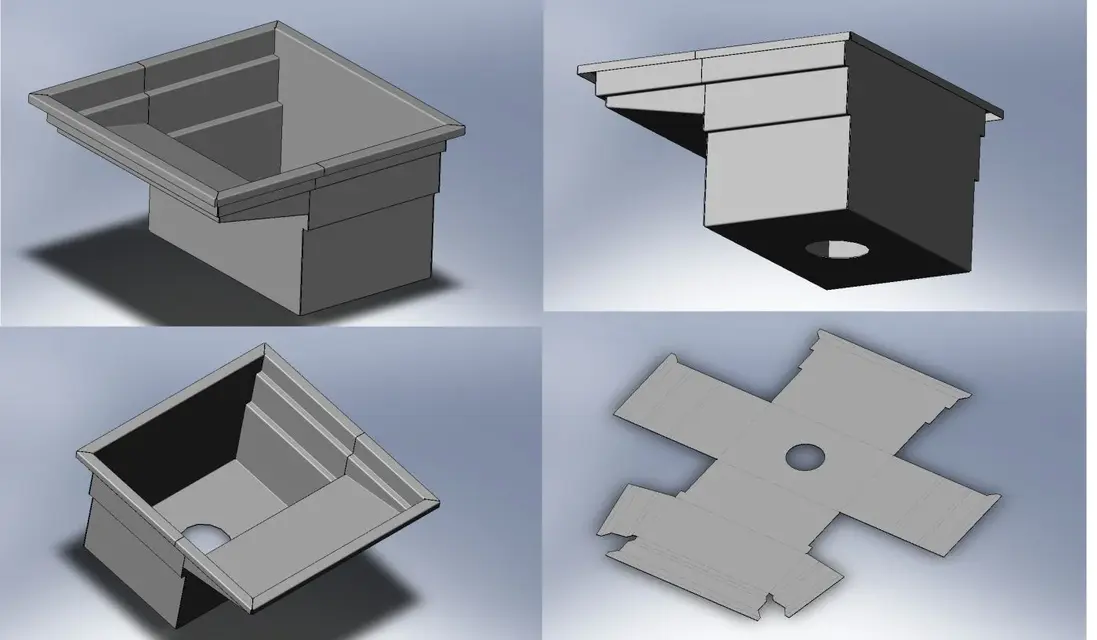
I reinterpreted it so... to make sure I understood...:confused: I should like to say that the Commission is not in the interests of the Commission. drawing made according to the quotas of the first drawing external measures, thickness sheet 1, game on the edges to weld from 5/10, all folds with 1,5 rectangular discharge, bending radius 1, k sheet 0.273. I did it in speed is not exactly perfect, you should also know how it will be welded...:redface::rolleyes:
 

Attachments

  • Vasca_Con_Scivolo_e_Foro_Diam_80.webp
    Vasca_Con_Scivolo_e_Foro_Diam_80.webp
    50.5 KB · Views: 27
I reinterpreted it so... to make sure I understood...:confused: I should like to say that the Commission is not in the interests of the Commission. drawing made according to the quotas of the first drawing external measures, thickness sheet 1, game on the edges to weld from 5/10, all folds with 1,5 rectangular discharge, bending radius 1, k sheet 0.273. I did it in speed is not exactly perfect, you should also know how it will be welded. . .
Nice! (.. looks like a washing machine:biggrin:. . )
but sincerely done so in one piece it seems to me a gamble (and I do not know how feasible). Let us remember that "on the card" everything is done, then we collide with the "hard fero" and the rough carpenters :biggrin:.
In addition, Sebastiano immediately said that the channel/slip would be apart and then welded (and narrower than the tub from what I understood).
however as exercise for swx can go.
rather, how did you realize the double edge around the part with inclined bottom? would you just post that individually with visible procedure?

greetings
Marco:smile:
 

Forum statistics

Threads
44,997
Messages
339,767
Members
4
Latest member
ibt

Members online

No members online now.
Back
Top