• This forum is the machine-generated translation of www.cad3d.it/forum1 - the Italian design community. Several terms are not translated correctly.

at what speed do you turn your cart? :)

  • Thread starter Thread starter reggio
  • Start date Start date
Hi, sorry, I was writing mine and I hadn't seen yours yet.
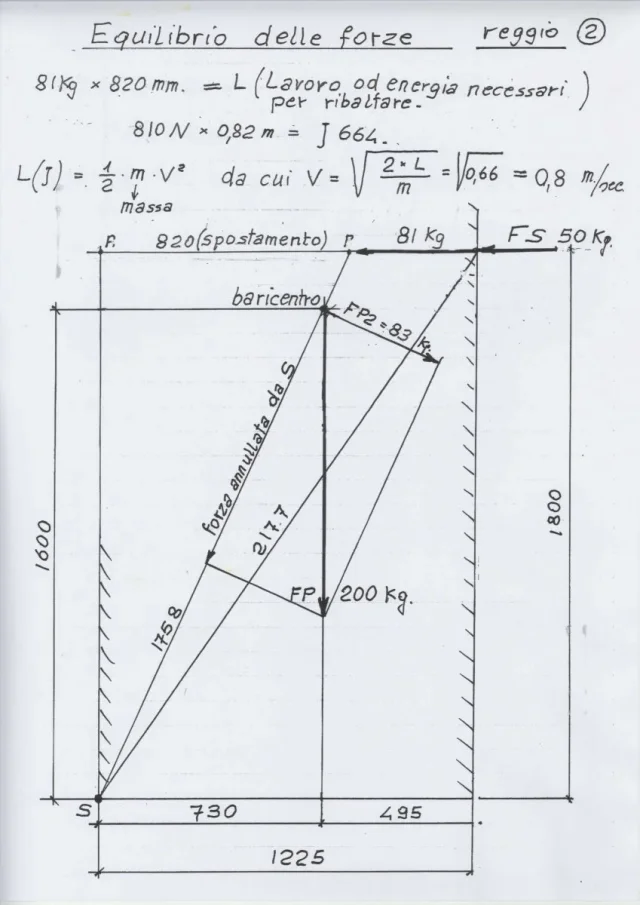
using fp2 efs2, from me you find graphically, it proved that the two calculations,
my and proposed by others, lead to the same result of 81 kg, which is the tipping force applied on the same line of the fs force.
Can you leave here as you messed up?
two calculations, mine and proposed by others, lead to the same result of 81 kg
What calculations? Where?
Now it is only necessary to calculate the speed at which the cart develops an inertia force of 81 kg.
How do you suggest you get it?
 
I also wondered what the 1225mm share is for (I already have the man's arm of force), and I also wondered what hardware calculations referenced, since I found no more 81kg around the post.

Anyway, I can put my head on lunch break if you can wait. . .
 
How do you suggest you get it?
Perhaps this is one of the cases where it is best to address a consultant rather than the users of the forum, if you are unable to assess the correctness of the answers.
 
is not so much a question of speed (as has already explained well @meccanicamg ): the cart can also make 200 m/s, if you can choose it in half an hour. He won't bounce. . .

you are interested in deceleration, which generates the "f" you are looking for, but going backwards. Of course, it cannot consider a perfect shock, because even for a ridiculous speed you would have a deceleration that tends to infinite. from non-engineer, I think you have to determine how much time "s" you have to choose, with this you can tie deceleration to speed and then to strength, going backwards to make sure that the tipping moment is lower/equal at the stabilizing moment.
How much is this time "s"? as I told you, on lunch break I try to think about it, but I already tell you how I would hypothesize it (powering the cart as undeformable): Suppose that between bump against the obstacle and cart still the part where the leftover force of 50mm is applied (anti-clockwise rotation of all the cart compared to the pebble), after which it will turn back clockwise until the wheels return to rest. This rotation, at a certain speed, takes some time, telling you how much deceleration is worth. "playing", even with an excel sheet, on the initial speed (which modifies as you want), and/or on the rotation of the point of application of the force that you feel acceptable (0,1° as 10°) from which you gain deceleration (so the tipping force, and from this the tipping moment), according to me you can obtain the triad of values [velocità, rotazione del carrello (considerato rigido) e quindi tempo a disposizione per la decelerazione, e decelerazione/forza ribaltante che ti vanno bene].

ps: I have considered the cart infinitely rigid. even for modest decelerations, the wheels behind should rise. It doesn't really happen because I think there is a waterfall of mini-deformations that dissipate the energy of the shock. from a certain deceleration onwards you will really have the detachment of the rear wheels (insured, never nailed with the front of the mtb downhill? If you brake enough the wheel behind it rises, there are no but... :-)

but maybe what I wrote is all to throw. I think about it in an hour
 
I see it like this:
If the system was still (consistent speed = 0 m/s) it would be nothing but a studded beam in the s point and resting on the rear wheel.
making the balance of moments to me comes the resulting moment mr=560 nm (clockwise).
the moment must be balanced by the binding reaction of the rear wheel. applying the principle of virtual work we have that the work must be equal to 560 j (moment and work have the same units of measurement) from which the kinetic energy of the system, so that there is tipping, must be pairs to 560 j i.e. v=(560*2/200)^0.5=2.37 m/s approximately. (200 kg of the only mass present in the problem).
This exercise reminds me of my writing of rational mechanics of a century ago, they saw us all... the professor had gone to the carnival with his son and had seen the pirate ship. the exercise consisted in establishing what was the maximum oscillation that the ship could have considering precisely the traliccio to which it was anchored at one end and leaned to the other.
p.s. sorry the postman: the units of measurement must be correctly written m, s, kg (with the minuscule k), n, j ...
pp.s. I had wrongly written the formula of speed multiplying and not dividing by the mass.
 
Last edited by a moderator:
I see it like this:
If the system was still (consistent speed = 0 m/s) it would be nothing but a studded beam in the s point and resting on the rear wheel.
making the balance of moments to me comes the resulting moment mr=560 nm (clockwise).
the moment must be balanced by the binding reaction of the rear wheel. applying the principle of virtual work we have that the work must be equal to 560 j (moment and work have the same units of measurement) from which the kinetic energy of the system, so that there is tipping, must be pairs to 560 j i.e. v=(560*2/200)^0.5=2.37 m/s approximately. (200 kg of the only mass present in the problem).
This exercise reminds me of my writing of rational mechanics of a century ago, they saw us all... the professor had gone to the carnival with his son and had seen the pirate ship. the exercise consisted in establishing what was the maximum oscillation that the ship could have considering precisely the traliccio to which it was anchored at one end and leaned to the other.
p.s. sorry the postman: the units of measurement must be correctly written m, s, kg (with the minuscule k), n, j ...
pp.s. I had wrongly written the formula of speed multiplying and not dividing by the mass.
560nm from the dove down?
 
560nm from the dove down?
I have done this

a1=atan(730/1600) angle to the base fp
a2=atan(1225/1800) angle to the base fs
l=.73/sin(a1) m arm force fp
l2=1.225/sin(a2) m arm force fs
fp1=2000(a) n
fs1=500

m2=l2*fs1=900 nm
mr=560 nm

always that the starting hypothesis is correct.
 
I have done this

a1=atan(730/1600) angle to the base fp
a2=atan(1225/1800) angle to the base fs
l=.73/sin(a1) m arm force fp
l2=1.225/sin(a2) m arm force fs
fp1=2000(a) n
fs1=500

m2=l2*fs1=900 nm
mr=560 nm

always that the starting hypothesis is correct.
but assuming fs1 as indicated. as I would rule out to calculate the tipping.
 
with the forces you cannot solve
as they have suggested, balances mechanical energy

1. before the shock is all kinetic translation energy (1/2*m*v2)
after the shock is all kinetic energy of rotation (1/2*j*w2), where j is the moment compared to the point of rotation, w is the uncognized angle speed that revenues you from the equality between the two

2. at this point the baricentre of the system begins to rotate around the rock, climbing
the limit condition reaches it when the baricentro reaches the vertical on the rock, with a variation of altitude equal to the radius of rotation-the altitude of the baricentro at the beginning of the rotation
this variation of quota (clear h) corresponds to the potential gravitational energy mgh
if your rotational kinetic energy (i.e. kinetic energy of initial translation) is greater than this gravitational potential energy, then flips. Therefore, with the various steps you get that 1/2mv2<mgh.


of course this is true if it is a unique piece: if in the meantime various parts slip, then the speech changes.

But in the end, don't you first clean from stones?

Hi.
 
with the numerals it turns out that the initial v to turn is about 5.8 m/s (obviously in the hypothesis of only rigid body): it is a high speed.
according to me you turn over the refrigerator you are carrying around the front base edge
 
Last edited:
the share of 1225 served for a completion of the drawing, but it also served to me for
show the breakdown of forces.
using fp2 efs2, from me you find graphically, it proved that the two calculations,
my and proposed by others, lead to the same result of 81 kg, which is the tipping force applied on the same line of the fs force.
pushing the cart with a constant force of 50 kg, you create a bike evenly
accelerated, with a speed that will be increasing, but with a constant acceleration,
which will be given by the formula f = m*a.
I remember that speed is measured in m/sec, acceleration, which is the change of speed
in the unit of time, it is measured in square m/sec ( m/sec/sec). the mass in Newton.
from the formula is obtained: a = f/ m = 500 / 2000 = 0.25 m/sec square.
Now it is only necessary to calculate the speed at which the cart develops an inertia force of 81 kg.
I attach my design.
 

Attachments

  • Carrello reggio.webp
    Carrello reggio.webp
    64.6 KB · Views: 31
the tipping force of 81 kg. comes from the equivalence between the two moments, as has already been said.
or: 200kg * 730mm / 1800mm = 81 kg.
This force that acts horizontally on the same line of fs push, in order to get to the tipping, has to go to point a, a space from to b, that graphics I have detected of 820mm, but that with more precision you can calculate with trigonometry.
by multiplying the force for its shift, you get the work or energy in joules necessary to bring the centerpiece on the vertical of the rock.
as an attached drawing, a work l of 664j.
from formula l = 1/2*mass * speed to square, you get the speed.
v = square root of ( 2* l /mass ) = root of 0,66 = 0.8 meters /second. .
 

Attachments

  • Velocità del carrello..webp
    Velocità del carrello..webp
    65.4 KB · Views: 31
Excuse me, but did you want to know which force is to push it when it finds a hindrance, or the speed beyond which it tilts if it finds an obstacle?
in the first case, tipping moment > stabilizing moment (just enough force to raise the rear wheel that, if it continues to exercise, tilts the system)
In the second case initial kinetic energy > potential energy to tilt (and thrust forces do not affect me anything, so much so that he said that the thrust is removed when he finds the stone).
 
Excuse me, but did you want to know which force is to push it when it finds a hindrance, or the speed beyond which it tilts if it finds an obstacle?
in the first case, tipping moment > stabilizing moment (just enough force to raise the rear wheel that, if it continues to exercise, tilts the system)
In the second case initial kinetic energy > potential energy to tilt (and thrust forces do not affect me anything, so much so that he said that the thrust is removed when he finds the stone).
speed forget it.
 
considerations on the thrust force fs.
this constant force, it only serves to load the energy cart, until it reaches the tipping speed, when it comes to contact with the bone obstacle.
a lesser force will do it in a time and with a higher space, while a greater force will do it in a time and with a smaller space.
This is why this force has not intervened in the calculations, it is not removed but exhausted in the moment of tipping.
 
Good morning, everyone. I tried to make two accounts.
first, when the cart advances to the left and encounters the obstacle (in this case, the rock), a force of inertia equal to mcarrello* acceleration that is applied in the center of the system.
This force appears every time the system undergoes changes in speed, as in this case (because before the shock, it advanced at a certain speed and after the shock, it is totally firm and tilts).
as he said News You must find the acceleration.
We write the equation to the rotation around the rock.
(f. weight)
(f. weight)*g*x- (f. painted)*g*y - cart mass*ccel*z =0
the terms expressed on the left of equality are moments where:
  • the moment of force weight is such as to keep the vehicle on the ground;
  • the moments generated by the force of thrust and the force of inertia are tipping (that is, such as to turn the vehicle);
n.b.: ho considerto positive moments that make the body rotate clockwise and negative those that make the body rotate counterclockwise.

after that, we put the acceleration as unknown I and thus we estimate its value to overturn the system.

accel =[F.SPinta*g*Y-F.Peso*g*X]/[Massa Carrello*Z]where:
f.peso = cart mass = 200 kg;f.spinta = 50 kg;g = 9,81 m / s ^ 2 (gravity acceleration);x= horizontal distance from the center of gravity compared to the stone= 730 mm;y=vertical push distance compared to the stone= 1800 mm;z=vertical distance from the center of gravity compared to the stone= 1600 mm;by inserting them in the above formula we get/stimulate acceleration.

♪[200*9,81*730-50*9,81*1800]/[200*1600]accel=1.72 m/s^2Immagine discussione.png
 
Last edited:
the inertia is facing left because, our case, is a braking/stop of the vehicle.
if the vehicle to be stationed, then the force of inertia will be turned right.
all this always depends on the kinematics of the system, i.e. in which direction will advance the vehicle and how the speed varies depending on the time.
 
the inertia is facing left because, our case, is a braking/stop of the vehicle.
if the vehicle to be stationed, then the force of inertia will be turned right.
all this always depends on the kinematics of the system, i.e. in which direction will advance the vehicle and how the speed varies depending on the time.
the thrust force, would help the tipping if the left wheel was blocked, from the rock or from any other element.
but when the thrust acts, the rock is not there and any force applied constantly, pushes the cart to infinity, producing only speed increase, but not tipping it.
ask at what speed the cart tilts, if the left wheel stops, it is like asking at what distance from the wheel, I have to put the stone.
It is the force of growing inertia, accumulated during the race, which tilts the cart, if suddenly blocked the advance.
the stone must be considered as a muretto, impenetrable.
 

Forum statistics

Threads
44,997
Messages
339,767
Members
4
Latest member
ibt

Members online

No members online now.
Back
Top