• This forum is the machine-generated translation of www.cad3d.it/forum1 - the Italian design community. Several terms are not translated correctly.

bending press circuit sizing

  • Thread starter Thread starter nicocaroli
  • Start date Start date

nicocaroli

Guest
Good morning to all, I write here in hope that someone with more experience than me can help me.

in preparation for a university thesis, I must dimension and analyze the hydraulic circuit of a bending press. machine data are:

- max force in operation: 200 tonnes

- toolbar weight: 4 tonnes

- No linear actuators: 2


- downhill speed of the tool: 200 mm/s

- max plate working speed: 10 mm/s

- return speed of the tool: 150 - 200 mm/s


- downhill run: 250 mm

- work run: 50 mm


- load maintenance time: 3 s.


the objective of my work is to analyze 2/3 possible circuits, simulate them on amesim software and then compare the results obtained to evaluate the pros and cons of each system. the first system to which I thought is that in figure, consisting of the feeding system, 2 double-acting linear actuators connected together to get synchronism, a 2/2 valve used as safety in case of power failure, a balancing valve to control the downward speed of the toolbar.


even if the system is a bit rough, would it be able to carry out the desired cycle or is there any error?

Thank you in advance who will be able to help me.


I don't knowCiclo di lavoro.webpCircuito 1.webp
 
Hi.
I am a bending press designer, from 50 to 1.5 mt to 1000 t 10 mt, so I could help you, but only if in your work you can use components such as pumps, hydraulic groups and trade valves; as you do in the world of work. Otherwise it becomes a purely theoretical speech that serves little and only some professor could advise you for the best.
 
Hello, I thank you for the answer.
no,justly the sizing is started with theoretical values but then I have to insert real values available on the catalogs (I looked for some catalog on the web, not knowing the names of the main builders I found something, that is always better than nothing), and in the end verify that they respect the initial conditions of project. by curiosity, do you use any simulation software in the company?
 
In fact the cylinders imagine that they have to have a high area, while on the return the useful area will be very small to have great speeds, so they are difficult to find in the catalog. at least until here you have confirmed what were my assumptions:)
returning, instead, to the circuit that I posted at the beginning, maybe you will know how to give me some advice on how to go ahead with the sizing. I started from the right actuator (which I will call b), imposing the balance of forces: p_b*a_b = p'_b*a'_b + f, in which I assumed that the working pressure in the room is 250 bar, that the maximum agent force in the cylinder is equally distributed, therefore the 204 ton become 1020 kn, and I also assumed in the first approximation that p'_b is negligible; therefore remains: p_b*a_b = f ---> a_b = f/p_b ---> a_b = 40.800 mm^2 ---> d_b = 228 mm (from catalog I will take a 250 mm).
Now problems arise: what I know is that the speeds of the 2 cylinders must be equal, so the flow from the cylinder to must be equal to the one entering the cylinder b; from this consideration I refer the report: (d_a)^2 - (d_a)^2 = (d_b)^2, but I have 2 unknowns and one equation. What do you think I'm wrong?
I thank you,
greetings
 
Unfortunately in these days I don't have time to properly analyze your scheme and the method of calculation you intend to use. we do one thing I attach the spreadsheet, provided by hoerbiger, which I use to size the components and consequently the plant. study it well, and then we resent it.
 

Attachments

Okay, thanks, I'll take a look. 2 quick questions:
- Is this a single cylinder press?
- What do you mean "pestone"?
 
- Is this a single cylinder press? no are 2, single cylinder bending presses do not exist- What do you mean "pestone"? Pestone is the mobile structure that is attached to the pistons where the punches are mounted
 
but I have to ask you more questions:
- Are the 2 cylinders connected in parallel? because the circuit that I modeled I previews 2 cylinders in series, but I doubt that with current technologies it is implemented (problems of parallelism of the peston)
- on the sheet I find a fast down speed of 15 mm/s, I need about 200 mm/s, but this makes the aspiration flow of the cylinders splash, with huge flow rates; am I wronging something in the use of the sheet?
 
:
- Are the 2 cylinders connected in parallel? . . .
each cylinder has its own separate system, synchronization takes place through proportional valves. look well the pattern in the catalog hoerbiger
- on the sheet I find a fast descent speed of 15 mm/s, I need about 200 mm/s, ...
for 15 mm/s, the data is wrong. but 200 mm/s is very high, I recommend 120 - 150 mm/s max
 
each cylinder has its own separate system, synchronization takes place through proportional valves. look well the pattern in the catalog hoerbiger
Okay, so I have to look at the catalog circuit. There are some valves I didn't know about, or I just always heard them call with other names:
- 1.0600 is a pre-fill valve?
- 1.1200 is called a selection valve, but what is it for?
I would have put a proportional valve with closed chain control to synchronize the 2 cylinders.
for 15 mm/s, the data is wrong. but 200 mm/s is very high, I recommend 120 - 150 mm/s max
even with 150 mm/s , d = 220mm, d = 212 mm, the intake flow should be more than 300 l/min, without a potential energy recovery of the peston or a accumulator I don't know how to reach
 
Bye. I among the various machines that design, I have a favorite that is a 2 or 3 or 4 cylinder hydraulic press with 250-300-350 mm with 120mm racing.
average work with total carrying of 300-400l/min.
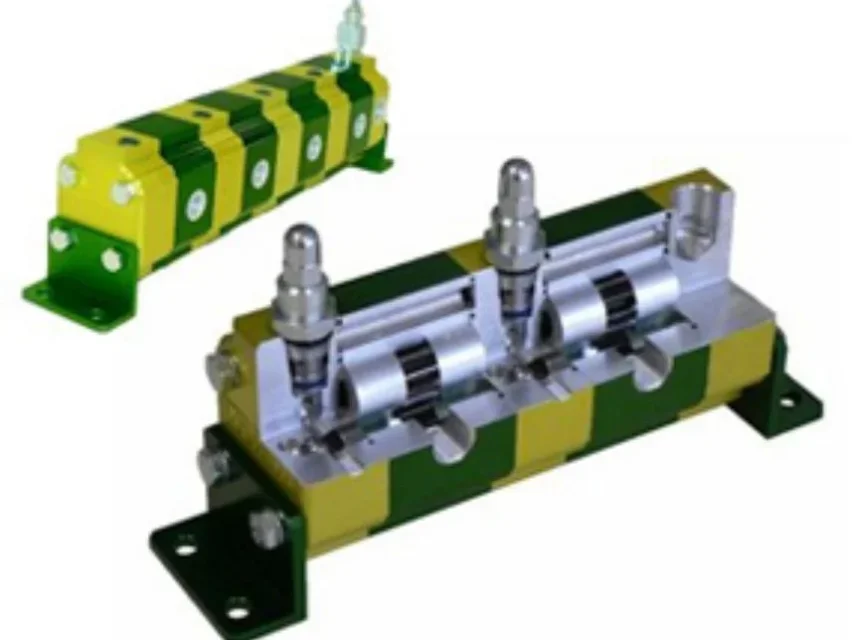
cylinders are connected to a special collector called divider (which is a series of chambers divided with pumping gears) to ensure the equal output of the stems connected in parallel and a reset circuit.Screenshot_20191217_212504.webpas for 110mm I need maximum speed and for 10mm maximum use force of special pumps that adapt to the hydraulic resistance they find.

another system could be to have dive cylinders with upper shirts falling by gravity. on the roof the tank is made and each cylinder has an opening/closing valve.
a series of small cylinders bring down the press bridge, open valves allow the inflating of the cylinders.... closes the valve and puts pressure for the ride useful to make maximum force.
the valve opens and the small cylinders make the bridge rise that makes the cylinders empty by filling the tank.
then add some control for balancing the flow and is done.
100/150 mm/s are common....200mm/s are a little high and no one wants to get there.
 
Last edited:
Bye. I among the various machines that design, I have a favorite that is a 2 or 3 or 4 cylinder hydraulic press with 250-300-350 mm with 120mm racing.
average work with total carrying of 300-400l/min.
cylinders are connected to a special collector called divider (which is a series of chambers divided with pumping gears) to ensure the equal output of the stems connected in parallel and a reset circuit.View attachment 55521as for 110mm I need maximum speed and for 10mm maximum use force of special pumps that adapt to the hydraulic resistance they find.

the divider was a solution that I thought too, but for simplicity I can model even half the circuit and pretend that it is independent. the problem, however, is that I have to use a fixed cylinder and not special pumps, otherwise I would have opted for 2 pumps, one that works only in the approach phase and the other that works in all stages.


another system could be to have dive cylinders with upper shirts falling by gravity. on the roof the tank is made and each cylinder has an opening/closing valve.
a series of small cylinders bring down the press bridge, open valves allow the inflating of the cylinders.... closes the valve and puts pressure for the ride useful to make maximum force.
the valve opens and the small cylinders make the bridge rise that makes the cylinders empty by filling the tank.
then add some control for balancing the flow and is done.
100/150 mm/s are common....200mm/s are a little high and no one wants to get there.
I have not quite understood the functioning of this solution.
 
I have not quite understood the functioning of this solution.
The split?
inside with a pipe having total flow of mandate in the divider. the divider rotates and allows the oil to escape equally from each mouth and therefore each cylinder comes out of equal stroke.
However, at each cycle it must be reset to not accumulate errors due to the physical cycle of manufacture of cylinders that are never identical between several cylinders of the same stroke (+/-1mm).
 
The split?
inside with a pipe having total flow of mandate in the divider. the divider rotates and allows the oil to escape equally from each mouth and therefore each cylinder comes out of equal stroke.
However, at each cycle it must be reset to not accumulate errors due to the physical cycle of manufacture of cylinders that are never identical between several cylinders of the same stroke (+/-1mm).
I meant the second solution. The first one is clear to me and it is something similar to what I had in mind.
 
the second solution is made by taking a very large tank and to put on the roof of the press. the cylinders are not mounted with the connecting bottom for gravity to the tank and interposed an open/closed valve. the stem drops down and is connected to the upper deck.
two or four small cylinders carry the bat upwards.
diving cylinders are very used especially in the past where electronics are not masterful.
 
the second solution is made by taking a very large tank and to put on the roof of the press. the cylinders are not mounted with the connecting bottom for gravity to the tank and interposed an open/closed valve. the stem drops down and is connected to the upper deck.
two or four small cylinders carry the bat upwards.
diving cylinders are very used especially in the past where electronics are not masterful.
therefore 2 cylinders work by gravity and serve to bring down the beam, and 2/4 cylinders to make it go back?
 

Forum statistics

Threads
44,997
Messages
339,767
Members
4
Latest member
ibt

Members online

No members online now.
Back
Top