• This forum is the machine-generated translation of www.cad3d.it/forum1 - the Italian design community. Several terms are not translated correctly.

better solution to close a surface.

  • Thread starter Thread starter panormus
  • Start date Start date

panormus

Guest
hi forumisti,

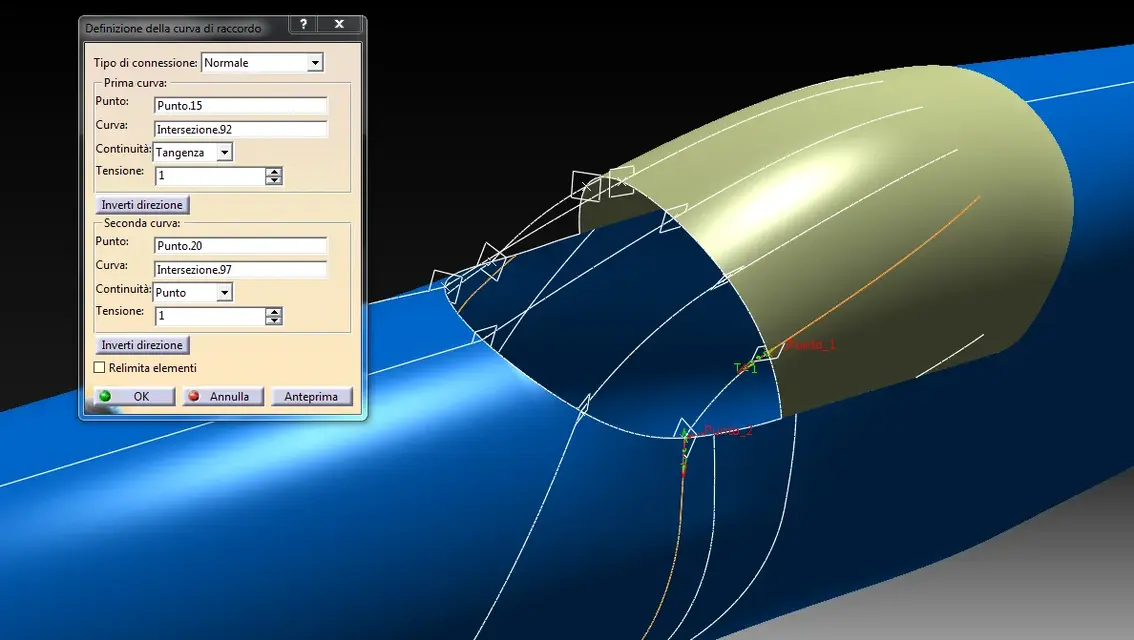
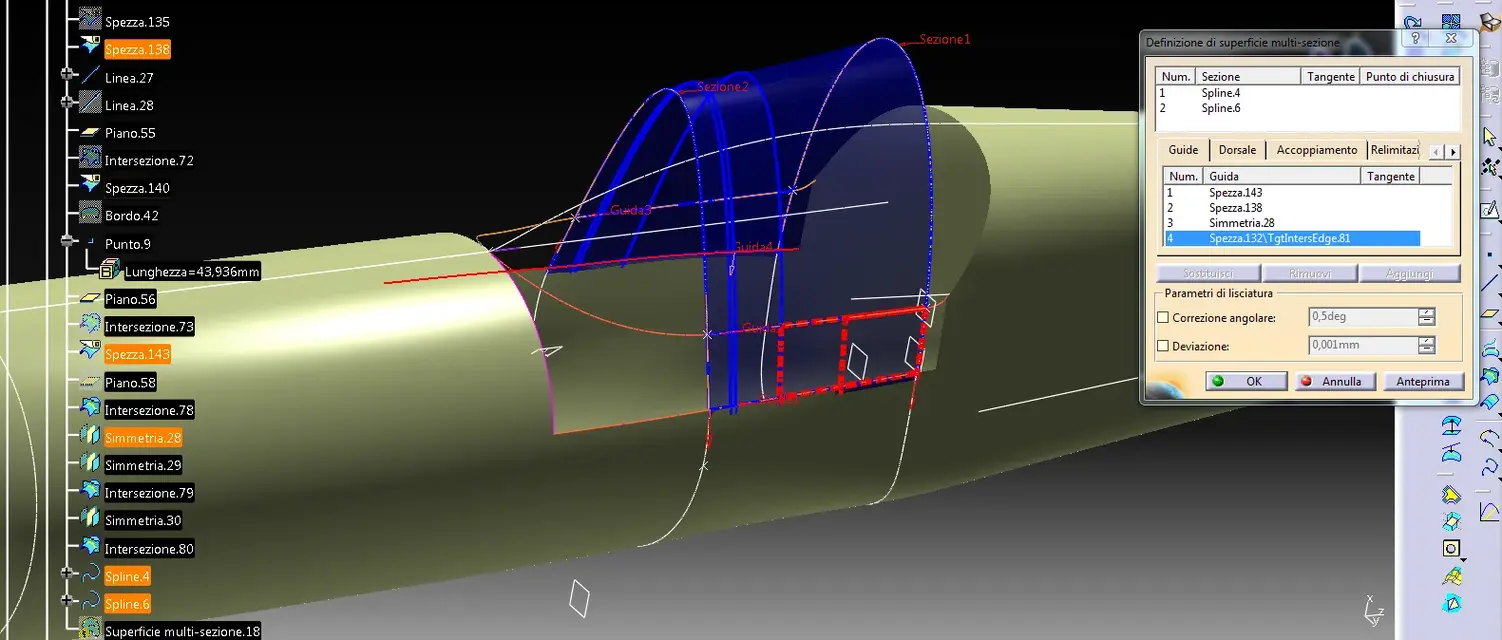
I'm trying to create a passing surface for curves, but I don't understand what can be the best solution in these cases:

- I have to further break the area to be realized so as to get so many quadrangular pieces


- or can it be good to create tangent splines to the fuse and then cut them properly?

the second seems to me the most clean and logically correct, but the beautiful catia returns me errors of the attached type. . .


Thanks always.


I take this opportunity to ask you where I can find detailed information about the gsd sweep.
 

Attachments

  • Cattura43.webp
    Cattura43.webp
    90.5 KB · Views: 55
  • Cattura44.webp
    Cattura44.webp
    85.9 KB · Views: 57
  • Cattura45.webp
    Cattura45.webp
    29.2 KB · Views: 37
hi forumisti,

I'm trying to create a passing surface for curves, but I don't understand what can be the best solution in these cases:

- I have to further break the area to be realized so as to get so many quadrangular pieces


- or can it be good to create tangent splines to the fuse and then cut them properly?

the second seems to me the most clean and logically correct, but the beautiful catia returns me errors of the attached type. . .


Thanks always.


I take this opportunity to ask you where I can find detailed information about the gsd sweep.
Hi, from the images I understand and I don't understand, you can attach the iges only of the curves on which you want to pass the surfaces I take a look at. Perhaps I can help you by showing you how I would do with nx (which has tools similar to catia) because it seems to me to see an incorrect approach in the construction of surfaces.
 
Thanks baskets, something I have done, see attachment, but what I am interested in is how to proceed and how to proceed in these cases, more than having good and done the exercise, especially in areas where two curves converge at an angle point.
 

Attachments

  • Cattura47.webp
    Cattura47.webp
    19.4 KB · Views: 27
we say that I have reached a good approximation, but I would like to know from professionals how it works in such situations.

bye
 

Attachments

  • Cattura48.webp
    Cattura48.webp
    15.8 KB · Views: 26
the problem of catia is that you do not see isoparametrics. Can't you see them? the surfaces that come out could be very bad.
multisection sweeps should be used when there is no alternative. with reference to the images of the first post you should make a surface for four edges, and then move the parameters until the sections of the surface at the curves are mostly coincident with the curves themselves. the surface is much leaner and easy to manipulate.

ideal would avoid using edges that come from surface cuts. If there are no strings of tangences, you should draw a "larger" surface and then go to intersect with the fuselage. various surface parameters until the intersection approaches what you want, and then cuts. the surface is even more clean and beautiful.

so you work for the local details. for the details "mother", that is, of the details that have no life, but refer to the mother surfaces, you should duplicate the fuselage, deform it entirely until you get the detail you want, and then cut. I explained to myself as dogs, I know. Therefore, if you see the annex, the surface 'a' is a mother's detail, it must be obtained from the surface 'b' by scaling in one direction. then both 'a' and 'b' are cut by 'c' which instead is a local detail, to be realized as an autonomous surface until the intersection with 'a' and 'b' originates the desired curve.

I don't know how the car is actually made, but drawing 'a' as an autonomous surface, without starting 'b' is wrong. projecting curves with which to cut 'b', from the edge of the cut attempt to generate 'c' is even more wrong.

I don't know if I explained. . .
 

Attachments

  • renault-megane-03.webp
    renault-megane-03.webp
    18.6 KB · Views: 70
Thanks baskets, something I have done, see attachment, but what I am interested in is how to proceed and how to proceed in these cases, more than having good and done the exercise, especially in areas where two curves converge at an angle point.
This is exactly the likely mistake you might have made: starting from the limits of the surfaces. You find yourself with corners. Should these singularities be the result of construction as intersection of the surfaces not their departure, do I explain? and is basically what suggests you in the previous post Roman lightning.
Hi.
 
the problem of catia is that you do not see isoparametrics. Can't you see them? the surfaces that come out could be very bad.
multisection sweeps should be used when there is no alternative.
Why are they so bad?with reference to the images of the first post you should make a surface for four edges, and then move the parameters until the sections of the surface at the curves are mostly coincident with the curves themselves. the surface is much leaner and easy to manipulate.
so if the only alternative is a surface of 4 edges, I can get it for filling and in the past there are those who told me that the filling function is better to use it as little as possible. .ideal would avoid using edges that come from surface cuts. if there are no tight bonds of bribes,Well, there's...you should draw a "big" surface and then go to intersect with the fuselage. various surface parameters until the intersection approaches what you want, and then cuts. the surface is even more clean and beautiful.
mhhh I would like to see this concept in practice... If you can. .so you work for the local details. for the details "mother", that is, of the details that have no life, but refer to the mother surfaces, you should duplicate the fuselage, deform it entirely until you get the detail you want, and then cut.??I explained to myself as dogs, I know.No, I realize the difficulty. It would take at least some pictures.Therefore, if you see the annex, the surface 'a' is a mother's detail, it must be obtained from the surface 'b' by scaling in one direction. then both 'a' and 'b' are cut by 'c' which instead is a local detail, to be realized as an autonomous surface until the intersection with 'a' and 'b' originates the desired curve.

I don't know how the car is actually made, but drawing 'a' as an autonomous surface, without starting 'b' is wrong. projecting curves with which to cut 'b', from the edge of the cut attempt to generate 'c' is even more wrong.

I don't know if I explained. . .
Thank you. I attach an image that comes close to the result, but if I use the filling comes a half-rough, I try creating a set of connections to then use the multisection, but it fails. .

ps happened to me to extrapolate the edges, to enlarge the area and to note that the extracted line is not on the edge, same thing for the intersections of plane with surfaces: you know how to tell me why?

Sorry, while trying to make filling sup to post it gave me a mistake.. then I tried the connection surface and went great :)))

But what I'm saying is I don't have a method, but I'm going to try.
 

Attachments

  • Cattura53.webp
    Cattura53.webp
    53.1 KB · Views: 34
  • Cattura54.webp
    Cattura54.webp
    67.9 KB · Views: 32
Last edited:
ps happened to me to extrapolate the edges, to enlarge the area and to note that the extracted line is not on the edge, same thing for the intersections of plane with surfaces: you know how to tell me why?
you do not see the surface, but the surface rendering, which may have a approximation not to weigh the display.
 
Maybe I enabled them now. .
mmhh... I don't know caia for the surfaces, but so you enabled the creation of isoparametrics, not the visualizationisoparametrics are the "parameters" of a nurbs. when there are too many isoparametrics, or these are disordered, or they all end up in one point, it means that the surface is overgrown. a surface like this is dirty, even if you can't see from the render. Just do some sections and analyze them.
 
Just analyze them say.. then return to the post "quality of a surface". how do you do these quality analysis?

Thank you.
 
attached a film (of bad quality but is what passes the convent.. :smile:) where you see what told you Roman lightning.
we analyze the surfaces with tools like these that you see in nx (and I think that catia has equally valid and powerful).
on the first surface are the isoparametrics (in u and v) with the corresponding 'pettine', this surface is not bad.
the second, which is a blend between two surfaces, has flexes highlighted by isoparametrics (see that the curvature passes from one side to the other of the surface), this, in this case, is not acceptable; it could be in others but they have to be seen overall.
p.s. I'm looking at your file. Have patience but I don't have much time.

Hi.
 
thanks baskets, I appreciate the time dedicated to the community with your video. :finger:

I would also like to know how to behave, how to analyze and above all correct the surfaces "mal masses".
 
the example posted actually hides a trick: If you try to fix the incriminated surface, you'll never do it. to put it in place you have to act on the 'beautiful' surface that commands it.
Hi.
 
the example posted actually hides a trick: If you try to fix the incriminated surface, you'll never do it. to put it in place you have to act on the 'beautiful' surface that commands it.
Hi.
He really hides another trick... making sections along u and v is not always a good idea. do sections with different angles sometimes reserve bad surprises!
 
I don't follow you anymore. will be because you talk about nx..
No, I don't even know nx, and I don't even know caia for surfaces. I'm talking about generic techniques.
in the film you can see sections of a surface, and the curvature analysis on the sections. if the sections make them long u and v you do them along the natural directions of the surface. a good curvature of these sections does not mean that they are as other sections with different angles.

I don't know if I explained.
 
It seems to me that I have read somewhere that Roman lightning is not nx user (correct me if I am wrong), this shows that what we are suggesting is independent from the cad used.
fall of this kind will have different algorithms, different terminology but they support the same mathematical concepts.
I would like to say that we have to look at the results very thoroughly and not stop at the first and most obvious.
 
It seems to me that I have read somewhere that Roman lightning is not nx user (correct me if I am wrong), this shows that what we are suggesting is independent from the cad used.
No, I don't even know nx, and I don't even know caia for surfaces. I'm talking about generic techniques.
That's right.
I would like to say that we have to look at the results very thoroughly and not stop at the first and most obvious.
"superficie nurbs" is mathematics, "superficie di classe a" is philosophy! :biggrin:
 

Forum statistics

Threads
44,997
Messages
339,767
Members
4
Latest member
ibt

Members online

No members online now.
Back
Top